

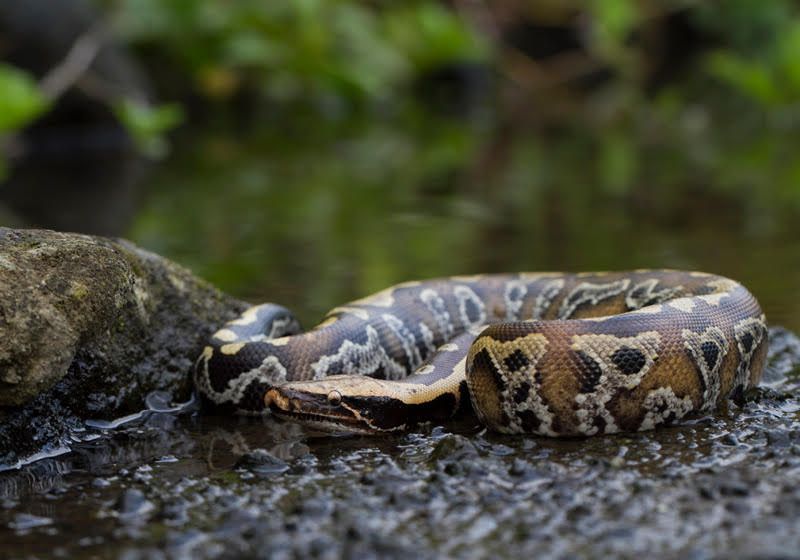
Scientists studied snake color patterns, their excretions, and venom chemistry, hoping to understand the creatures better and use some of the insights to develop effective antivenoms.
Snakes slither across diverse landscapes all over the planet, ranging from dry scrublands to forests drenched in rain and rocky plains to urban colonies. These creatures have long-captured the interest of scientists, who sought to understand these serpents—including their appearance and venom chemistry—as well as to develop better antivenoms to neutralize the toxins they inject. Glide across this article to learn more about snakes’ skin patterns, their excretions, and venoms.
Tzika and her team have characterized several different color morphs of corn snakes. A dorsal view of the morphs is shown here.
LANE laboratory (https://www.lanevol.org/)
Corn snakes (Pantherophis guttatus) come in different forms: While some are striped, others are not. To understand why, Athanasia Tzika, an evolutionary developmental biologist at the University of Geneva, compared the genomes of wild type (WT) corn snakes that display blotches with those of color morphs that are striped. This helped the researchers identify genetic variants that could underlie these different patterns. Tzika and her team also developed a CRISPR-Cas9-based gene-editing protocol to knock out candidate genes, which confirmed that a mutation in the premelanosome protein (PMEL) gene drove the differing phenotypes. While PMEL-expressing cells form aggregates that eventually give way to blotches in WT corn snake embryos, mutants cannot form such aggregates, giving rise to a striped phenotype.
While humans and other mammals excrete urea diluted in large volumes of water as urine, some insects, birds, and reptiles expel this chemical in solid form, called urates. Jennifer Swift, a chemist at Georgetown University, and her team compared urates from primitive, non-venomous snakes such as boas and pythons and advanced, venomous snakes like rattlesnakes. Microscopy revealed that both urates contained microspheres as well as crystals, indicating similar waste management systems across species. However, a closer look using X-ray diffraction indicated that primitive snakes contained much fewer crystals compared to advanced snakes. The rattlesnakes utilize crystals to isolate ammonia, which likely reduces the possibility of the snakes’ bodies coming in contact with the toxic chemical as they slither on the ground.

Regional climate influences the venom toxin composition of Russell’s vipers.
Kartik Sunagar
Russell’s vipers glide across vast landscapes all across India—from arid deserts to rain-soaked jungles. These snakes are responsible for the majority of snakebite-related deaths in the country, with snakebites across regions causing different symptoms because of varying venom composition and activity. Kartik Sunagar, an evolutionary biologist at the Indian Institute of Science, and his team sought to investigate if climate-related factors influenced the venom chemistry of Russell’s vipers. By analyzing the chemical composition of venom samples collected from 115 Russell’s vipers across different biogeographic zones in India, the researchers found that snakes from drier regions had higher activity of protein-degrading enzymes that damage human tissue. These findings could potentially predict the clinical symptoms of snakebites in different regions and help doctors administer appropriate therapies.
When venomous snakes bite, they pack a powerful punch of toxins which cause internal bleeding, or hemorrhage, which often results in death. Biologist Mátyás Bittenbinder and chemist Jeroen Kool, from Vrije University Amsterdam created an organ-on-a-chip model of blood vessels that mimics the human circulatory system to study this hemorrhagic process. They co-cultured endothelial cells with extracellular molecules like collagen in microfluidic channels. The cells formed 3D tubular structures resembling blood vessels. By treating this model with venoms from different snakes, the researchers discovered that various toxins break down blood vessels in distinct ways. In addition to providing insights about the peculiarities of venoms from diverse snake species, the system offers a platform to test different antibodies to mitigate the detrimental effects.

Timothy Friede (center), a self-taught herpetologist and director of herpetology at Centivax, injected himself with 700 escalating doses of snake venom from the world’s deadliest snakes over 18 years.
Jacob Glanville
When Jacob Glanville, a computational immune-engineer at Centivax heard of Timothy Friede, a truck mechanic-turned herpetologist at Centivax, Glanville knew he was onto something. Over many years, Friede, a snake collector, endured hundreds of snakebites including from taipans, mambas, and cobras, and injected himself with about 500 additional venom doses. He did all this with the hope that his blood could someday help other snakebite victims. Glanville joined forces with Columbia University structural biologist Peter Kwong to isolate antibodies from Friede’s hyperimmune blood. This helped them develop a potent antivenom against toxins from some of the world’s deadliest snakes. While some experts expressed concerns about the approach of self-immunizing against snake venoms, Friede paved the way towards a universal antiserum that may offer protection against diverse snake venom toxins.

Scientists tested 18 elapid venoms. The only venom that the new recombinant nanobody-based antivenom could not neutralize was that from the eastern green mamba.
Wolfgang Wüster
Antivenom administration is one of the only ways in which to save the lives of hundreds of thousands of snakebite victims annually. Creating antivenom traditionally involves immunizing horses with venom from a specific snake species, purifying the antibodies from the horse plasma, and giving those antibodies to snakebite victims. However, many people’s immune system reacts to receiving molecules from another animal. To overcome this, Shirin Ahmadi, a snake venom and antibody development researcher at the Technical University of Denmark, and her team, developed a new antivenom made up of just eight nanobodies. This mixture of a few recombinant nanobodies can be produced in vitro, leading to safer and more effective snakebite treatments.
