

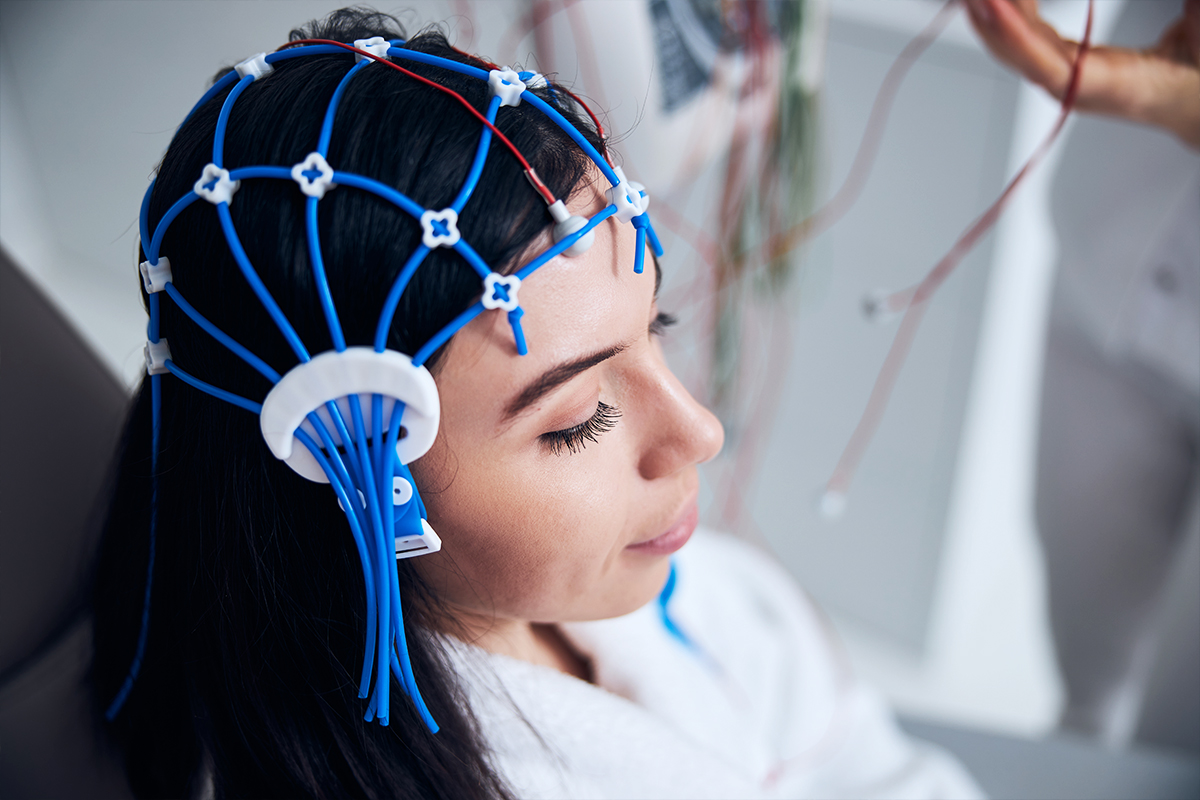
Using real-time brainwave data, clinics claim to help focus, mood and memory – can retraining neural circuits slow cognitive decline?
Neurofeedback sits in that intriguing borderland between hard neuroscience and soft promise. It is non-invasive brain training built on real-time monitoring of neuronal activity, typically via electroencephalography (EEG) and more rarely through functional imaging. The premise is disarmingly simple: show the brain what it is doing as it does it; let it practice doing something else.
Through electrodes placed on the scalp, EEG detects patterns of electrical activity generated by synchronized neuronal firing; software then translates those patterns into immediate visual or auditory feedback. Over repeated sessions, the brain can learn – implicitly, not intellectually – to spend more time in a “desired” state: steadier attention, calmer arousal, less noise in circuits linked to pain. Not magic. Not mind control. More like teaching a nervous system to stop gripping the steering wheel so tightly.
For longevity-minded readers, the appeal is obvious. Aging brains do not simply slow down; they often become less flexible. Oscillatory rhythms can flatten, fragment or grow stubbornly rigid, particularly when sleep degrades, stress hardens, inflammation simmers or vascular health slips. Neurofeedback proposes to nudge plasticity back into play – to restore range, not just function.
The science behind it
At the center of neurofeedback is neuroplasticity: the brain’s capacity to reshape its networks in response to experience. This is not a metaphor; it is a measurable set of processes – synaptic remodeling, changes in excitatory-inhibitory balance, altered connectivity, shifts in network efficiency – happening across cortex and subcortical regions.
EEG signals are commonly described in terms of frequency bands – delta, theta, alpha, beta, gamma – each associated with broad cognitive and physiological states. In practice, these bands behave less like tidy shelves and more like overlapping weather systems; context, age, fatigue and pathology all alter the pattern. Still, the general idea holds: healthy brains modulate oscillatory activity fluidly to meet the moment. When that modulation becomes constrained – too much slow-wave activity at the wrong time, insufficient alpha stability, excessive beta arousal, reduced phase synchrony – cognition and mood can wobble.
Neurofeedback works by turning those oscillations into a training target. The brain is rewarded (usually via a simple game-like interface) when it produces activity within a defined parameter; over time, it learns to replicate that state more easily. Importantly, the learning is largely implicit – closer to adjusting posture through repeated cues than “thinking” your way to a new rhythm.
The technique is not restricted to EEG. Real-time fMRI neurofeedback has shown that patients with major depressive disorder can learn to modulate activity in the amygdala – a key hub for emotional salience – with measurable short-term effects on mood [1]. That matters because it suggests neurofeedback can operate not only at the level of broad oscillatory tone, but also at the level of specific circuits and regions, provided the signal is accurate enough and the training is well-designed.
However, while fMRI offers surgical spatial precision, its reliance on multimillion-dollar scanning suites makes it a clinical rarity – far more expensive and less accessible for the typical longevity seeker than the portable, head-gear-based EEG alternatives found in most boutique clinics.
Which is where things get complicated. Neurofeedback is not one thing. Protocols vary widely; outcome measures differ; placebo and expectation effects are not trivial; individual variability is often enormous. Useful? Potentially. Guaranteed? Not remotely.
What are the clinical benefits for patients?
Neurofeedback has been explored across a wide spectrum of indications – from neurodevelopmental to psychiatric to neurodegenerative – but the strength of evidence is uneven. Some areas look increasingly credible; others remain more aspirational than proven.
ADHD is the most studied clinical application, with multiple trials suggesting EEG-based neurofeedback can reduce inattention and impulsivity, and that benefits may persist beyond the end of training. Results vary, but the signal is there: training appears capable of shifting attentional control in a subset of patients.
In psychiatric disorders, neurofeedback is often pitched as a route to recalibrating dysregulated networks without relying on verbal processing alone. Anxiety, depression, OCD and PTSD are associated with measurable alterations in resting-state activity and task-related dynamics; neurofeedback aims to target those neurophysiological correlates rather than the story a person can tell about their symptoms. That can be appealing for patients who feel “talked out” or who struggle to access conventional psychotherapy.
The strongest narrative case may be chronic pain, where the modern understanding is no longer purely peripheral damage but central amplification – enduring rewiring in networks for sensation, attention and emotion. A pilot study in multi-resistant chronic low back pain reported that EEG training focused on alpha-phase synchronization produced lasting pain reduction and improved quality of life [2]. Pain is not “all in the mind” – but the mind, quite literally, is involved in pain; in that context, re-training cortical rhythms begins to look less like an indulgence and more like a plausible adjunct.
Neurofeedback has also been explored in neurodegenerative conditions, including Parkinson’s disease [3], though evidence here is still early-stage and mixed; the complexity of progressive neurobiology makes simple training effects harder to sustain, and study sizes remain small.
And then there is the more delicate question: healthy aging. Can neurofeedback preserve cognitive resilience before impairment appears? The mechanistic argument is attractive – support flexibility, reduce maladaptive rigidity, strengthen attentional control – but robust longitudinal proof is still thin. It belongs, for now, in the “promising but unproven” drawer. A neat drawer, but still a drawer.
How a neurofeedback session unfolds
The experience itself is markedly un-dramatic. Sensors are placed on the scalp and connected to a recording system; the session typically lasts 30–60 minutes. Real-time algorithms extract features from the EEG signal – perhaps amplitude within a frequency band, coherence between regions, phase synchrony, or other parameters depending on the protocol – and translate those features into feedback.
The feedback might be as simple as a moving bar, a shifting sound or a game that becomes smoother when the brain hits the target state. Crucially, the patient is not usually asked to “try harder”; conscious effort can sometimes make the signal noisier. Instead, neurofeedback relies on conditioning and repetition: the nervous system learns, by reinforcement, what it is being rewarded for.
Most protocols involve multiple sessions per week over several weeks, often totaling several dozen sessions. That sounds intense because it is. Neuroplasticity is not lazy; if you want lasting change, you practice. Over time, the aim is that the trained patterns stabilize – so the brain can access them even without the equipment.
Some people describe a subtle effect after a few sessions: steadier focus, calmer sleep, less emotional reactivity. Others feel nothing at all. A minority feel worse temporarily – headaches, fatigue, agitation – usually reflecting an overzealous protocol or a mismatch between training goals and the individual’s baseline dynamics. The brain is adaptable; it is also opinionated.
Limitations, controversies and perspectives
Neurofeedback’s biggest problem is not that it never works – it often does. The problem is heterogeneity: in protocols, in practitioners, in populations, in outcome measures and in the quality of controls. Some studies are careful; others are… enthusiastic. Neurofeedback can be delivered by highly trained clinical neurophysiologists or by operators whose credentials are closer to “watched a seminar.” The difference matters.
Response varies substantially between individuals, and not just because of motivation. Baseline network organization, neurochemical state, sleep quality, medication, comorbidities and even moment-to-moment arousal can shape trainability. Add to that the reality that neurofeedback sits uncomfortably close to expectation effects – the brain is exquisitely responsive to belief, context and reward – and it becomes difficult to cleanly separate signal-specific learning from broader therapeutic ingredients. That doesn’t mean the benefits are “fake”; it means the mechanism is not always singular.
There is also the matter of standardization. The field has worked to improve reporting and design (see the consensus checklist published in Brain, 2020), and professional bodies have published practice guidelines emphasizing competence, accurate claims and ethical delivery [4]. But clinics marketing neurofeedback as a brain upgrade for everyone – sharper, happier, younger, forever – should be read with the same skepticism you’d apply to any longevity product that promises the moon and forgets to mention gravity.
So where does neurofeedback fit in a healthspan conversation? As a potential adjunct – a tool for specific indications, delivered by trained professionals, measured with clear outcomes, and combined with the boring-but-effective fundamentals: sleep, physical activity, metabolic health, social connection, cognitive challenge. In other words: neurofeedback is interesting; it is not a substitute for living like you have a brain you’d like to keep.
Photograph: Iakobchuk/Envato
[1] https://journals.plos.org/plosone/article?id=10.1371/journal.pone.0088785
[2] https://pubmed.ncbi.nlm.nih.gov/31254096/
[3] https://www.isnr-jnt.org/article/view/16539
[4] https://isnr.org/guidelines-for-practice
