

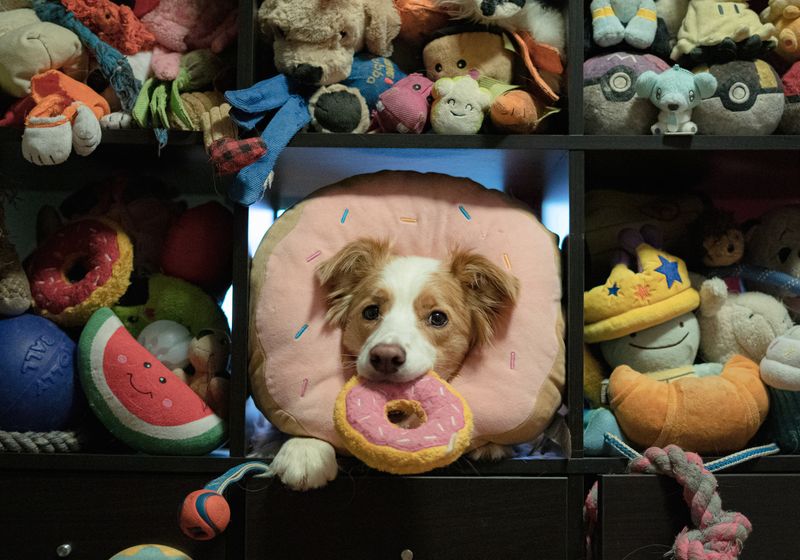
Miso is a 6-year-old male border collie from Canada who knows the names of about 200 toys.
Image credit:Veronica Suen
Most dogs can understand lots of different words like sit, stay, and—most importantly—treat. But some dogs can learn hundreds of different words, earning these pups the name Gifted Word Learner (GWL) dogs.1
Human toddlers pick up new words by a variety of mechanisms, including by eavesdropping on adults. Prior research has shown that GWL dogs can learn many different toy names just by playing with their owners, so scientists wondered if perhaps these talented canines could learn new words by overhearing people too.2
Bryn, an 11-year-old male Border Collie from the UK, knows the names of about 100 toys.
Helen Morgan
In a new study published in Science, researchers, led by animal trainer and cognitive scientist Shany Dror at Eötvös Loránd University and the University of Veterinary Medicine, discovered that GWL dogs can learn new words by eavesdropping on their owners and can even learn the name of a new toy while it’s out of view.3
“Our findings show that the socio-cognitive processes enabling word learning from overheard speech are not uniquely human,” said Dror in a statement. “Under the right conditions, some dogs present behaviors strikingly similar to those of young children.”
To investigate the pups’ learning abilities, the researchers tested ten GWL dogs in two different conditions. In the “addressed condition,” the dog’s owner showed the dog a new toy while saying the toy’s name. In the “overheard condition,” the owner and another family member sat in front of the dog while talking about and handling the new toy but not interacting with the dog at all. Later, when the researchers asked the dogs to retrieve a specific toy by name, the dogs had no significant difference in their ability to bring back the right toy in either task. These results recapitulate those found in similar studies on word learning in toddlers.4

Augie is a 5.5-year-old Labrador from Texas who participated in the study.
Don Harvey
The team then wondered if the dogs could also learn new toy names if the owner first showed the dog the new toy and then said the toy name when the toy was out of the dog’s view. Even with this disconnect between the visual and auditory stimulus of the new toy, five out of the eight GWL dogs tested in this experiment retrieved the correct toys, suggesting that these dogs can learn new words by multiple different mechanisms.
“These dogs provide an exceptional model for exploring some of the cognitive abilities that enabled humans to develop language,” said Dror. She and her team are eager to continue studying these GWL dogs to better understand the mechanisms they use to learn new words and how they may parallel how young humans learn language.
