

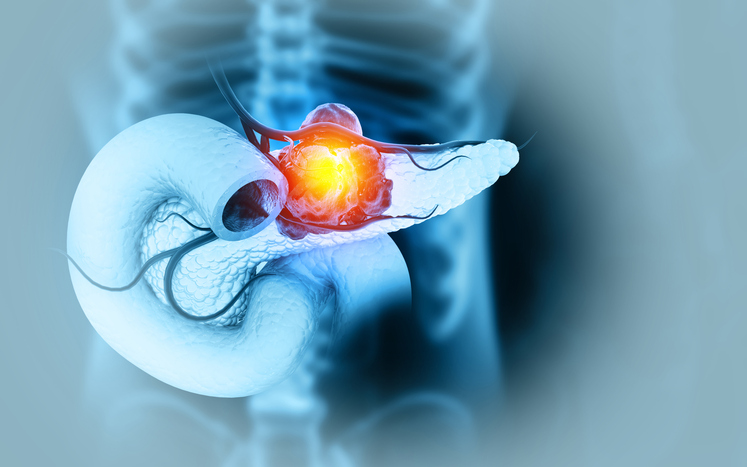
Researchers at Tokyo University of Science have identified a gene that appears to act as a tumor suppressor pancreatic ductal adenocarcinoma (PDAC), the most common form of pancreatic cancer. Their research, published in Cancer Genomics & Proteomics, analyzed large-scale genomic and clinical data sets and found that low expression of the gene CTD nuclear membrane phosphatase 1 (CTDNEP1) was associated with important oncogenic mutations, immune suppression of the tumor microenvironment, and poor patient survival, which point to the potential that the gene plays a role in slowing tumor progression and influencing anti-tumor immunity.
“These results suggest that CTDNEP1 low expression occurs early in pancreatic cancer and may play a role in disease progression and malignancy,” said senior author Tadayoshi Hayata, PhD, a professor of molecular pharmacology at Tokyo University of Science. He also noted that the gene “could help in the early detection of pancreatic cancer, serve as a prognostic indicator for predicting disease severity, and potentially act as a therapeutic target.”
CTDNEP1 encodes a phosphatase involved in multiple cellular signaling pathways. Prior research had linked CTDNEP1 deficiency to altered bone morphogenetic protein and transforming growth factor–beta signaling in mice, leading to organ defects and delayed bone formation. Other research has also shown reduced CTDNEP1 expression in medulloblastoma, “suggesting its potential role as a tumor suppressor gene,” the researchers wrote, but its role in pancreatic cancer, until now, remained unclear.
To find out how if the gene played a role in PDAC, the researchers conducted a comprehensive bioinformatic analysis using multi-omics data from The Cancer Genome Atlas and the Pan-Cancer Atlas. In total, the data detailed genetic and clinical information from 184 patients with PDAC. The team used these data to analyze the effects of CTDNEP1 expression on patient outcomes, while also searching for the biological processes linked to the gene, and its tumor immune infiltrating capacity.
These analyses showed that CTDNEP1 expression was “significantly lower in PDAC tissues compared to normal tissues, especially in early-stage tumors,” the researchers wrote. Tumors with low CTDNEP1 levels were more likely to harbor mutations or deletions in major driver genes such as KRAS, TP53, CDKN2A, and SMAD4. Clinically, patients with low CTDNEP1 expression had worse overall survival and disease-specific survival, with the strongest prognostic effect observed in stage II disease.
The functional analyses of CTDNEP1 provided insight into how its loss may promote aggressive tumor growth. Low expression was associated with pathways related to macroautophagy, protein degradation, and immune and inflammatory responses, while high expression was linked to mitochondrial translation, oxidative phosphorylation, and metabolic activity.
The gene also appeared to have an influence on the tumor microenvironment. Higher CTDNEP1 expression correlated with increased infiltration of immune cells such as CD4+ T cells, macrophages, neutrophils, and dendritic cells, while low expression was associated with chronic inflammation and immune evasion.
The findings have several implications for drug development and diagnostics. CTDNEP1 could serve as a prognostic biomarker to help risk stratify patients, particularly at earlier stages when treatments can be more effective. Its early downregulation also raises the possibility that CTDNEP1 might contribute to early screening and detection. Further, modulating CTDNEP1 activity or targeting downstream pathways affected by its loss could be an effective approach for new therapies.
The research did have limitations, including reliance on retrospective TCGA data and limited sample sizes for advanced-stage disease. As a next step, the team is now conducting in vitro and in vivo studies to show, in more detail, how CTDNEP1 affects pancreatic cancer cell proliferation, metastasis, and immune interactions. By defining the regulatory mechanisms controlling CTDNEP1 expression, their hope is to identify additional targets that could be translated into future PDAC therapies.
