

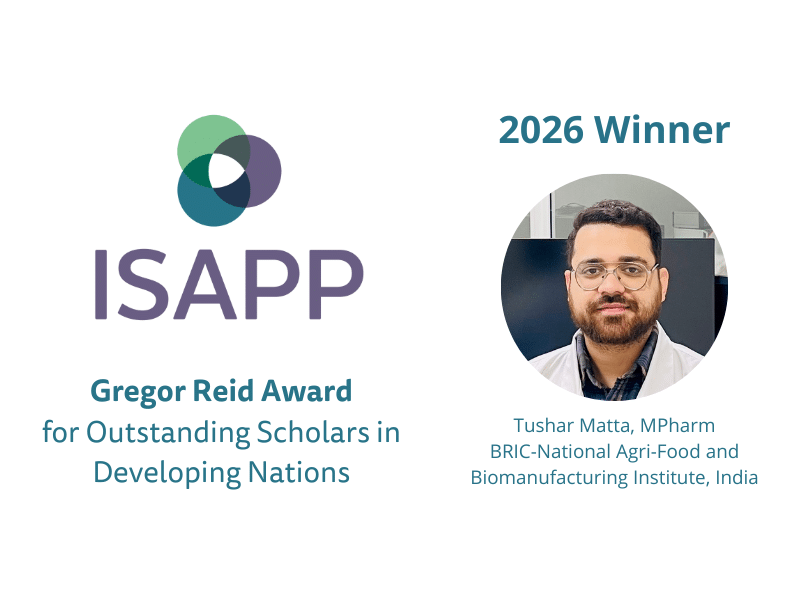
The selection committee for the Gregor Reid Award for Outstanding Scholars in Developing Nations has announced this year’s winner: Tushar Matta, MS Pharm, a researcher currently working on his PhD at the BRIC-National Agri-Food and Biomanufacturing Institute in India. Tushar’s work focuses on identifying bacterial strains with the potential to modulate the gut-brain axis, and in particular the screening and characterization of strains that produce the neurotransmitter gamma-aminobutyric acid (GABA).
Tushar completed a Master of Pharmacology and Toxicology degree (MS Pharm) in 2020, gaining a foundational understanding of drug mechanisms and translational therapeutics. He went on to pursue a PhD with Dr. Kanthi Kiran Kondepudi at the BRIC-National Agri-Food and Biomanufacturing Institute, focusing on potentially therapeutic microorganisms and their mechanisms of action.
Tushar says that during his Master’s degree in pharmacology, he worked on antibiotic resistance and molecular pharmacology during his dissertation research. He says, “This experience was a turning point, as it made me realize that understanding drug action alone is insufficient without insight into how microorganisms interact with drugs and the host. Hands-on exposure to microbiological techniques showed me how pharmacology and microbiology operate in parallel, particularly in host-microbe interactions, and molecular mechanisms of action.” Thus, he considers microbiology as crucial to understanding drug efficacy, resistance development, and safety, making it indispensable for modern drug development.
His recent work demonstrated that Levilactobacillus brevis LAB6 is a potent GABA-producing microorganism with anti-inflammatory and neuroprotective effects. When combined with modified kodo millet bran, this strain restores GABA in the hippocampus, reduces neuroinflammation, and modulates gut microbiota composition. His approach includes conducting comprehensive genomic analyses to find the genetic determinants responsible for GABA biosynthesis, as well as extensive safety assessments using in silico, in vitro, and in vivo approaches.
This work, which has potential applications in epilepsy and related disorders, has led to several publications and a patent filed in India. Alongside his microbiological experiments, he also works with bioinformatics and programming capabilities to support data-driven approaches in drug discovery, target validation, and immunometabolism.
After Tushar obtains his PhD, he plans to pursue postdoctoral research in gut–brain axis biology, focusing on the mechanistic role of the vagus nerve and enteric nervous system in microbial-host communication. His ultimate goal is to develop translational strategies that link microbiome interventions with neural and behavioral outcomes.
ISAPP established the Gregor Reid Award for Outstanding Scholars in Developing Nations in honor of Dr. Gregor Reid PhD to support and recognize early career researchers within low and middle income countries (LMICs). Dr. Reid is a founding board member of ISAPP, former President of ISAPP, and founder of the ISAPP Students and Fellows Association. His work in LMICs throughout his career showed his commitment to scientific excellence, innovation, and community development. As the recipient of this year’s award, Tushar will receive a cash award and a speaking slot at the ISAPP annual conference in Tokyo in October, 2026.
