

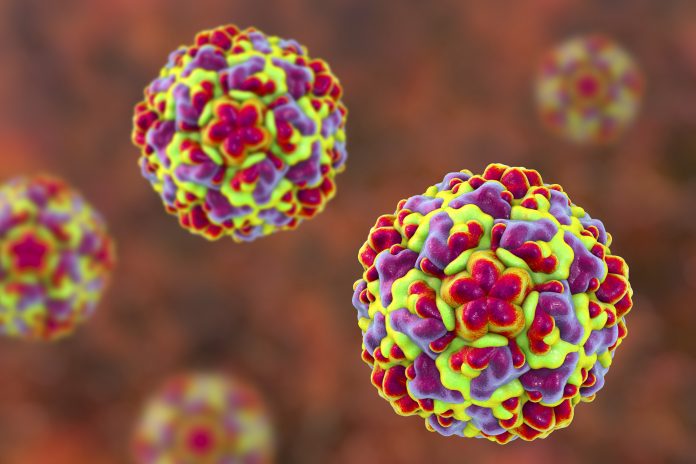
Researchers at Yale School of Medicine have demonstrated how the cells lining our nasal passages work together to defend us from infection by rhinoviruses (RVs)—the most frequent cause of the common cold. Studying an organotypic model of the human nasal mucosa, the researchers found that it’s our body’s defense to rhinovirus—not the virus itself—that typically predicts whether or not we catch a cold, as well as how bad our symptoms will be. The findings also pointed to potential therapeutic targets.
“As the number one cause of common colds and a major cause of breathing problems in people with asthma and other chronic lung conditions, rhinoviruses are very important in human health,” said research lead Ellen Foxman, MD, PhD, associate professor of Laboratory Medicine and Immunobiology at Yale School of Medicine. “This research allowed us to peer into the human nasal lining and see what is happening during rhinovirus infections at both the cellular and molecular levels.”
Foxman and colleagues reported on their findings in Cell Press Blue, in a paper titled “Rhinovirus triggers distinct host responses through differential engagement of epithelial innate immune signaling,” in which they stated that their results “… elucidate molecular mechanisms leading to distinct host responses to RV infection and reveal potential therapeutic targets.”
“Rhinoviruses (RVs) are the most frequent cause of common colds, but they are also a major cause of respiratory distress in high-risk groups, for example, smokers and people with asthma, the authors wrote. Like many respiratory virus infections, RV infections have a wide spectrum of clinical manifestations, ranging from no symptoms to severe respiratory distress, they continued. “Although there are many different RV variants, epidemiological and experimental infection studies indicate that even subjects with identical RV exposures can have disparate clinical outcomes, indicating that host factors play a central role in determining pathogenesis.”
This indicates that host factors may play a central role in determining pathogenesis. However, the team noted, “The molecular mechanisms leading to the wide range of infection outcomes are not fully understood.”
![Electron micrograph of differentiated human nasal epithelial organoids with cilia of multiciliated cells accentuated in blue. [Julien Amat & Bao Wang]](https://www.genengnews.com/wp-content/uploads/2026/01/Low-Res_Human-nasal-organoids-with-cilia-CREDIT-Julien-Amat-Bao-Wang-300x234.jpg)
Previous research has indicated that host-virus interactions in the respiratory epithelium, which is the main tissue in which RVs replicate, may play an important role. One key antiviral defense mechanism triggered in respiratory epithelial cells by RV infection is the interferon (IFN) response, and studies have also suggested that reduced IFN response may represent a key factor in increases susceptibility to severe RV infections.
To investigate this further the researchers created lab-grown human nasal tissue. They cultured human stem cells for four weeks while exposing the top surface to air. “We used primary human nasal epithelial cells (HNECs) from healthy donors, cultured at the air-liquid interface (HNEC-ALI) for four weeks with the apical surface in contact with air,” they explained.
Under these conditions, the stem cells differentiated into a tissue with many of the cell types that are found in the human nasal passages and lining of the lung airways, including cells that produce mucus and cells with cilia. “HNEC ALI cultures support robust RV replication, providing an ideal model to examine the interplay between viral replication and host responses to infection in the virus target tissue,” the team pointed out.
![Electron micrograph showing a human nasal epithelial cell releasing rhinovirus (blue). [Julien Amat & Bao Wang]](https://www.genengnews.com/wp-content/uploads/2026/01/Low-Res_Human-nasal-epithelial-cell-releasing-rhinovirus-blue-CREDIT-Julien-Amat-Bao-Wang-300x235.jpg)
“This model reflects the responses of the human body much more accurately than the conventional cell lines used for virology research,” Foxman said. “Since rhinovirus causes illness in humans but not other animals, organotypic models of human tissues are particularly valuable for studying this virus.”
The model allowed the team to examine the coordinated responses of thousands of individual cells at once and test how the responses changed when the cellular sensors that detect rhinovirus were blocked. In doing so, the researchers observed a defensive mechanism that keeps rhinovirus infections at bay, coordinated by interferons—proteins that block the entry and replication of viruses.
Upon sensing rhinovirus, cells in the nasal lining produce interferons, which induce a coordinated antiviral defense of infected cells and neighboring cells, making the environment inhospitable for viral replication. If the interferons act quickly enough, the virus cannot spread. “In the intact human nasal epithelium, RV primarily induces an interferon response, which restricts the infection to <2% of cells,” the scientists commented. When they then prevented this response experimentally, the virus quickly infected many more cells, causing damage and, in some cases, death of the infected organoids.
“Our experiments show how critical and effective a rapid interferon response is in controlling rhinovirus infection, even without any cells of the immune system present,” said first author Bao Wang, PhD.
The research also revealed other responses to rhinovirus that kick in when viral replication increases. For example, rhinovirus can trigger a different sensing system that causes infected and uninfected cells to synergistically produce excessive mucus, increase inflammation, and sometimes cause breathing problems in the lungs. “Inhibiting this response increases viral replication and exaggerates nuclear factor κB (NF-κB)- and Nod-like receptor protein 1 (NLRP1)-dependent pro-inflammatory responses and mucus hyperproduction with positive feedback from interleukin (IL)-1β release,” they reported.
These responses may be good targets for intervening in rhinovirus infection and promoting a healthy antiviral response, the team suggested. “We demonstrate the potency of the epithelial IFN response in limiting RV in its target tissue and define conditions that promote a distinct pro-inflammatory response mediated by NLRP1 and IL-1R signaling, pointing to the NLRP1-IL-1 axis as a potential therapeutic target to alleviate RV-induced airway obstruction.”
The team acknowledges that the organoids used contain limited cell types compared to those in the body, since in the body an infection attracts other cells, including those in the immune system, to join the defense against rhinovirus infection. They say that understanding how other cell types and environmental factors in the nasal passages and airways calibrate the body’s response to rhinovirus infection is an important next step of this work. Nevertheless, the authors concluded, “Our results highlight the usefulness of ALI culture, and human organoid models in general, for understanding the dynamic interplay between innate immune sensing, viral replication, and tissue-specific phenotypes that result from viral infection.”
Foxman added, “Our study advances the paradigm that the body’s responses to a virus, rather than the properties inherent to the virus itself, are hugely important in determining whether or not a virus will cause illness and how severe the illness will be. Targeting defense mechanisms is an exciting avenue for novel therapeutics.”
