

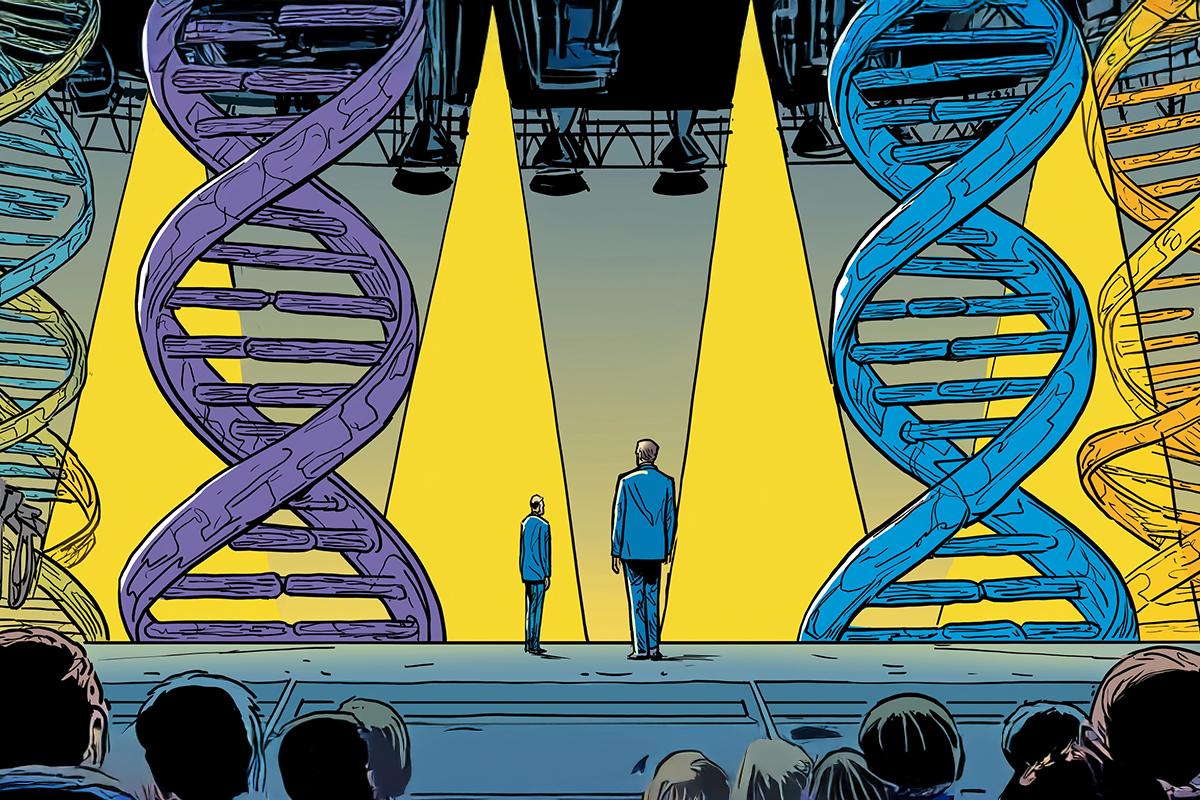
Correcting for extrinsic mortality suggests intrinsic lifespan is far more heritable than previously thought.
For decades, the heritability of human lifespan has been treated as modest, even disappointing. Twin studies and family analyses repeatedly suggested that genes account for perhaps 10–25% of variation in how long we live, leaving environment, chance and circumstance to do the rest. It was an appealing narrative, particularly for public health – improve living conditions and longevity follows – but one that never quite sat comfortably with the mounting biological evidence that aging itself is a regulated, genetically influenced process.
A new paper in Science by Shenhar and colleagues challenges that long-standing estimate, arguing that it is not simply low, but systematically mismeasured. When deaths driven by extrinsic factors – accidents, infections, violence and environmental hazards – are separated from mortality driven by aging biology, the heritability of intrinsic human lifespan rises sharply, to around 50–55%. In short, the authors suggest we have been mixing signal with noise and then wondering why the message sounded faint [1].
Longevity.Technology: For years we have told ourselves a comforting story about longevity: that genes play only a modest role and the rest is lifestyle, luck and the slow march of public health; Shenhar and colleagues argue we have been undercounting genetics by mixing biology with bad weather – accidents, infections, environmental hazards and the other extrinsic ways humans inconveniently stop being alive. Correct for that statistical static and the heritability of intrinsic lifespan lands at roughly 50–55%, suddenly making longevity look less like an outlier and more like any other complex trait worth mapping, modeling and ultimately manipulating. That is not a victory lap for genetic determinism – half the variance is still non-genetic, and heritability is famously a property of populations and eras, not a cosmic constant – but it is a provocative reminder that as societies succeed at keeping people from dying young, the remaining problem is increasingly the one geroscience has been pointing at all along: aging itself.
A question of what we measure
The core argument of the paper is deceptively simple. Traditional lifespan heritability estimates are based on total lifespan, yet total lifespan is influenced by many causes of death unrelated to the biological rate of aging.
“Extrinsic mortality,” the authors write, “systematically masked the genetic contribution to life span [1].” In environments where infection, injury and hazard dominate, even a strong genetic predisposition to slower aging may never have the chance to express itself.
To address this, the team combined classical twin data with a mechanistic mortality model that explicitly separates intrinsic and extrinsic components of death risk. This approach allowed them to estimate what heritability would look like if deaths unrelated to aging biology were mathematically removed. The answer was strikingly consistent across models: around half of the variation in intrinsic lifespan appears to be heritable.
When public health succeeds
One of the more subtle implications of the work is temporal. Using data from the Swedish Twin Registry, the authors show that estimated heritability increases in later birth cohorts, coinciding with declining extrinsic mortality. As societies reduce deaths from infection, trauma and early-life hazards, the relative contribution of aging biology begins to become more visible.
This is less of a paradox than it sounds. Success in sanitation, vaccination and safety does not make genes more powerful – it simply removes competing causes of death. Longevity, once buffered from external shocks, starts to resemble other complex traits such as height or metabolic disease risk, where genetics and environment share the explanatory burden.
Not genetic destiny
The authors are careful to stress what their findings do not mean. A heritability of 50% does not imply inevitability, nor does it erase the influence of socioeconomic status, education, lifestyle or access to care. “Heritability,” the authors note, “is a statistic that applies to a particular population in a particular environment at a particular time – it is not a fixed quantity like the gravitational constant [1].” Change the environment and the estimate changes with it.
That nuance is echoed in a commentary by Bakula and Scheibye-Knudsen, published alongside the paper in the same issue of Science [2]. They caution that while the reframing is compelling, it should not be mistaken for proof that longevity is predominantly genetically preordained. Rather, they argue, it highlights the need to align research questions with the biology under investigation; if the question is aging, measuring total lifespan may be the wrong proxy.
Implications for geroscience
For longevity research, the paper opens a door to a possible consequential reframing. If intrinsic lifespan shares heritability levels with other complex traits, the logic of pursuing longevity-associated variants, pathways and mechanisms becomes stronger, not weaker. It also raises practical questions about study design: in low-extrinsic-mortality populations, setting inclusion ages too high may inadvertently discard informative variation linked to intrinsic aging risk.
At the same time, the findings resist easy translation into prediction. Identifying genetic contributors to aging does not equate to forecasting individual lifespan, nor does it diminish the role of prevention. It sharpens the target, rather than narrowing the solution.
After the noise fades
As extrinsic mortality continues to fall in parts of the world, longevity will increasingly reflect the biology we carry with us, modulated by the environments we construct. The challenge, for science and policy alike, is to decide what to do once the noise recedes and the signal becomes harder to ignore.
[1] https://www.science.org/doi/10.1126/science.adz1187
[2] https://www.science.org/doi/10.1126/science.aee3844
