

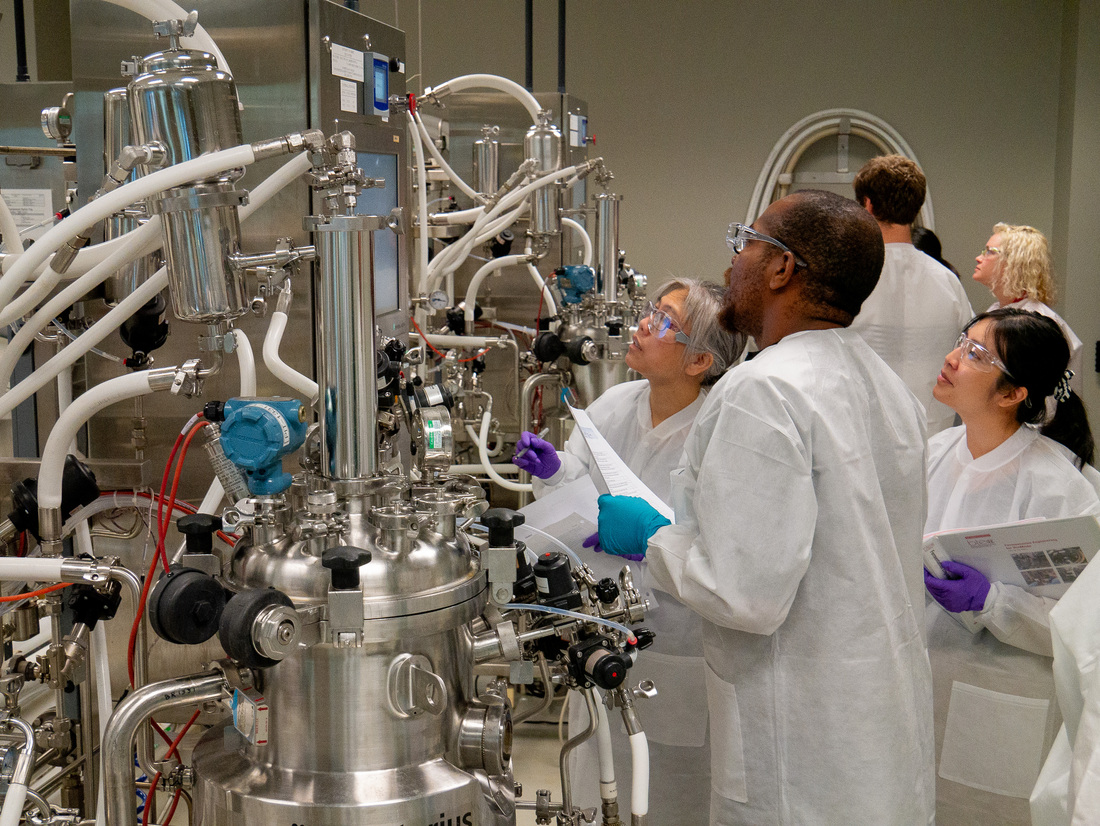
A biomanufacturing framework addresses the challenges of scaleup and scaledown, enabling biomanufacturers to scale more quickly and efficiently, whether they’re going from bench- to pilot-scale, or enhancing legacy processes.
Developed by North Carolina State University (NC State University) and BioMADE, “the framework uses a statistical model of bioprocesses at both the microbioreactor scale as well as pilot scale. It combines all the data collected during fermentation batches,” Kurt Selle, PhD, director of operations, Biomanufacturing Training and Education Center (BTEC) at NC State University, tells GEN. “Cross-comparison allows us to predict how changes at the smaller scale would transfer to the larger scale. It is accurate to within 10% for biomass and product titer.”
“The model is for reference,” adds Ryan Barton, PhD, manager of bioprocess automation at BTEC. “The benefit to industry is that this framework provides an easy, step-by-step guide” that shows the types of data and best practices biomanufacturers can use to generate a model for their own processes.
In practical terms, the framework reduces waste and time during the development process. For example, this team scaled from 1 mL to 30 L—that’s a 30,000-fold increase in volume, with high accuracy and predictability for the most important parameters. Typically, biomanufacturers would scale up using multiple steps, increasing by factors of ten, which increases material costs as well as time. “Although traditional scale-up involves fewer and fewer batches, the experiments at the intermediate-to-large scale are significantly more expensive because of material costs,” Barton says.
Using a microbioreactor enabled Selle and Barton to complete 48 individual fermentations in 24 hours, rather than the five that would have been possible with 30-L (pilot scale) fermenters. Therefore, Selle says, “we were able to test more process variations in the same timeframe…increasing throughput for testing process conditions such as clone/cell line and medium composition.”
In-line product monitoring
In addition to the scaling component, the team also addressed in-line product monitoring. “For complex products, there’s no dedicated sensor that can measure things like the quantity of cells present or the actual recombinant protein product [during the fermentation process],” Selle says. “Instead, you have to use an advanced spectral sensor. Raman spectroscopy’s advantage over other spectral sensors is that it doesn’t have as much signal interference from water, and fermentations are aqueous.”
The framework emerged when BTEC needed to characterize a legacy process, Selle says. By running this framework in reverse, scaling down, biomanufacturers can test process improvements at a smaller scale.
The details of this work will be shared widely within the BioMADE member community. “By sharing the framework and predefined outcomes, to say ‘here’s the raw data that goes into this, here’s the work we did, and here’s what that actually looks like when you apply best practices,’ it lets people determine how to do this themselves and apply it to their own processes,” Selle says.
“A lot of companies have probably done similar work internally,” Barton admits, “but it’s kept close to the chest. We’re trying to make something that’s more accessible to everybody that will have a greater impact on the industry as a whole.”
“We want to continue to work with BioMADE and add industry partners to build on the expertise from this effort and to broaden our look at spectral sensors to monitor fermentations,” Selle adds.
