

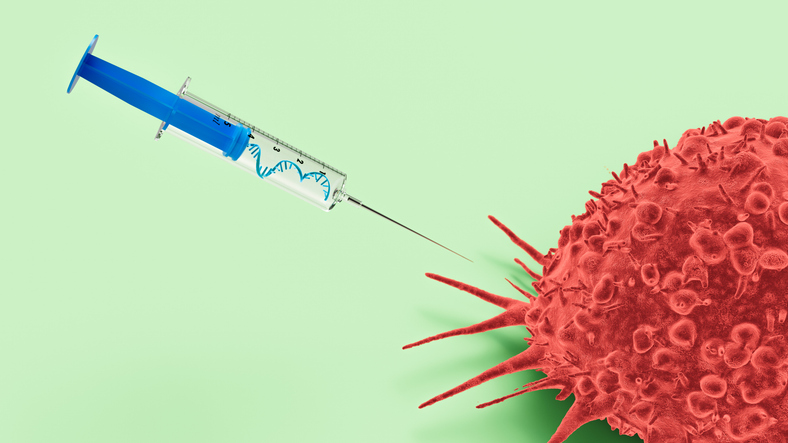
For decades, a cancer biopsy has marked a critical point in a patient’s journey, as a small piece of tissue is removed and examined under a microscope and, more recently, also sequenced to guide treatment. But a growing body of research suggests that the biopsy of the future may go further than identifying and classifying a patient’s cancer—it could provide the blueprint for a vaccine custom-built to train the immune system to recognize and eliminate cancer cells unique to that individual. That possibility is moving closer to clinical reality as BioNTech researchers build on promising clinical data for their portfolio of personalized mRNA vaccines.
In a first-in-human study of patients with early-stage triple-negative breast cancer (TNBC), BioNTech researchers report that individualized mRNA cancer vaccines targeting patient-specific tumor mutations can generate powerful, durable T cell responses that persist for years and may help protect against relapse in one of the most aggressive forms of breast cancer. In this clinical trial—the TNBC-MERIT (Mutanome Engineered RNA Immuno-Therapy) study—up to 20 patient-specific neoantigens were encoded on two mRNA molecules, delivered intravenously via lipid nanoparticles (LNPs) to target dendritic cells.
This clinical work, published in Nature, comes weeks after BioNTech kicked off 2026 by announcing having received their second FDA Fast Track designation for an mRNA vaccine program. While these two programs, BNT113 (HPV16+ head and neck cancer) and BNT111 (advanced melanoma), use a fixed set of neoantigens, this progress is laying the groundwork for BioNTech’s path to regulation with its growing personalized RNA neoantigen vaccine platform.
In speaking with Inside Precision Medicine, Özlem Türeci, MD, co-founder and chief medical officer at BioNTech and professor of personalized immunotherapy at the Helmholtz Institute for Translational Oncology (HI-TRON), emphasized the flexibility of the platform. Türeci said, “mRNA technology is a platform technology. This means it allows us to relatively easily adapt it to a target. We have developed and optimized our technology over decades to make it potent for use in cancer medicine. These characteristics make this technology a pan-tumor technology that is suitable to be used across various tumor types and as a combination partner for novel combination strategies in cancer medicine.”
Exploiting the tumor’s mutanome
TNBC accounts for approximately 10-15% of breast cancers and is defined by the absence of estrogen receptor (ER), progesterone receptor (PR), and HER2 receptor. Without those molecular targets, many of the most effective targeted therapies available for other breast cancer subtypes are ineffective in TNBC.
Indeed, TNBC is notorious for early recurrence, particularly within the first three years after diagnosis. Although many patients respond well to chemotherapy, those who do not achieve a pathological complete response remain at substantial risk of relapse. The need for new post-surgical strategies to eliminate microscopic residual disease is pressing.
At the same time, TNBC’s genomic instability means tumors often harbor numerous somatic mutations. Some of these mutations give rise to the abnormal protein fragments found only in cancer cells. Because the immune system has not been tolerized to these mutated sequences, these neoantigens represent attractive targets for T cell–mediated immunity.
Türeci, explaining the rationale behind targeting this particularly challenging subtype, said, “Its genomic instability and immunogenic microenvironment make it a strong candidate for individualized immunotherapy,” Türeci explained. “With an mRNA cancer immunotherapy approach, we aim to activate the immune system against multiple antigens specific to a patient’s tumor, thereby increasing the likelihood of inducing immune responses against the tumor and establishing long-lasting immunological memory to prevent relapses.”
The BioNTech team tested whether these patient-specific mutations could be systematically identified and turned into a personalized mRNA vaccine in the TNBC-MERIT study—an exploratory Phase I trial evaluating personalized neoantigen mRNA vaccines following surgery and standard therapy.
The process begins at the time of surgery. Tumor tissue and matched normal tissue are subjected to next-generation sequencing to identify somatic mutations unique to the cancer. Bioinformatic algorithms then predict which mutations are most likely to generate neoantigens capable of being presented on the patient’s HLA molecules and recognized by T cells.
Up to 20 selected mutations are encoded into two strands of immunostimulatory, non-nucleoside-modified uridine mRNA. These RNAs are packaged in lipid nanoparticles (LNPs) and administered intravenously, where they preferentially target dendritic cells in lymphoid tissues. Inside these antigen-presenting cells, the mRNA is translated into protein fragments that are processed and displayed on MHC class I and II molecules, activating CD8⁺ cytotoxic and CD4⁺ helper T cells. At the same time, the RNA platform activates natural sensors like Toll-like receptors, triggering type I interferon responses that help boost T-cell growth.
Manufacturing proved feasible in a clinical setting. The average turnaround time from sample receipt to vaccine release was 69 days, demonstrating that individualized vaccine production can be integrated into real-world oncology workflows. Patients received eight doses over approximately two months. Side effects were generally mild to moderate, including fever, chills, headache, nausea and fatigue, typically resolving within one to three days.
Universal immune activation
All 14 treated patients mounted vaccine-induced or amplified T cell responses against one or more of their personalized neoantigens. In nearly all patients, responses were directed against multiple targets, reflecting the poly-epitopic design of the vaccine. Both CD8+ cytotoxic T cells and CD4+ helper T cells were induced.
In some individuals, neoantigen-specific CD8+ T cells expanded to represent up to 6-17% of circulating CD8+ T cells following vaccination, levels rarely observed with conventional cancer vaccines and more commonly associated with adoptive T cell therapies.
Importantly, many responses were not detectable prior to vaccination and were newly generated de novo by the immune system. In several cases, the same mutated sequence gave rise to epitopes recognized by both T cell subsets or by distinct CD8+ T cell clones restricted by different HLA alleles.
The immune responses were not only strong but also durable. In patients evaluable for long-term follow-up, neoantigen-specific T cell responses expanded during the vaccination phase, contracted modestly and then stabilized at high levels for years. In some cases, specific mutation-targeting CD8+ T cell populations remained detectable for up to six years after the final vaccine dose, even in the absence of booster immunizations.
Phenotypic analyses revealed that vaccine-induced CD8+ T cells differentiated into late-stage cytotoxic effector cells expressing markers associated with immediate tumor-killing capacity. Over three to six years, these cells developed toward a CD45RA-re-expressing phenotype, indicative of late-differentiated effector memory cells poised for rapid action.
Simultaneously, a subset of vaccine-induced T cells displayed a stem cell–like memory phenotype characterized by expression of TCF7 (TCF-1) and IL7R. These markers are associated with self-renewal and long-term persistence. The coexistence of highly cytotoxic effector cells and regenerative memory populations suggests that the vaccine establishes a renewable immune reservoir capable of sustained tumor surveillance.
As of early 2025, ten of the fourteen patients remained relapse-free, with a median follow-up of five years after the last vaccine dose. One additional patient remained relapse-free until death from unrelated causes.
While the study was not designed to definitively demonstrate efficacy, the relapse-free outcomes in this high-risk population are encouraging and align with the robust immune responses observed.
Türeci placed the findings in a broader context. “The results of this exploratory Phase I clinical trial add to the growing body of evidence supporting proof of concept of mRNA cancer immunotherapies as platform technology. The results demonstrate feasibility and durable neoantigen-specific immunity in TNBC.”
This study further strengthens BioNTech’s growing body of evidence supporting the clinical potential of personalized mRNA cancer vaccines, building on several cancer trials conducted over the past three years. Current clinical data for BNT122 (autogene cevumeran) show that follow-up from Phase I trials demonstrated durable neoantigen-specific T-cell responses up to three years and a correlation with delayed tumor recurrence in some patients with resected pancreatic cancer. Ongoing Phase II trials in adjuvant pancreatic ductal adenocarcinoma, colorectal cancer, and melanoma for BNT122 are actively enrolling or progressing, with interim data from these larger studies anticipated in late 2025 or early 2026.
Together, these studies suggest that personalized mRNA neoantigen vaccines may function across tumor types with differing mutation burdens, from highly mutated melanoma to relatively low-mutation pancreatic cancer and TNBC.
Lessons from resistance
Three patients experienced relapse, and each case provided insight into potential mechanisms of immune escape. Türeci, reflecting on these instructive cases, said, “The findings in three patients with relapses in this clinical trial were instructive for potential future combination treatment strategies to overcome resistance, each revealing a distinct escape mechanism to be addressed.”
Türeci expanded on these three cases. In one patient, a relatively weak vaccine-induced immune response may have fallen below a necessary threshold for durable tumor control. The subsequent complete remission with anti–PD-1 therapy suggests that combining personalized vaccines with checkpoint blockade could amplify responses and overcome residual disease.
In another case, the recurrent tumor displayed near-complete loss of MHC class I expression, likely driven by downregulation of beta-2 microglobulin (B2M). Such antigen-presentation loss is a known escape mechanism from T cell–mediated therapies and highlights the potential need for combination strategies that either restore antigen presentation or target tumors through alternative immune mechanisms, such as antibodies.
In a third patient with a BRCA1 mutation and bilateral breast tumors, the relapse originated from a genetically distinct primary tumor that had not been sequenced for vaccine design. The recurrence carried different mutations from those encoded in the vaccine, illustrating the importance of comprehensive tumor sequencing in hereditary cancer settings.
“These results point to novel treatment strategies to overcome resistance, especially through informed treatment combinations,” said Türeci.
Although limited by a small sample size and lack of a control arm, the TNBC-MERIT study demonstrates the end-to-end feasibility of personalized mRNA cancer vaccination from biopsy and sequencing to individualized manufacturing and durable immune activation. The data suggest that such vaccines can consistently induce strong multi-epitope T cell responses that persist for years, including both cytotoxic effector cells and stem-like memory populations.
Türeci emphasized that the work is advancing into later-stage trials. “There are currently several advanced Phase II clinical trials ongoing for this approach in various indications, aiming to demonstrate proof of concept compared to the standard of care,” said Türeci. “The data from these clinical trials will inform the next steps.”
If ongoing trials confirm clinical benefit, the implications could be transformative. A tumor biopsy would no longer serve merely as a diagnostic step but as the starting point for a bespoke immunotherapy program based on the tumor’s unique mutational signature into an mRNA vaccine designed to educate and arm the immune system for years. In that future, sequencing a tumor might not simply reveal what the cancer is. It could determine how to mobilize the immune system to eliminate it—and perhaps prevent it from ever returning.
