

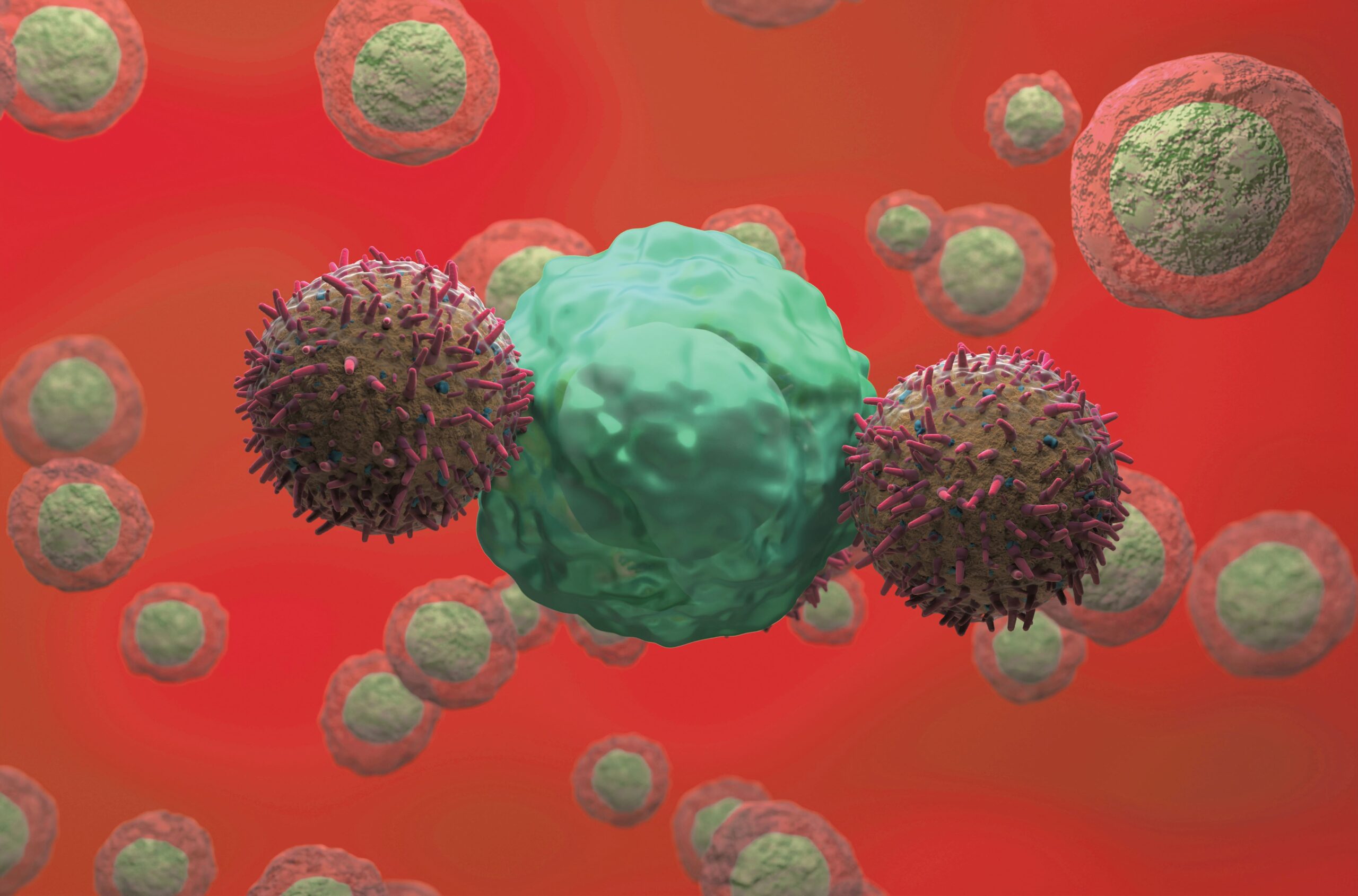
Among the most promising tools of cancer therapy, engineered immune cells known as chimeric antigen-receptor (CAR) T cells have already transformed the treatment of blood cancers. Yet, despite their promise, CAR T cells do have their limitations. For one thing, they’ve so far largely failed against solid tumors, which is to say, most types of cancer. For another, they can inadvertently kill healthy cells along with cancerous ones—or, separately, provoke a systemic immune overreaction—causing serious and sometimes even lethal side effects.
To address these challenges, researchers led by Ludwig Lausanne’s Melita Irving, PhD, and Greta Maria Paola, PhD, Giordano Attianese, PhD, and their colleagues Leo Scheller, PhD, and Bruno Correia, PhD, at École Polytechnique Fédérale de Lausanne (EPFL) have engineered a CAR T technology, known as DROP-CAR, that can swiftly, and with minimal fuss, be switched off, on demand, using an existing anticancer drug.
“Our work introduces a simple and clinically realistic way to reversibly dial down CAR T cell activation using, as a remote control, a cancer drug, venetoclax, that is already in clinical use as a cancer therapy,” said Irving. “The remote control doesn’t trigger the self-destruction of the CAR T cells, which is how many others have approached this challenge, but simply prompts them to disengage and fall off from their cancerous targets. This capability could help clinicians better modulate the delivery of CAR T therapy and perhaps enable its application to more patients and types of cancer.”
The team reported in Nature Chemical Biology (“Drug-controlled CAR T cells through the regulation of cell–cell interactions”) the development and preclinical evaluation of the DROP-CAR-T cell technology, through which they demonstrated both efficacy and controllability in mouse models of cancer.
“Chimeric antigen receptor (CAR) T cell therapy is constrained by on-target, off-tumor toxicities and cellular exhaustion because of chronic antigen exposure,” the team wrote. “… on-target, off-tumor toxicity of CAR T cells directed against solid tumor antigens, which are also present on healthy tissues with few exceptions, is a priori a safety concern.”
Most CARs used in the clinic are second-generation (2G) and comprise a protein receptor that sticks out of the engineered T cell like a wand. This cancer cell-detecting end of the CAR is typically derived from the antigen-binding fragment of an antibody molecule—“… typically a single-chain variable fragment, scFv,”—which can be designed to grab virtually any target with exquisite specificity.
When it detects its molecular quarry—a cancer antigen—this engineered receptor triggers the transmission of signals from its tail end inside the cell to engage the T cell’s cytotoxic machinery. The internal signaling components are stitched together from the biochemically active part, or “domain”, of a protein called CD3-ζ, which is required to activate the T cell upon antigen binding, and another from a co-stimulatory protein (such as CD28) that boosts the function and persistence of the T cells after activation.
However, as the authors noted, there are limitations to 2G-CAR technology. These include T cell exhaustion as a result of chronic antigen exposure, or toxicity resulting from on-target reactivity against healthy tissues, and adverse events such as cytokine release syndrome (CRS), which can be triggered as a result of overresponsiveness at high antigen density or tumor burden.
“On-switch and off-switch CAR designs that allow remote control of T cell activity levels by small-molecule administration represent a promising strategy for balancing function and safety,” the investigators further suggested. In fact, Irving, Attianese, and their colleagues had previously devised a method to control CAR T activity by separating the cell’s internal signaling chain from the receptor and using venetoclax to bring them together to activate the CAR T cell. In that system, another drug induced the degradation of the internal signaling component to switch off the CAR T cell.
Their new remote-controlled CAR T cell sports a “drug-regulated off-switch PPI CAR” (DROP-CAR) that places the switch on the outside of the cell. “Here, through rational protein design and library screening, we generated a stable protein–protein interaction (PPI) of human origin that can be efficiently disrupted by the clinically approved molecule venetoclax,” they explained.
The signaling component of the CAR inside the cell is linked to a strip of protein on the outside of the cell. That strip carries at its tip a computationally designed human domain known as dmLD3 that binds a protein named BCL-2 with very high affinity. The cancer-sensing antibody of the CAR, for its part, carries at its tail end the bit of BCL-2 recognized by dmLD3. “We incorporated the components into a drug-regulated off-switch PPI (DROP)-CAR design, including a transmembrane signaling (S)-chain that noncovalently engages through the PPI with a receptor (R)-domain.
Held together by this spontaneous protein-protein interaction, the CAR remains intact and functional until venetoclax disrupts that interaction. At that point, the dmLD3 and BCL-2 domains disengage, and the CAR falls apart, effectively switching off the CAR T cell lights. When venetoclax is withdrawn, the CAR reassembles, and the CAR T cells get back to killing cancer cells.
The researchers tested the DROP-CAR T cells in vitro and also in a mouse tumor model. Their studies confirmed that venetoclax inactivated the DROP-CAR T cells. Importantly, they further stated, “… we showed that the suppression is reversible as, upon venetoclax withdrawal, DROP-CAR T cells regained tumor control, even at an advanced stage.” The results, they stated, “… demonstrate remote and reversible control of DROP-CAR T cells by venetoclax in vivo.”
Attianese said, “Unlike previous controllable CAR designs, our system uses only human protein components and a clinically approved, non-immunosuppressive drug to directly disrupt tumor cell binding by the CAR T cells. Because the switch acts at the level of cell–cell contact rather than inside the cell—by, for example, blocking signaling, degrading CAR components, or inducing cell death—it offers an enhanced safety profile and permits control of the CAR T cells without requiring their sacrifice, thus preserving them for continued treatment.
This ability to control CAR T cell activity could also help mitigate a phenomenon known as T cell exhaustion that accounts for the failure of many T cell-based immunotherapies. Caused by the continuous and nonproductive stimulation of T cells in the immunosuppressive microenvironment of tumors, exhaustion pushes T cells into a functionally sluggish state in which they’re incapable of killing their target cells. Previous studies have shown that giving CAR T cells periods of rest between bouts of active tumor targeting can reverse the genomic alterations that drive exhaustion and boost their functional efficacy. DROP-CAR T cells are well-suited to this strategy.
Since the drug required to control DROP-CARs is already approved for cancer therapy, Irving, Attianese, and their colleagues suggest their CAR T system is uniquely poised for clinical evaluation. “The DROP-CAR system expands the toolbox of switchable CAR technologies, providing a modular framework for drug-controlled regulation of cell–cell interactions and supporting the development of advanced multi-input control strategies for cellular immunotherapies,” the authors wrote.
