

WASHINGTON, DC—Nine months after the “Baby KJ” story brought new hope to the rare diseases community, the Department of Health and Human Services (HHS) has issued a draft guidance promoting innovation for rare disease therapies.
The FDA’s Plausible Mechanism Pathway draft guidance is comprised of a series of initiatives designed to increase regulatory flexibility and spur the development of bespoke gene-editing therapies for rare and ultra-rare disorders, which collectively total about 30 million individuals in the United States.
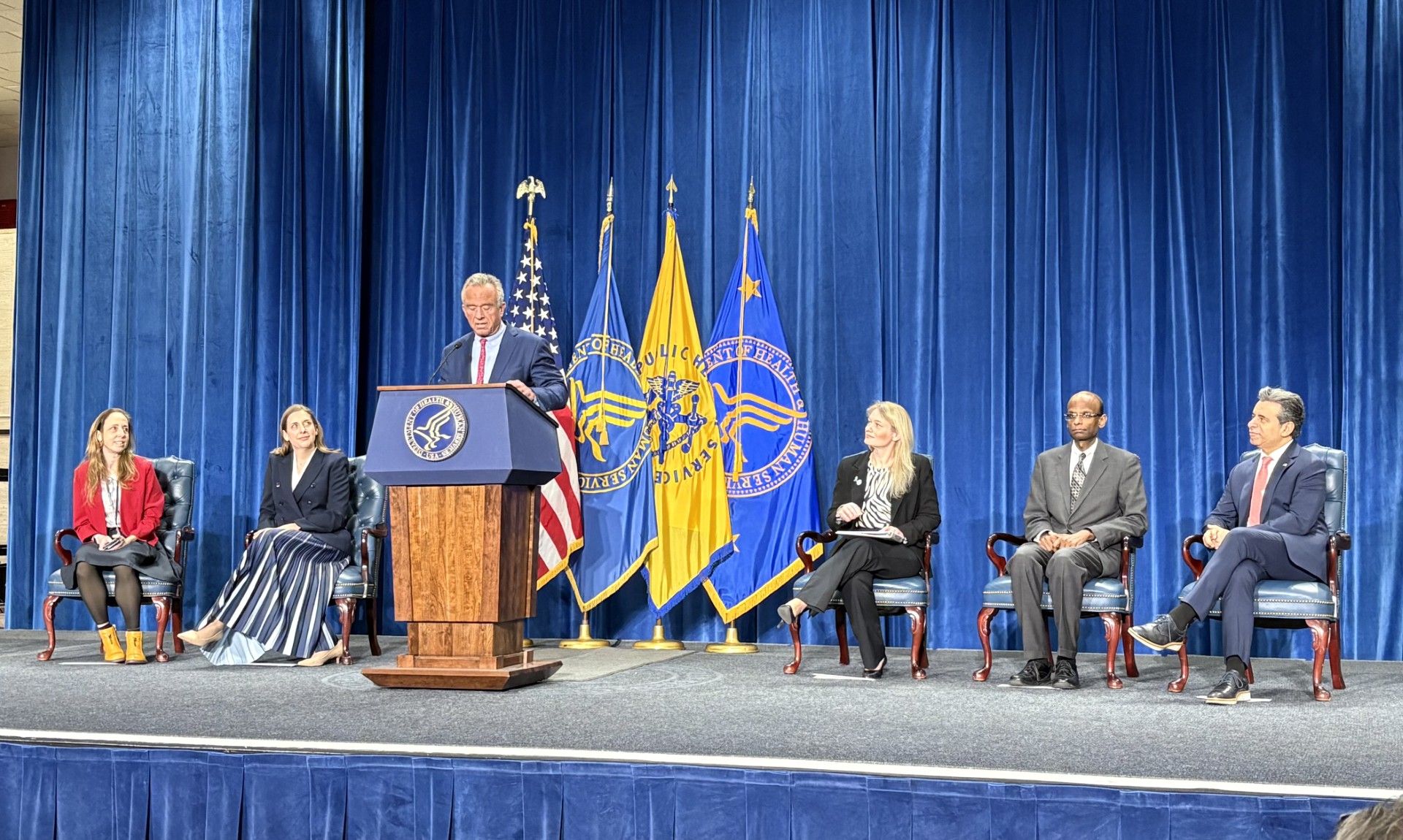
The draft guidance was unveiled in a briefing held at HHS headquarters in Washington DC, hosted by HHS Secretary Robert F. Kennedy, Jr., and the Commissioner of the U.S. Food and Drug Administration (FDA), Marty Makary, MD, MPH. In attendances were dozens of families and patient advocates impacted by rare disorders.
In his opening remarks, Kennedy hailed the KJ Muldoon story as “a medical miracle.” But it could not remain a one-time miracle. “Every child deserves the same kind of treatment,” Kennedy said.
“For decades, families heard the same thing: not enough patients, approvals take too long,” Kennedy continued. “That ends today… A disease with 100 distinct mutations in the same gene will no longer require 100 clinical trials… Individualized medicine is no longer theoretical.”
Kennedy and Makary were joined on stage by two Philadelphia-based physician scientists—Kiran Musunuru, MD, PhD (Perelman School of Medicine at the University of Pennsylvania) and Rebecca Ahrens-Niklas, MD, PhD (Children’s Hospital of Philadelphia). It was largely the “Baby KJ” clinical breakthrough last year, led jointly by Musunuru and Ahrens-Niklas, that provided the impetus for the release of the Plausible Mechanism Pathway plan.
Back to the future
In May 2025, a research consortium led by Ahrens-Niklas and Musunuru announced the successful treatment of KJ Muldoon, an infant born with a rare metabolic disorder. A rapidly assembled private-public partnership designed and tested a bespoke base editing treatment that was able to engineer a single-base substitution in the defective gene. KJ was discharged last June, receiving a police escort home, before his parents undertook a flurry of national television interviews. Nine months later, KJ, Musunuru said, is now “thriving, growing well, and full of unbridled joy.”
Last June, at an extraordinary roundtable of cell and gene therapy researchers and clinicians hosted by the FDA, base editing pioneer David Liu, PhD, proposed that a reasonable goal would be to treat 1,000 patients with rare genetic diseases by 2030.
But making strides towards that goal, as FDA leaders acknowledged at the time, would require a host of regulatory steps and accommodations to adapt to the new reality of rare disease therapeutics, which has traditionally been at odds with the economics of drug development.
Addressing the families of children with rare diseases, Kennedy pledged to end the delays in regulatory approval for rare disease therapies. “You should never have had to fight the government while fighting for your children’s life,” he said. In rare disease situations where randomized clinical trials are simply not feasible, Kennedy said that moving forward, “one well-controlled clinical investigation can support approval.”
A new pathway
FDA commissioner Makary acknowledged that the market size for rare disease therapies was too small to incentivize companies. He said his mantra since joining FDA has been: “Is there anything humanly possible that we can do differently?”
“Historically, rare diseases at the FDA have been an afterthought,” Makary said. But the agency has come a long way. “Today, the majority of drugs we approve at FDA are for rare diseases.”
The agency has expanded flexibility for cell and gene therapy manufacturing, removed “onerous requirements” for CAR T therapy follow-up, and is “embracing Bayesian statistics” suitable for small populations. “We can learn from individual patients,” he said.
Makary hailed the new draft guidance on the Plausible Mechanism Pathway as “common sense,” affording the developers of ultra-rare disease therapies “a path to accelerated or traditional approval based on the experience of individuals.”
In a brief set of remarks, Musunuru, a cardiologist by training, said his first clinical experience using base editing came in his work (as a co-founder of Verve Therapeutics) designing a therapy for heart disease to lower expression of the LDL receptor in the liver. By tweaking the GPS component of the gene editor, the same principle could be used to treat rare diseases, such as that in the case of Baby KJ.
“He was so close to death there were serious discussions about transitioning him to comfort care,” Musunuru recalled. But after KJ was moved to CHOP, and with funding from NIH, Musunuru said, “we took that same heart disease therapy and changed the GPS to turn the broken gene in his liver back on.”
Musunuru said: “We can do this over and over again with liver-centered diseases.” Indeed, researchers have turned KJ’s therapy into a platform that can be tested in a single clinical trial for urea cycle disorders.
“We intend to expand work to many liver-centered diseases,” Musunuru said. “This will allow doctors to get treatments for many disorders.” Success in treating diseases of the liver should help drive bespoke therapies for diseases affecting other organs.
Make firsts happen
Ahrens-Niklas said that her team had received “thousands of requests” for help from desperate parents and siblings seeking help for their family members. “This is heartbreaking, we need to do better,” she said. But the types of bespoke therapies epitomized by the KJ story “do not fit in the traditional model of drug development. We need these innovative regulatory frameworks.”

With these new opportunities comes great responsibility. “Every piece of data from every patient is priceless,” Ahrens-Niklas cautioned. “I hope we proceed with radical transparency.”
“It’s an amazing time in the history of science and medicine,” she concluded. “We’re the global leaders in designing cutting-edge treatments that will make our population healthier.”
The perspective of a rare disease patient advocate was provided by Judy Stecker. Her son Wheeler was born in May 2019. At four weeks old, he was diagnosed with a form of juvenile Batten Disease (CLN3 deficiency). The disorder, if left uncorrected, will steal his vision and ultimately his life.
Stecker served in the first Trump Administration and said she knew the risks when she became pregnant. “There was not enough data, not enough treatments, not enough hope,” she said. “Families like mine have had to build their own path. They raise millions of dollars hosting bake sales and golf tournaments.”
These were acts of “desperate heroism,” she said, but each fundraising drive only helps “one child, one mutation, one desperate family at a time.”
“This Administration has proven they have the commitment to make firsts happen,” Stecker said. To the government officials, payors and providers in the audience, she said: “There are 30 million possible firsts in this country. 15 million are children, and one of them is mine.”
Among the scientists in attendance at the HHS briefing was Fyodor Urnov, PhD (Innovative Genomics Institute), a pioneer of human genome editing and co-founder with Nobel laureate Jennifer Doudna, PhD, of Aurora Therapeutics, a biotech company that aims to advance therapies for rare genetic disorders.
Also present was Timothy Yu, MD, PhD (Boston Children’s Hospital), whose team in 2018 developed the first bespoke genetic therapy, Milasen, to treat Mila Makovec, a young girl from Colorado with a rare form of Batten disease. Mila passed away in 2021, but her legacy is also enshrined in the Plausible Mechanism Pathway initiative.
Guidance highlights
Tracy Beth Høeg, acting director of the Center for Drug Evaluation and Research (CDER), said that the Baby KJ story had inspired the creation of the Plausible Mechanism Pathway. “FDA is likely going to be overwhelmed with applications. We’re going to need to be creative to meet this new demand.” Reviewers would be sourced from CDER and the Center for Biologics Evaluation and Research (CBER), she said.
Among the specific measures the FDA is proposing are the following:
Modular product development: The FDA is proposing a streamlined regulatory approach, including a single Investigational New Drug (IND) or Biologics License Application (BLA) route for multiple variants within the same gene. In other words, if different guide RNAs are needed to target different mutations within the same gene, these product “variants” can be included, provided the method of correction remains the same.
The FDA will also consider expanding indications if a “plausible” mechanism of action can be provided to support the addition of new gene editing product variants to treat patients with mutations that were not included in the original clinical trial used for approval.
Regulatory Flexibility: The FDA will exercise regulatory flexibility to streamline non-clinical testing. For example, the agency will allow a single hybrid definitive proof-of-concept or safety study instead of multiple replicated studies. The agency will encourage the use of new approach methodologies, including organoids and in silico methods, to replace or supplement traditional animal models. And FDA will provide flexibility in study duration and model selection for gene-editing products that possess a well-understood mechanism of action.
Clinical Trial Designs: The draft guidance supports changes in clinical trial design such as the use of external controls (in cases where a disease’s natural history is well-characterized), rather than relying on a concurrent placebo group. To streamline data collection, the FDA is also open to the use of master protocols, which allow for the simultaneous evaluation of multiple therapies targeting different genetic changes for the same disease. And the agency will consider results from single pivotal clinical trials, where substantial evidence of effectiveness has been established.
Manufacturing Flexibilities: The FDA proposes several Chemistry, Manufacturing, and Controls (CMC) efficiencies, including: (a) Leveraging prior knowledge, in which sponsors can use their past experience to establish control strategies and process validation; (b) Validation across variants, in which process validation from one product can be used to support a similar product using the same manufacturing process at the same site; and (c) Adaptable potency assays—mutation-specific assays that can be adapted for different gene variants rather than creating entirely new assays for each one.
Expedited Approval Pathways: The FDA says that novel rare disease therapies may qualify for accelerated approval based on surrogate endpoints if they are deemed likely to predict clinical benefit. This allows for earlier patient access while additional data is collected to verify clinical benefit.
The draft guidance is open for public comments for 60 days.
