

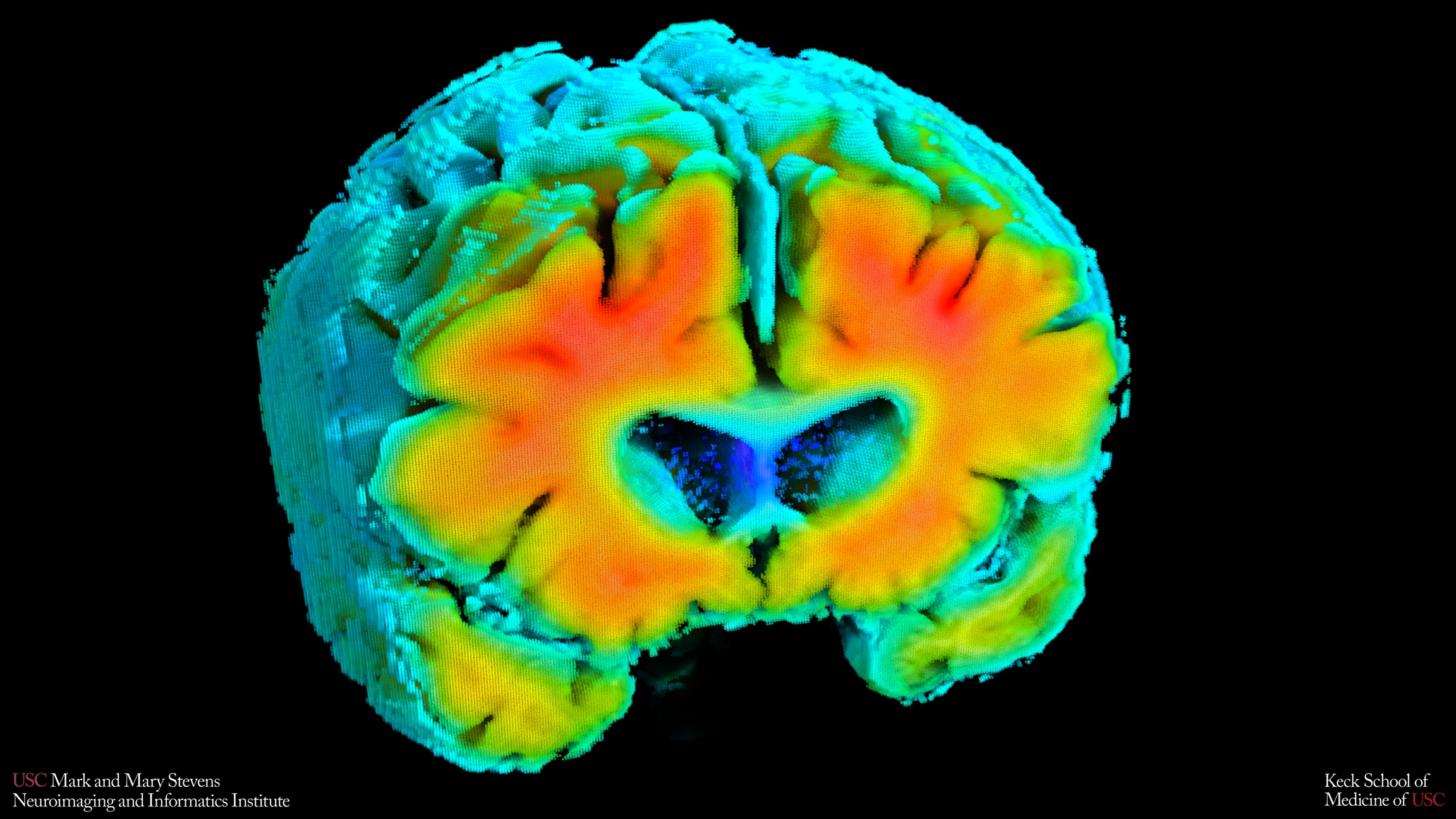
Researchers at the University of Southern California (USC) have found that changes in blood flow and oxygenation of the brain could identify early clues of the development of Alzheimer’s disease and other forms of dementia. Published in the Alzheimer’s and Dementia journal, their approach could offer a non-invasive and low-cost alternative to brain imaging methods used today to detect Alzheimer’s before symptoms appear.
“Amyloid and tau are often considered the primary players in Alzheimer’s disease, but blood flow and oxygen delivery are also critical,” said Amaryllis A. Tsiknia, PhD candidate at USC and lead author of the study. “Our results show that when the brain’s vascular system functions more like it does in healthy aging, we also see brain features that are linked to better cognitive health.”
Tsiknia and colleagues used two non-invasive methods to assess the vascular health of the brain in 292 participants. One was transcranial doppler ultrasound, which measures how fast blood moves through the brain’s vasculature. The other was near-infrared spectroscopy, which measures how much oxygen reaches the brain near the cortex surface. The goal was to estimate the capacity of the brain vasculature to maintain blood flow and oxygenation in response to spontaneous changes in blood pressure and carbon dioxide level while the patient is at rest.
These measurements were then compared to a range of established neuroimaging markers of Alzheimer’s, including hippocampus volume, cortical thickness, white matter hyperintensity, and amyloid beta levels. Results showed that brains with normal vascular function, and therefore a better ability to respond to changes that affect blood flow and oxygenation, were linked to neuroimaging phenotypes linked to a better cognitive status. In particular, strong associations were found with a larger hippocampus volume and lower amyloid burden in patients with markers of healthy vascular function.
“These findings add to growing evidence that Alzheimer’s involves meaningful vascular contributions in addition to classic neurodegenerative changes,” said Arthur W. Toga, PhD, director of the Mark and Mary Stevens Neuroimaging and Informatics Institute (Stevens INI) at the Keck School of Medicine. “Understanding how blood flow and oxygen regulation interact with amyloid and brain structure opens new doors for early detection and potentially prevention.”
Importantly, the two techniques used in the study are much less expensive to perform than MRI and PET scans. They are also non-invasive and do not require active participation from patients, making them a promising alternative to imaging techniques used today, such as MRI and PET scans, especially in large-scale screening efforts as well as for patients who cannot tolerate invasive or more demanding imaging procedures.
“These vascular measures are capturing something meaningful about brain health,” said Meredith N. Braskie, PhD, assistant professor of neurology at the Keck School of Medicine of USC and senior author of the study. “They appear to align with what we see on MRI and PET scans that are commonly used to study Alzheimer’s disease, providing important information about how vascular health and standard brain measures of Alzheimer’s disease risk may be related.”
While results are promising, more research will be needed to validate them. Longitudinal studies are already underway at Stevens INI to determine if the associations found in the current study are consistent over time and can accurately predict cognitive decline and response to therapeutic interventions.
“If we can track these signals over time, we may be able to identify people at higher risk earlier and test whether improving vascular health can slow or reduce Alzheimer’s-related brain changes,” said Tsiknia.
