

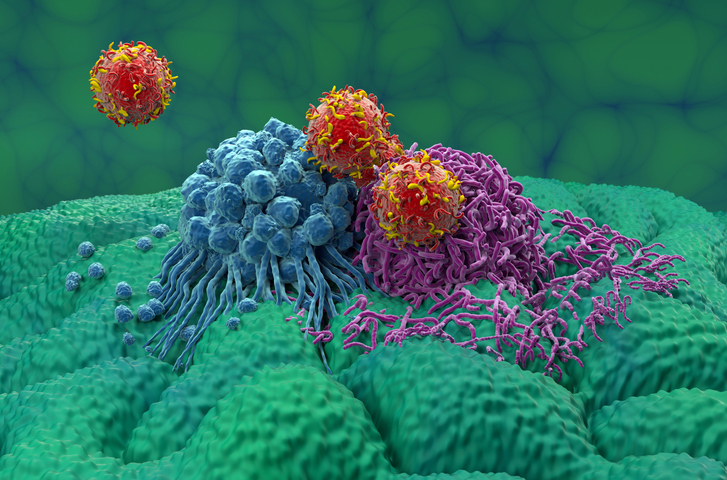
Researchers at UCLA say they have developed a way to prevent cancer immunotherapies from being starved of energy inside solid tumors, addressing a common treatment problem of T cell exhaustion. The findings, published in Cell, showed that giving engineered T cells cellobiose, a glucose disaccharide found in plant cellulose, provided an exclusive source of energy that was inaccessible to cancer cells, allowing immunotherapies to sustain their efficacy.
“A problem with solid tumors is that the immune system tries to fight the cancer, but the tumor cells deplete the key nutrient glucose from their environment,” said senior author Manish Butte, MD, PhD, a professor of pediatric allergy, immunology and rheumatology at UCLA. He further noted that this imbalance leaves T cells with not enough glucose to make cytokines and kill the cancer cells. The team’s solution equips T cells with the ability to metabolize cellobiose, a sugar inaccessible to tumors, restoring their function in low-glucose environments.
One of the key challenges to developing effective T cell therapies is addressing the immunosuppressive microenvironments in solid tumors that inhibit tumor-infiltrating lymphocytes via the “voracious consumption of glucose,” the researchers noted. Since glucose is vital in T cell biology, being outcompeted for this energy source by cancer cells is a significant hurdle for these therapies.
“Glucose is a critical fuel for cellular bioenergetics and a major source of biosynthetic precursors for anabolic pathways,” the researchers wrote. Once they have stimulated antigens, CD8+ T cells shift their metabolism toward aerobic glycolysis to sustain proliferation, cytokine production, and cytotoxicity. But within tumors, cancer cells upregulate glucose transporters and glycolytic enzymes, consuming glucose at high rates which diminishes the availability of this vital fuel for the T cells.
To address this, the UCLA researchers sought to discover whether T cells could be reinvigorated by supplying an “exclusive” glucose source that cancer cells could not access. “We hypothesized that tumor-infiltrating lymphocytes (TILs) could be invigorated if provisioned with an ‘exclusive’ source of glucose that was inaccessible to cancer cells, allowing them to fulfill their role in clearing tumors more effectively,” the wrote.
They settled on using cellobiose since mammalian cells cannot efficiently transport or hydrolyze it because sugar transport is largely limited to monosaccharides and the glycosidic bond in cellobiose resists mammalian glycoside hydrolases.
To test this, the team engineered T cells that provided the capacity to import cellobiose and hydrolyze it intracellularly into glucose effectively providing the T cells with an exclusive energy supply. “We equipped mouse T cells and human chimeric antigen receptor (CAR) T cells with two proteins derived from fungi that enable import and hydrolysis of cellobiose, and we demonstrated that cellobiose supplementation during glucose withdrawal restores key anti-tumor T-cell functions: viability, proliferation, cytokine production, and cytotoxic killing,” the researchers wrote.
To test their design, the investigators conducted both in vitro experiments designed to mimic the nutrient-poor tumor microenvironment with in vivo testing in mouse models of solid cancer. Their data showed that in culture conditions where glucose levels were reduced to concentrations similar to those seen in human tumors, unmodified T cells rapidly lost viability and effector function. Engineered T cells supplied with cellobiose, however, maintained proliferation, produced IFN-γ and TNF, and continued killing tumor cells.
In mouse models, tumor-targeted T cells capable of metabolizing cellobiose slowed tumor growth and prolonged survival compared with standard T cells. Notably, some of the mice showed complete tumor regression. Examination of tumor-infiltrating immune cells showed that engineered T cells were more proliferative and exhibited fewer features associated with exhaustion.
“We demonstrate not only that glucose can be a limiting component of an effective anti-tumor response, but that we can design strategies to bypass the metabolic tug-of-war and deliver a high-value nutrient to T cells engineered with the proprietary metabolic processing system,” said first author Matthew Miller, PhD, a postdoctoral researcher at the Salk Institute for Biological Studies.
This new approach has implications for clinical CAR T therapies, which have been quite effective for treating hematologic malignancies but have shown significantly diminished efficacy in solid tumors. Currently, there are more than 500 clinical trials worldwide testing CAR T cells in solid tumors, many of which are constrained by T-cell exhaustion and metabolic suppression.
“Our method has the potential to benefit virtually any T cell-based therapy being developed for solid tumors,” Butte said. The team envisions further preclinical development to refine gene delivery and dosing strategies, and to explore how exclusive nutrient access might be used to interrogate metabolic interactions in mixed cell populations. If translated to clinical care, the strategy could enable engineered T cells to maintain function in metabolically hostile tumor microenvironments, potentially extending the reach of immunotherapy to solid cancers that have remained resistant.
