

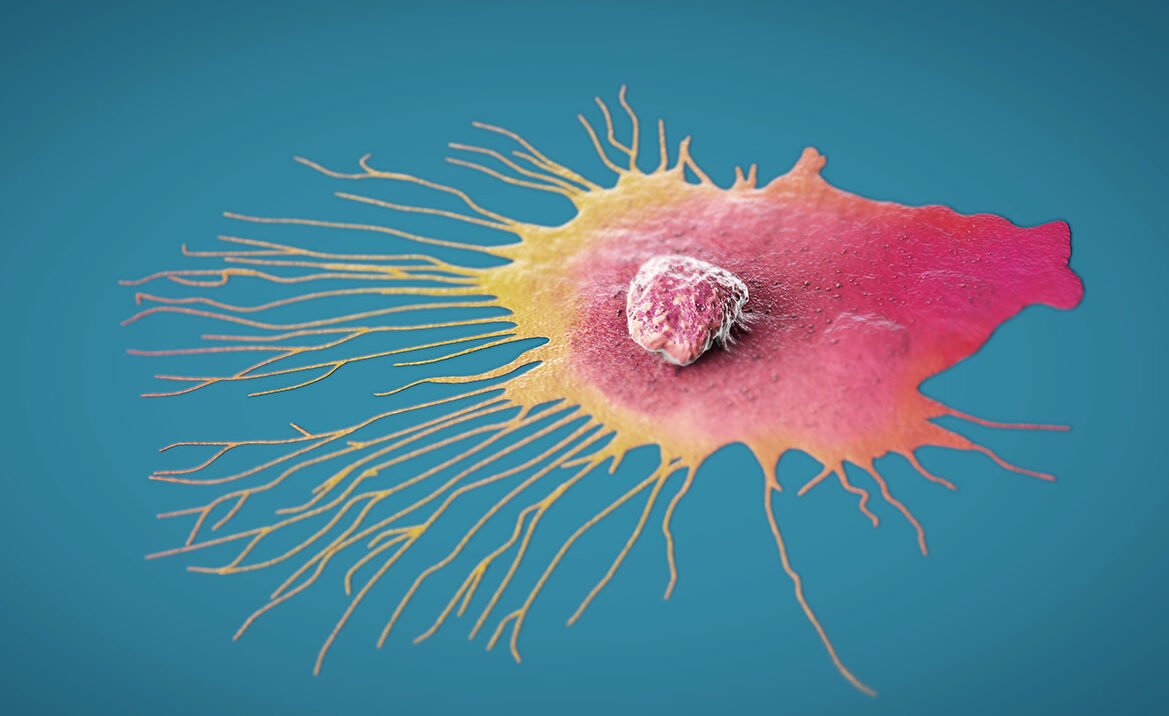
Researchers at The University of Texas MD Anderson Cancer Center have shown that a novel metric, tumor-specific total mRNA expression (TmS), better predicts chemotherapy response than existing methods for defining triple-negative breast cancer (TNBC) subtypes.
The new, pathway-independent tool, developed by Wenyi Wang, PhD, professor of bioinformatics and computational biology, and colleagues, is derived from matched RNA and DNA sequencing data.
“Most existing TNBC classification strategies, such as the Lehmann or Fudan University Shanghai Cancer Center (FUSCC) subtypes, are based on expression patterns of selected genes alone, essentially asking ‘what types of genes are turned on’,” Wang explained.
“Our approach with TmS takes a different angle, asking ‘what is the total expression level summed over all genes’. For TNBC specifically, TmS offers a unique advantage to measure dynamics between the transcriptional activities for tumor cells and those for stromal and immune cells in the tumor microenvironment,” she told Inside Precision Medicine.
Wang and team report in Cell Reports Medicine that, in an analysis of 575 TNBC patients from four ethnically diverse cohorts, TmS separated patients into those with high-TmS tumors, associated with better prognosis, and those with low-TmS tumors, associated with poorer outcomes.
Furthermore, the method outperformed the Lehmann TNBCtype-4 and FUSCC classification subtypes in predicting chemotherapy outcomes and the survival benefit associated with high TmS was consistent across all four cohorts.
By contrast, TNBCtype-4 subgroups of the same patients showed no significant differences in survival outcomes.
“The four cohorts in our study span different ethnicities, clinical treatment protocols, and sequencing platforms, so achieving consistent prognostic findings across all of them was not guaranteed to say the least,” said study co-author Bora Lim, MD, associate professor in the department of breast medical oncology at MD Anderson.
The researchers hypothesized that the distinctions between TmS and previous TNBC classification systems could indicate that the contrasting TmS subtypes may be associated with different biological activities at the cellular level.
“What we found was that low TmS consistently identified an immunosuppressive, extracellular matrix (ECM) enriched microenvironment associated with worse outcomes across every cohort, whereas the immune activation signature characteristic of high TmS was more pronounced in the Western cohorts,” said Lim.
“This suggests that certain biological features captured by TmS are genuinely universal across ethnic populations, while others may reflect population-level differences in tumor–immune interactions that warrant further investigation. That combination of reproducibility and biological nuance was, I think, one of the most compelling aspects of the study.”
The researchers observed that, in Asian cohorts, high-TmS tumors were marked by strong cell cycle–related proliferation programs, while low-TmS tumors displayed features of immune dysfunction, including enrichment of memory B cells and distinct RAS/mitogen-activated protein kinase signaling activation compared with Western cohorts.
They point out that “the ethnicity-specific tumor microenvironment patterns revealed by TmS have important implications for cross-population application of emerging combination therapies.”
For example, Wang and colleagues note that the development of anti-angiogenesis plus anti-PD-L1 combinations predominantly in Chinese patient populations “strongly supports” the findings that Asian low-TmS patients exhibit both vascular abnormalities and T cell dysfunction. However, the authors caution that the same strategy might not be as effective in the Western population.
“These insights emphasize the importance of biomarker-guided, population-aware clinical trial designs to optimize therapeutic regimens across diverse patient groups,” they remark.
The investigators also found that TmS values varied significantly across and within the four cohorts, meaning that the numerical threshold defining high versus low TmS had to be defined separately for each cohort based on the range of the TmS values per study.
“This is an important practical question,” said first author Yaoyi Dai, PhD, graduate research assistant, department of bioinformatics and computational biology. “Our data suggests different cut-offs may be necessary for populations where different biological underpinnings for low-TmS group are identified.
“However, before we can do that, substantial work is still needed to remove confounders between studies such as sequencing platform-specific artefacts and establish a normalization procedure to recalibrate TmS across these studies,” she added.
Wang believes that “in the near term, TmS offers a new lens for understanding why TNBC patients respond differently to chemotherapy. By identifying patients whose tumors present a low TmS, we can potentially flag individuals less likely to benefit from standard chemotherapy or immunotherapy alone, and who may instead be candidates for ECM-targeting strategies or interventions designed to convert the tumor from an immune-cold to an immune-hot state, thereby priming them for subsequent response to immunotherapy.”
“Longer term, if validated in prospective cohorts, TmS could be incorporated into treatment selection algorithms that move beyond the current limited toolkit for TNBC. We may also develop sub-population specific dimension of TNBC biology—uncovered by TmS score that opens a path toward more equitable precision diagnostics,” she concluded.
