

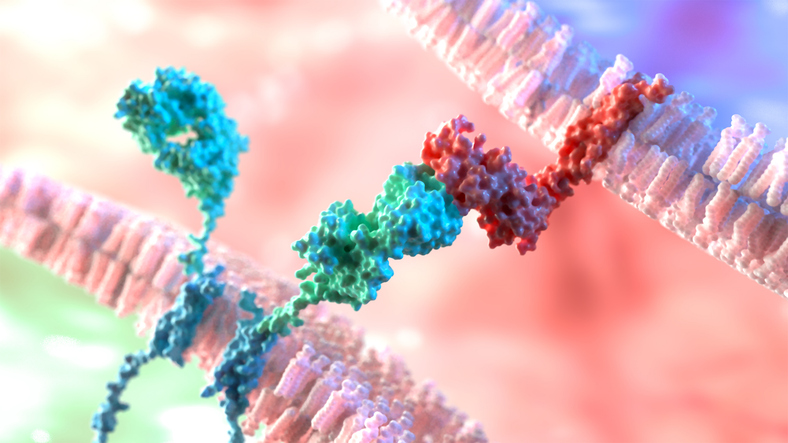
Researchers at the Columbia Initiative in Cell Engineering and Therapy (CICET) have found that a new class of cell therapy can potentially address a major barrier to using CAR T cell therapies for treating solid tumors, the inability of existing engineered T cells to detect cancer cells that express only low levels of a target antigen. The research, published in the journal Science, describe how HLA-independent T cell (HIT) receptors that can sense a very small number of the target molecule CD70 that enabled the killing of heterogeneous kidney, pancreatic, and ovarian tumors in mouse models.
“Curing solid tumors is not easy, but this work solves one piece of the puzzle,” said senior author Michel Sadelain, MD, PhD, director of CICET, and a pioneer in the development of current CAR T therapies.
While CAR T cells have made a major impact in treating a number of hematologic malignancies, their success has not been duplicated in solid tumors. The main reason for this is that in blood cancers targets such as CD19 are expressed uniformly which allows for CAR T cells to be engineered to identify and kill virtually all of the malignant cells. Solid tumors, however, are highly heterogenous and this lack of a single target antigen presents challenges in engineering effective treatments. As Sadelain noted, even if a therapy eliminates 90% of tumor cells, those cells not killed by the therapy will lead to relapse, which points to the need to develop more comprehensive cell targeting.
For this research, the Columbia team focused on CD70, a molecule previously thought to be heterogeneously expressed in solid tumors. While earlier research has suggested that some tumor cells lacked CD70 entirely, Sophie Hanina, PhD, a research associate scientist at CICET and lead author of the study, hypothesized that apparently negative cells might express CD70 below the detection threshold of most testing methods and these low levels would also render them invisible to conventional CAR T cell therapies.
“The properties of an ideal target include (i) expression on all tumor cells, (ii) restricted expression on dispensable normal cells, and (iii) common to many tumor types,” the researchers wrote. “CD70 is potentially one such target, fulfilling criteria (ii) and (iii), but its expression pattern (i) is typically heterogeneous in solid tumors.”
To test this hypothesis, the investigators developed patient-derived xenograft mouse models of kidney, ovarian, and pancreatic cancers with heterogeneous CD70 expression. Conventional CD70-directed CAR T cells eliminated CD70-positive tumor cells but left behind those deemed CD70-negative, recreating the same patterns of resistance seen in clinical settings.
To address this shortcoming of current CAR T cell therapies, Hanina created a new method to detect CD70 and found that all tumor cells examined carried at least low levels of CD70. To effectively attack these cells, the team engineered HIT, a more sensitive receptor design. “HIT cells are the next generation of CAR T cells. They can be programmed like a CAR T cell, but they have the sensitivity of a natural T cell and can detect cancer cells that have only a vanishingly small number of target molecules,” Hanina said.
The team then applied these newly engineered CD70-targeted HIT T cells in the xenograft models, which resulted in complete tumor eradication across all three cancer types, compare with conventional CAR T cells that only achieved partial responses.
To better understand why some tumor cells only have a minute number of target antigens, the Columbia researchers conducted mechanistic studies. “We…determined that seemingly CD70-negative tumor cells retain residual CD70 expression due to epigenetic silencing by EZH2-mediated H3K27me3, which accounts for CAR resistance but HIT susceptibility,” the researchers wrote.
Single-cell profiling of primary kidney cancer samples showed that tumor cells with apparent CD70 negativity had an epigenetic signature consistent with low-level expression, suggesting potential susceptibility to HIT therapy. Safety studies of CD70 chromatin accessibility in normal tissues found limited expression outside activated immune cells. In cytotoxicity assays and a humanized in vivo model, CD70-HIT T cells did not demonstrate greater toxicity than CD70-CAR or CD19-CAR T cells.
“Studies suggest that the escape of undetected cancer cells is the key impediment to therapeutic success with conventional CAR T therapy,” Hanina said. “We hope our CD70-directed HIT cells help us find a way to eradicate the entire tumor.”
The researchers now plan to move from mouse models to in-human testing of CD70-targeted HIT cells in patients with ovarian and other cancers at Columbia University Irving Medical Center.
The team also noted that CD70 is expressed to varying degrees in nearly 20 additional tumor types, including glioblastoma and pancreatic adenocarcinoma, raising the possibility that enhanced-sensitivity receptors could broaden the scope of adoptive cell therapy using this newfound approach.
