

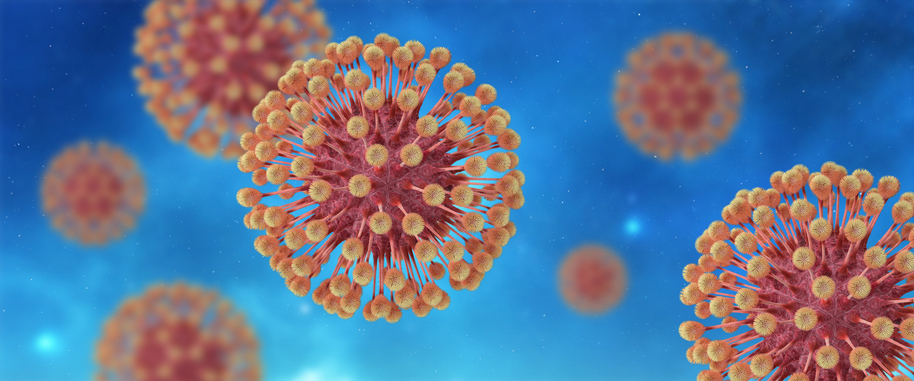
A study headed by researchers at NYU Langone Health has found that herpes simplex virus 1 (HSV-1) partially liquifies the tightly packed, gel-like interior of human cell nuclei to help copy itself faster.
Viruses invade cells and use host genetic machinery to replicate. For viruses that replicate in the nucleus, production and replication can be hindered by the high level of nuclear molecular crowding. The NYU Langone Health team, led jointly by Liam Holt, PhD, a professor in the department of biochemistry and molecular pharmacology at NYU Langone Health and faculty in the Institute for Systems Genetics, along with Ian Mohr, PhD, and Angus Wilson, PhD, professors in the department of microbiology, discovered that HSV-1 uses a protein called infected cell protein 4 (ICP4), which is produced early during infection, to make the human cell nucleus more fluid-like, which in turn makes it easier for the virus to replicate itself.
Their results also showed that blocking the ability of ICP4 to fluidize the nuclear compartment caused a four-fold drop in the number of new viral copies. “We are working now to confirm the mechanism by which ICP4 fluidizes the nucleus, which could give us new, specific targets to physically counter viral replication,” said Nora Herzog, PhD, a recent graduate from the biomedical sciences program at NYU Langone, and now a postdoctoral fellow at Universitat de València Parc Cientific. “We will also be looking to see if this mechanism is used by other viruses that replicate in the nucleus, from double-stranded DNA viruses including the agent responsible for shingles to RNA viruses like influenza virus to retroviruses like HIV.”
Added Holt, “The physical state of the nucleus is a fundamental barrier that this virus must overcome to multiply. Viruses are masters at manipulating cells, and by studying their tricks, we uncover fundamental rules of biology.” Holt told GEN, “If the material properties of the nucleus are a general barrier to virus replication, and viral proteins like ICP4 must alter nuclear biophysical properties to support replication, we may be able to block the proteins that drive these physical changes, potentially tipping the balance in favor of the cell. More speculatively, if we can drive cells to a more solid-like biophysical state (or maintain them in this state) this could be a very general way to create broad-spectrum antivirals.”
Co-senior authors Holt, Mohr and Wilson together with first author Herzog and colleagues, reported on their results in Molecular Cell, in a paper titled “Herpes simplex virus 1 fluidizes the nucleus, enabling condensate formation.”
Viruses can alter cell physiology
“Molecular processes are profoundly influenced by the biophysical properties of the cell interior,” the authors wrote. “However, the mechanisms that control these physical properties and the processes they impact remain poorly understood, especially in the nucleus.” Viruses are obligate intracellular parasites that manipulate host cells to support viral replication. “Viruses can drive extreme perturbations of cellular physiology, including suppression of host cell transcription, translation, and mRNA splicing, as well as changes to chromatin architecture and modifications to cellular histones,” the team further explained.
To multiply, the authors note, viruses need room to build relatively large structures called condensates. The research team chose to study herpes simplex virus 1 because it is one of the most prevalent and successful human pathogens, and they note one study estimating that globally 64% of adults have become infected for life, although many without symptoms.
For HSV-1, condensates serve as temporary factories built inside the host nucleus to mass-produce viruses. If there is enough space to move, small droplets merge into larger ones, which the researchers think gathers the viral reproduction machinery in one place for greater efficiency. “Previous studies showed that viral replication compartments (vRCs) initially nucleate as small pre-RCs and then coalesce into larger vRC condensates,” the investigators explained.
Inflating a balloon in a fishing net
They hypothesized that some viruses might change the biophysical properties of the nucleus to favor virus survival and replication and theorized that HSV-1 makes space by taking advantage of a vital process that comes with structural changes in human nuclei. In the cell nucleus chains of DNA are known to be wrapped around protein spools called histones, all within the chromatin superstructure. In a normal nucleus, the formation of viral condensate factories is hampered by the chromatin network, like trying to inflate a balloon inside a tight fishing net.
“Our previous work has shown that the physical properties of the cell interior can change, and are actively controlled to globally regulate biological processes,” Holt said, speaking with GEN. “This led us to ask whether viruses, as expert manipulators of host cell processes, might also alter the biophysical state of the cell to subvert cellular processes towards their own replication. Work from Lynn Enquist’s group showing that the chromatin network was changed to help the movement of large HSV-1 capsids out of the nucleus at the late stages of infection made us curious about the biophysical state of the nucleus specifically, and since very little was known about nuclear biophysical regulation during infection, we felt well-positioned to investigate it. We also know very little in general about the regulation of the physical properties of the nucleus; there’s a long history of using viruses to discover fundamental mechanisms of cellular control (e.g. the discovery of oncogenes and tumor suppressors that control cell division and cancer), so we reasoned that viruses could help us to elucidate physical regulation, too.”
To measure the physical properties of cell nuclei, the research team engineered the cells to produce glowing protein nanoparticles called nucGEMs. They recorded videos through microscopes to track the degree to which these particles moved as a measure of how much the dense nuclear environment slows down motion. When the team infected the cells with HSV-1, the glowing particles bounced around to a much greater degree.
ICP4 is required to fluidize infected cell nucleus
Further analyses demonstrated that the HSV-1 protein ICP4 is needed to fluidize the infected cell nucleus. ICP4, the study authors suggest, can prepare human nuclei for viral replication because it attaches to the proteins that get human cells ready for transcription, the process by which a stretch of the gene code gets read by the cell’s machinery to pass on its message.
For any piece of genetic code to be read, its surrounding chromatin must get the signal to unwind, which makes the DNA accessible to the transcription machinery. Previous research had found that ICP4 attaches to the protein machinery that executes this chromatin unwinding, changing the structure and motion of chromatin. The team’s newly reported study found that ICP4 alone caused chromatin motion to increase, correlating with the increase in nucGEM movement. Importantly, however, the authors did not see changes in the global rate of the transcription .
ICP4 can, they say, by itself and separately from other known processes, efficiently change the properties of the infected nucleus very early in infection to help viral replication. Specifically, the team showed that “the HSV-1 protein ICP4 caused fluidization and enabled the growth of synthetic nuclear condensates,” tying the observed changes in the nucleus driven by ICP4 directly to the biophysical process of condensate formation. They also showed that blocking fluidization reduced viral replication. “Conversely, conditions that decreased nuclear fluidity inhibited the growth of viral replication compartment condensates and reduced infectious virus production,” they stated. These findings further demonstrated that fluidization of the nucleus is important for virus infection, as inhibiting fluidization results in reduced condensate formation and a corresponding decrease in virus production.
The results collectively demonstrate that “… ICP4 can change nuclear biophysical properties to drive condensate formation,” Herzog noted. “Condensate formation is important for HSV-1 replication. Therefore, ICP4 is enhancing HSV-1 replication by driving formation of viral condensates.”
The researchers suggest that their newly reported findings, combined with those of previous research, indicate that viral ICP4 attaches to the protein complexes that unwind DNA around histones, not to enable access to genes, but just to cause the unwinding. This motion changes chromatin’s physical properties, loosening the nuclear interior to make possible viral condensate size increases. “We hypothesize that ICP4 alters the nuclear biophysical properties through interacting with these chromatin remodeling complexes,” Herzog noted. “However, this interaction with the chromatin remodeling complexes may have consequences for transcription as well as increasing local chromatin stirring—we don’t know enough to say it is only one thing or the other.
In summary the team wrote, “Using a synthetic system, we confirmed that ICP4 expression is sufficient to increase the efficiency of nuclear condensate formation. We also showed that condensate coalescence increased during ICP4-driven fluidization, while preventing nuclear fluidization frustrated HSV-1 vRC growth and maturation. These data suggest that HSV-1 fluidizes the nucleus to enable the growth, maturation, and efficient function of vRCs, thus driving progression of the virus life cycle.”
Figuring out how ICP4 changes biophysical properties
Speaking to GEN, Holt commented, “Because ICP4 expression alone is sufficient to fluidize the nucleus and promote phase separation, our findings raise the intriguing possibility that other viruses have evolved their own direct mechanisms for tuning host cell biophysical properties to support condensate formation and boost replication. More broadly, our work suggests that local biophysical properties may be a generalizable lever for controlling transcriptional programming or nuclear organization, which opens up exciting questions about how widely this strategy is used across virus families. Finally, if we can figure out how ICP4 changes nuclear biophysical properties, this may lead to the discovery of the fundamental mechanisms of physical control of the nucleus.
“We are currently investigating whether other nuclear-replicating dsDNA viruses induce the same nuclear fluidization we observed with HSV-1. We are also working to pin down the precise mechanism behind this fluidization, and while we outline our leading hypotheses in the paper, establishing a definitive causal relationship is the focus of ongoing work. We are also working generally on how the physical properties of the nucleus are controlled in normal biology (without virus infection).”
