

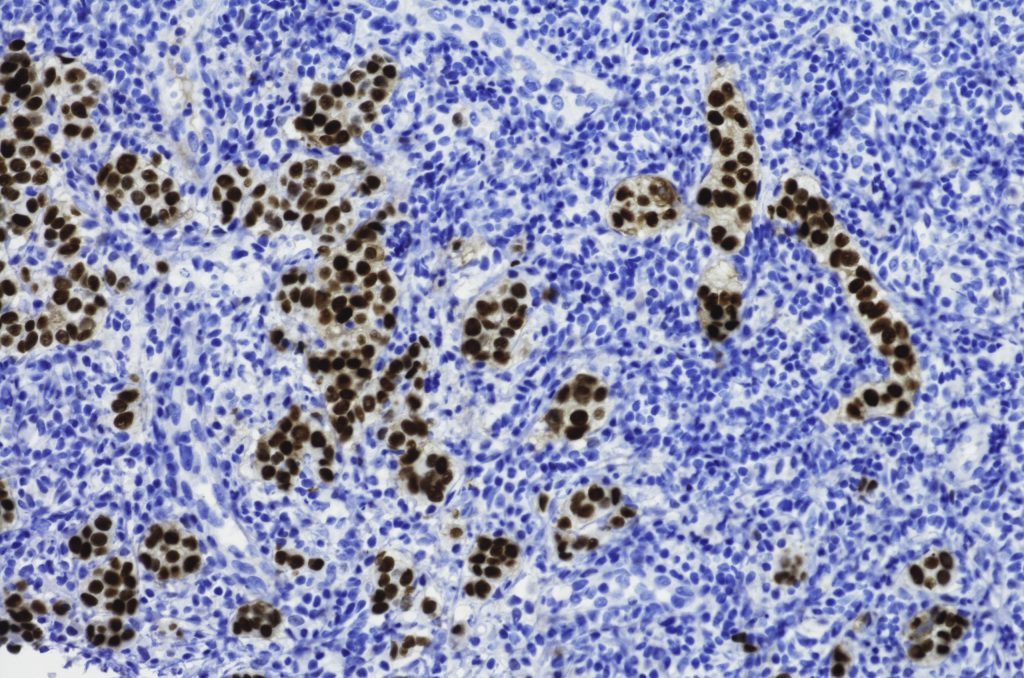
A research team from Dana-Farber Cancer Institute has identified a mechanism by which tumor cells that spread from triple negative breast cancer (TNBC) evade the immune system and highlighted a potential strategy to target these cells before they seed cancer in distant sites. The research, published in Nature, showed that disseminated tumor cells (DTCs) activate the glucocorticoid receptor (GR), which protects them from attack by cytotoxic immune cells. Using the FDA-approved drug mifepristone to inhibit GR, the researchers were able to sensitize these tumor cells to immune clearance and reduce metastatic burden in mice.
“Disseminated tumor cells (DTCs) are cancer cells that leave the original tumor mass (in the breast for breast cancer or in the colon for colon cancer) and travel to another organ such as the lungs, brain, or liver where they become the first initial seeds of metastasis, said the study’s senior author Judith Agudo, PhD, associate professor of immunology at Dana-Farber Cancer Institute and Harvard Medical School. “We were interested in studying these cells when they first reach a new organ and exist as only single cells or small clusters of cells before they grow into detectable cancer. This means that DTCs are inherently rare, and finding these few cells within the entire organ is challenging.”
For their work, the researchers used RNA sequencing and epigenetic profiling in combination with a novel labeling platform called Jedi to identify tumor cells that survived immune attack. By tagging tumor cells with green fluorescent protein (GFP) and exposing them to GFP-specific CD8+ T cells, the researchers were able to track rare DTCs and determine why they were able to avoid immune response. The collected data from their study showed that GR activation suppressed the death receptor Fas, which is normally engaged by both CD8+ T cells and natural killer (NK) cells to induce cell death. “We discovered a novel mechanism of immune evasion that operates specifically in DTCs, illustrating the unique immune-cancer interactions at this stage in the metastatic cascade,” the researchers wrote.
Previous research has mostly focused on immune suppression within the primary tumor, but DTCs must survive outside the tumor microenvironment in order to seed distant sites for tumor growth and this require adaptations different to those found in the primary tumor. “GR represses FAS-mediated cell death, allowing escape from Fas-FasL killing by both CD8+ T cells and NK cells,” the researchers wrote, adding that this mechanism may be widespread in metastasis given prior reports of FasL-mediated immune clearance in liver and brain metastatic models.
Building on these findings, the team then tested whether pharmacologic inhibition of the GR could prime the DTCs for immune attack. Mifepristone, already approved for indications including Cushing’s disease, was chosen because it is a potent GR inhibitor. In mouse models, treatment with mifepristone alone or in combination with an anti-PD1 checkpoint inhibitor reduced micro-metastatic lesions and extended survival. “Treating mice with mifepristone to inhibit GR synergized with anti-PD1 immunotherapy to reduce metastatic seeding by DTCs and extended survival of mice,” Agudo said.
The researchers noted that the GR activity signature they identified, adapted from prior work in both mice and humans, could also provide the basis for future diagnostic development. “Our analysis of transcriptional data from patients did show a correlation between higher GR activity and likelihood of metastasis and worse outcomes in patients,” Agudo said. While more research and clinical validations is required, GR could become a biomarker to help identify patients that are at higher risk of metastatic TNBC, which could help guide treatments.
The researchers also connected GR activation to chronic stress and its potential effects on metastasis. GR requires binding by glucocorticoids, stress hormones that increase during cancer progression. Higher GR activity enhances the survival of DTCs and could increase metastatic potential. “While our work did not investigate the production of GCs, it demonstrated that GR activity in metastatic seeds makes them stronger to overcome elimination by the immune system. Thus, if a patient has high GCs, that increases GR activity, and based on our experiments, that will augment the number of metastatic seeds,” Agudo said.
Next steps for the Dana-Farber team include to expanding their findings of DTC immune evasion into other cancer types, including colorectal and skin cancers, and to further explore how GR activity functions in later stages of metastasis.
“The long-term goal would be to find strategies to prevent metastasis, or even cancer altogether, in at-risk individuals,” Agudo said. “As it relates to GR, it would be interesting to understand how GR activity plays a role in other solid cancer types, at other metastatic sites, and at later timepoints as DTC seeds grow into detectable metastatic tumors. This would further inform the appropriate timepoint(s) and setting(s) for mifepristone administration in patients, potentially expanding its use beyond metastatic seeding in triple negative breast cancer.”
