

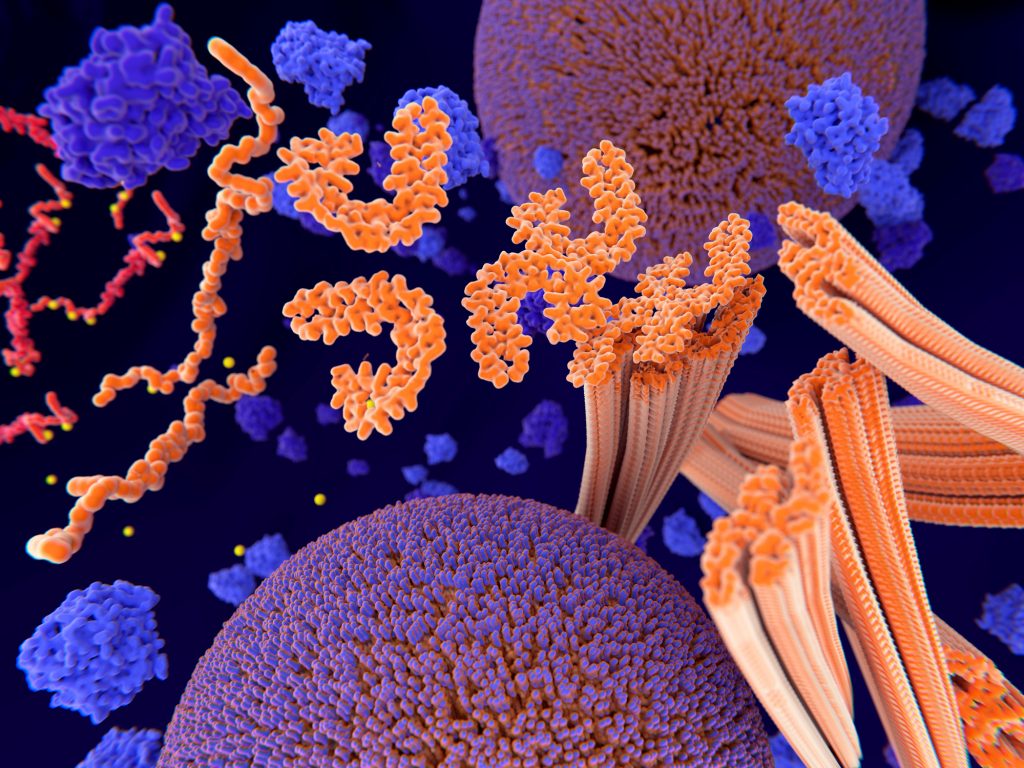
Researchers at Baylor College of Medicine have found that tubulin, a vital part of the neuronal cytoskeleton, can prevent the formation of toxic protein aggregates linked to Alzheimer’s disease (AD) and Parkinson’s disease (PD) by redirecting two disease-associated proteins toward their normal cellular roles. The findings, published in Nature Communications, describe how tubulin alters the behavior of tau and alpha-synuclein within microscopic cellular droplets known as condensates, preventing them from forming harmful clumps and instead promoting microtubule assembly, a potentially new approach for treating these neurodegenerative diseases.
“Tau and alpha synuclein are well known for their roles in neurodegenerative diseases like Alzheimer’s and Parkinson’s. In these conditions, these proteins can misfold, stick together and form harmful aggregates that damage neurons and contribute to memory loss, movement problems and other symptoms,” said first author Lathan Lucas, PhD, postdoctoral associate of biochemistry and molecular pharmacology at Baylor. “But tau and alpha synuclein also fulfill essential functions in healthy neurons—they help maintain cell structure and support communication by interacting with tubulin and contributing to microtubule assembly and stabilization.”
Tau and alpha-synuclein are neuronal proteins that are the hallmarks of both AD an PD, but they are also known to interact with microtubules, structures in the brain that are used for neuronal transport and organization.
The Baylor study focused on the role of proteins that undergo phase separation form condensates, concentrated droplet clusters comprising proteins that form inside of cells without membranes. Concentrates help regulate cells processes, but they can also create conditions that promote aggregation.
Within these droplets, tau and alpha-synuclein can interact with each other and form the aggregates that lead to disease development. Previous research has examine the potential to prevent the formation of condensates, and hence the accumulation of aggregated proteins, as a method to treat AD and PD.
“This led us to the following idea: what if instead of preventing the formation of droplets, we created conditions that would drive Tau and alpha synuclein inside the droplets toward their healthy path, discouraging them from taking the disease path?” said senior author Allan Ferreon, PhD, an assistant professor at Baylor College of Medicine.
To see if they could influence this process, the researchers first tracked protein interactions and structural changes in condensates over time to understand how the presence or absence of tubulin influenced the formation of tau and alpha-synuclein complexes.
They found that when tubulin was absent, tau-driven condensation accelerated the formation of pathological complexes and amyloid fibrils. But when tubulin was present, the proteins behaved differently. Instead of forming amyloid fibrils, the proteins assembled into structures that supported microtubule formation.
“When tubulin levels are low, as it has been found in Alzheimer’s disease, microtubules are less abundant and tau and alpha synuclein can form toxic aggregates,” Lucas said. “But when tubulin is present, tau and alpha‑synuclein shift away from harmful aggregates and instead promote the assembly of healthy microtubules,” Lucas said. “Tubulin redirects the activity of these proteins by giving them something productive to do.”
The study leveraged and built upon previous research that has shown that AD “consistently correlates with reduced α- and β-Tubulin levels, reflecting the progressive degeneration of neuronal microtubule networks,” the Baylor team wrote. Multiple studies have reported decreased tubulin levels in affected brain regions using a range of techniques including mass spectrometry, Western blot analysis, immunohistochemistry, and RNA sequencing. These changes can appear early in disease progression and intensify as neurodegeneration advances.
“Our findings significantly shift tubulin’s role in neurodegeneration, from a passive structural casualty of disease to an active protector against toxic protein aggregation,” Ferreon said.
The new findings suggest new potential pathways to treating neurodegenerative diseases to either stabilizing microtubule agents, or to restore tubulin levels or its activity—as opposed to indiscriminately blocking condensate formation—to promote tau and alpha-synuclein to perform the normal physiological roles.
The team will now look to see how tubulin affects other protein condensates that have been implicated in neurodegeneration. They also will seek to better understand the mechanisms that can shift condensates from pathological to physiological states.
