

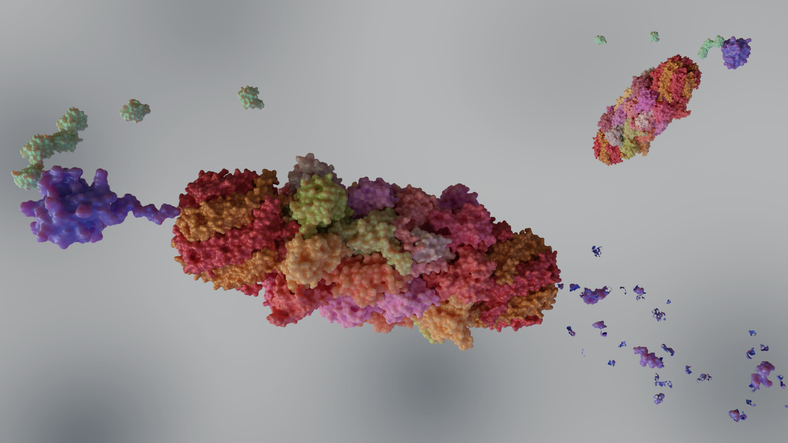
To block disease-causing proteins, many drugs have targeted specific motifs that are hard to reach and involved in protein activity and regulation for decades. Yet many of the most impactful proteins in human disease remain undruggable. Wouldn’t it be a lot easier if all of the protein’s surface was part of the chemical space for designing drugs instead? Instead of targeting dynamic functional domains like enzyme active sites, receptor ligand-binding sites, or allosteric sites to inhibit these proteins, a new class of drugs aims to remove them from the cell.
Targeted protein degradation offers a different solution: instead of trying to inhibit a protein’s activity, remove the protein entirely. These technologies harness the cell’s ubiquitination pathway, which normally tags unwanted proteins for destruction. Molecular glue degraders (MGDs) are small molecules that bring a disease-causing protein into proximity with an E3 ligase, triggering it to be labeled and broken down by the proteasome. Rather than temporarily blocking function, the approach eliminates the target protein altogether—potentially opening the door to drugging biology long considered “undruggable.”
Monte Rosa Therapeutics is one of the companies advancing this strategy. Led by CEO Markus Warmuth, MD, the Boston-based biotech has built a discovery platform designed to systematically identify new molecular glue interactions and translate them into drug candidates. Its pipeline now spans oncology and immunology, including programs targeting GSPT1 in cancer and VAV1 and NEK7 in inflammatory diseases. In this Behind the Breakthroughs episode, Warmuth discusses MGDs, their limitations, and their potential advantages over inhibitors and other targeted protein degradation technologies like PROTACs. Warmuth also discusses Monte Rosa’s pipeline selection, autoimmune programs, and why he thinks this modality could dominate drug development.
This interview has been edited for length and clarity.
IPM: How do MGDs compare to small molecules as well as protein degradation targeting technologies?
Warmuth: MGDs are all small molecules. They’re typically smaller than PROTACs or heterobifunctional molecules to begin with, so there’s a lot of room to play with. The most relevant limitation is cellular compartments. Most of the examples out there, and at least for now everything in our portfolio, are intracellular proteins. It’s harder, but likely not impossible, to go after membrane proteins. We’re actually working on some of these examples. The ligase we mostly work with, cereblon, can attract cell membrane proteins and ubiquitinate them. That’s been shown with PROTACs and some MGDs. On the intracellular side, secreted proteins also tend to be less accessible because of the way they’re produced. I wouldn’t necessarily say it’s absolutely impossible.
The other limitation is chemical space. Companies like Novartis started with libraries of somewhere around 3,000, maybe 5,000 molecules. We’ve heard from different directions: others have already explored the space; it seems like all the chemical space has been explored, so why bother? I don’t think so. Our library is now beyond 100,000 molecules. I wish we were able to synthesize many more. That’s just a function of how much funding we can dedicate to synthesizing a library and testing it out and learning from it versus investing in an existing program. So I think there’s the compartment limitation and then a bit of the chemical space limitation.
I think both of them will be taken care of over time. I do think that the opportunities for molecular integrators in general are very strong. I don’t think Monte Rosa alone can address them. We need a couple more Monte Rosas out there. But I do think that because of the convenience of making orally available drugs, this will become a very dominant modality in the industry over time.
IPM: What are the benefits of eliminating a protein with small molecules like MGDs over inhibiting it?
Warmuth: Once you’ve taken out a protein, it can’t be active until it’s resynthesized. Unless the protein comes back within minutes—which is rare—you get sustained inhibition. That’s why with a once-daily pill you can get complete pathway inhibition 24/7 with something like MRT-8102. That’s harder with a small-molecule inhibitor because you need enough potency and exposure to inhibit the active site continuously for 24 hours.
Another advantage is that with molecular glue degraders we can measure it directly. We can take a blood sample after 24 hours and ask whether the protein is still gone. With inhibitors you usually see exposure curves and estimates of IC50 or EC90, and companies infer activity from plasma levels. But those comparisons are flawed because they compare plasma exposure to in vitro activity. Being able to ask directly whether the protein is still gone after 24 hours makes life much easier.
The main limitation would be if degradation itself were toxic and the protein took a long time to come back. But that’s not different from an antibody with a long half-life. That’s something you address preclinically. With a solid safety package and the PK/PD advantages of degraders, those long-lasting pharmacodynamic effects are often better than what you get with a small-molecule inhibitor.
IPM: How does Monte Rosa pick MGD targets?
Warmuth: We come from two directions. One is the target space that’s really relevant in human diseases. Where do we have good preclinical or even clinical validation for a target we’d like to pick for our portfolio?
But there also needs to be a consideration of what’s actually possible today with the chemical space and the understanding we have. If someone came to me today and said, can you make a molecular glue degrader for KRAS, I have to say no. Based on everything we know so far, for the ligases we have at our disposal and the chemical space that we have created, that’s not a possibility.
What we really have to do is merge that interesting target space with the space that is accessible today. Today’s accessible space is likely smaller than tomorrow’s or the day after tomorrow’s space. What we can target is a function of time, because it’s also a function of how many ligases we have at our disposal and how much we have developed the chemical space for them. We do cereblon and we have another ligase now that we know is druggable. We’ll probably add another two to three over the next couple of years. As the chemical space grows, the accessible space will grow as well.
A good example in our portfolio is IKZF1. It’s super highly validated through many preclinical studies. Mouse knockouts completely protect from autoimmune diseases. It’s a target that was well known and very high on the radar of many strategic big pharma companies, but completely undruggable. Many companies tried and always failed.
For me that’s the sweet spot of targets we get excited about: highly validated, good data out there, some understanding that there is interest from strategic partners, and then starting to see that the target is accessible on our platform.
IPM: How is Monta Rosa using its discovery engine, Quantitative and Engineered Elimination of Neosubstrates (QuEEN) to build its own portfolio and create partnerships?
Warmuth: It can go multiple ways. Internally, sometimes the platform reveals something unexpected. VAV1 is a good example. I had known about the target, but we never screened for it. Through our AI platform and proteomics, we realized we had molecular integrators that could target it. So we decided to work on it.
Sometimes it’s the opposite. We identify a highly validated target and run a screen. Cyclin E1 is an example. It’s highly validated and amplified in cancers like ovarian cancer. We screened and found a single hit in our library. Our library is good enough that we trust singletons, and over a couple of years we turned that into a development candidate. So there are different ways to build the portfolio.
Partnerships work best when someone comes to us and says they want us to pursue a particular target they’ve dreamed about for a long time, but they also want to know what else our platform could target.
The deal we signed with Novartis at the end of last year reflects that well. They had a target they were very keen on addressing. I wasn’t sure we could do it, but we tried. I can’t name the target, but we now have good degraders about six months later. And other interesting things have emerged from the platform that could also be of interest to Novartis.
That’s the best way to utilize the platform: pursue specific goals but also stay pragmatic and capture opportunities the platform reveals.
IPM: How do Monte Rosa’s autoimmune programs compare with the rest of the therapeutic landscape?
Warmuth: If you look at the therapeutic landscape in autoimmune diseases today, historically we had drugs like methotrexate that essentially poison immune cells. They work but have side effects. There are small molecules like JAK inhibitors and TYK2 inhibitors, but they can be broadly active or not potent enough to have a major impact. Although recently there have been breakthroughs with TYK2. Then there are biologics. Those are more limited because they typically go after a single cytokine receptor or eliminate B cells. CAR T cells are the extreme version—like a sledgehammer approach to autoimmune therapy.
With VAV1, we’re trying to interfere selectively with a signaling node that is crucial in Th17 T cells and their signaling to B cells. That’s what excites us. Across many immune cell assays, we see this being quite selective for the Th17 response. In mouse models we seem to address every autoimmune disease we’ve tested so far. We’re not impacting vaccine responses in mice. If you have an immunomodulatory drug that still allows you to respond to vaccines, that’s close to a dream scenario. That’s what MRT-6160 targeting VAV1 appears to offer, although there is still a lot of work to do in the clinic.
Some of this is modality-related. It’s an oral drug, a once-daily pill. It’s not expensive to manufacture and it’s easy for patients. Whether it’s cancer, autoimmune disease, or cardiovascular disease, taking a pill once a day is better than injections. Some modalities like CAR T therapies can have a huge impact but also major toxicity. There’s always a risk-benefit calculation.
For molecular glue degraders, there are advantages. From a molecular size point of view, it’s not hard to make them orally available. Our entire portfolio is orally available, and we intend to keep it that way. From a biology perspective it’s also interesting. We’re targeting GSPT1, which regulates translation termination. It’s critical for protein synthesis but not for all proteins. When we remove GSPT1, only a subset of proteins is affected, particularly oncogenic proteins. Through GSPT1 we can take out multiple oncogenic proteins at the same time—MYC, cyclin D1, and others in prostate cancer. It’s like a combination therapy in a single pill.
Between the modality, the biology, and the convenience of a once-daily pill, it’s an elegant approach to treating castration-resistant prostate cancer.
IPM: The day we recorded this interview in late February, Monte Rosa came out with new clinical data. What is the news, and what does it mean for the company?
Warmuth: We have interesting data. The Phase I study of our GSPT1 degrader MRT-2359 in combination with enzalutamide in metastatic castration-resistant prostate cancer (mCRPC) shows a very significant signal in patients with mutations in the androgen receptor (AR). We have a 100% response rate. It’s small numbers—five out of five patients with an AR mutation having a PSA response. Their PSA levels go down. Each of these patients also has tumor shrinkage by RECIST (Response Evaluation Criteria in Solid Tumors) criteria. Two of them had shrinkage that was called out as partial responses.
It’s very exciting. These are heavily pretreated patients. We required every patient in the trial to have measurable visceral disease, which sets you up for the most disadvantaged patients from a prognosis point of view. Seeing that signal is very exciting. You also have to remind yourself that this is the first time a molecular glue degrader has been tested in a solid tumor setting. Celgene and BMS historically focused mostly on hematologic malignancies. This is the first proof of concept for an MGD in a solid tumor setting. It’s good proof of concept that using this modality in cancer is an option.
We also have immune programs where immune cells are active in tissues as well as blood. It’s good to see across our portfolio—with positive data on MRT-2359 and our two immune assets, MRT-6160 targeting VAV1 and MRT-8102 degrading NEK7 in the NLRP3 pathway—that we have achieved clinical proof of concept. That opens up opportunities for us to expand our portfolio. From a safety and selectivity point of view, we understand that we’re not restricted to oncology. Our molecules are selective and safe enough that moving into non-tumor indications like autoimmune diseases, cardiovascular settings, neuroscience, and possibly other indications is more than a possibility.
