

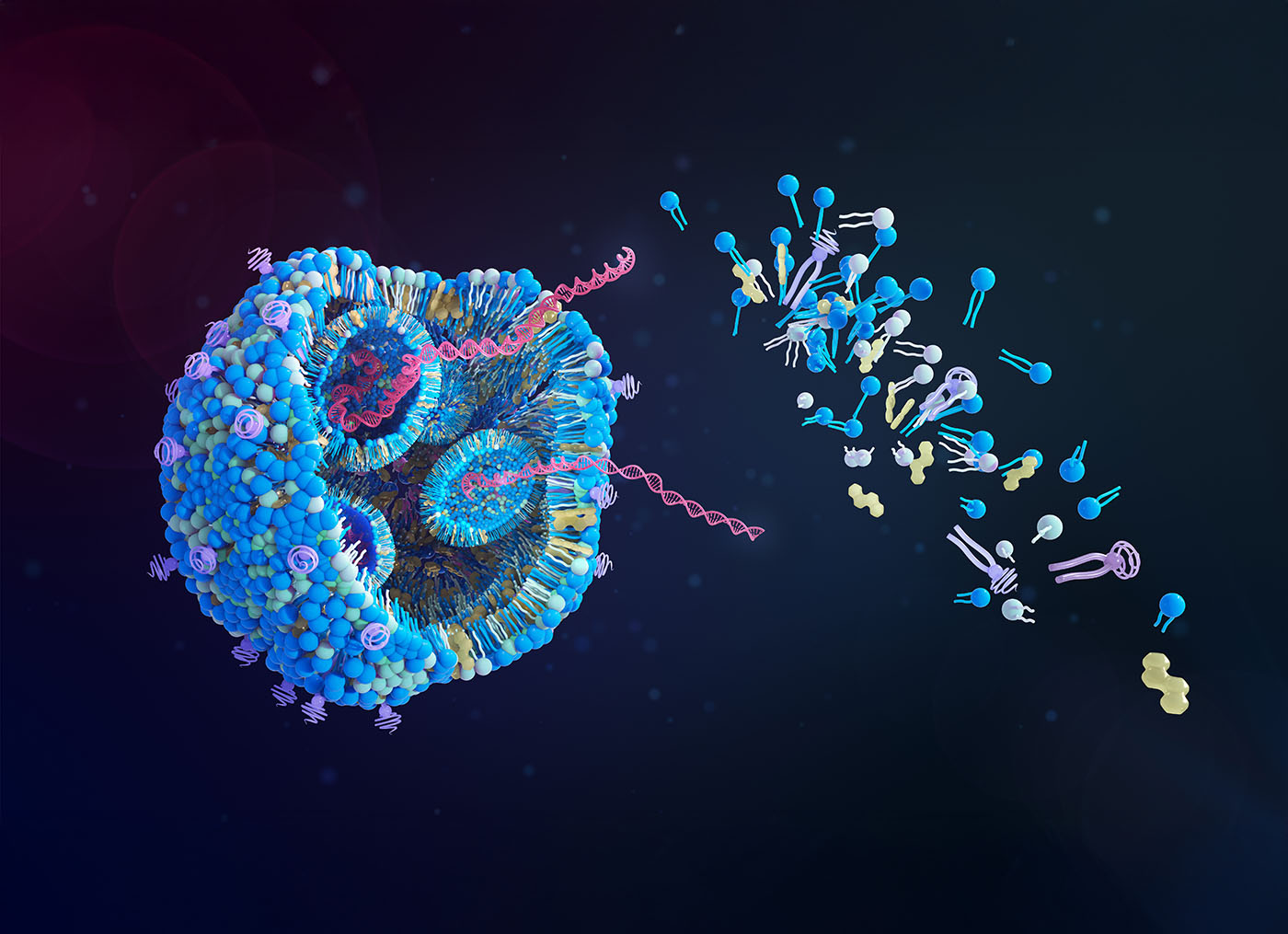
Lipid nanoparticles (LNPs) act as carriers for mRNA and CRISPR payloads across a wide range of therapeutic applications, from cancer to inflammatory and genetic diseases. The same delivery system used in COVID‑19 vaccines is now being adapted for other, more complex targets, but one challenge persists: LNPs transfer their cargo into cells far more readily in the lab than in the body. What makes in vivo delivery so much harder?
A new study from Biohub may have uncovered a surprisingly simple way around this barrier. From Science Translational Medicine, in a paper titled “Amino acid supplementation enhances in vivo efficacy of lipid nanoparticle‑mediated mRNA delivery in preclinical models,” the team reports that co‑injecting three common amino acids with LNPs dramatically boosts both mRNA delivery and CRISPR gene editing efficiency.
“Gene editing and mRNA‑based therapies will play increasing roles in the medicine of the future, but they require LNPs to reach and enter cells,” said Shana O. Kelley, PhD, president of bioengineering at Biohub and head of Biohub Chicago, in a press release. “Any LNP formulation being developed today could potentially benefit from our approach.”
Rather than redesigning the nanoparticles themselves—a major focus of the field—the researchers asked: Could the body’s own metabolic environment be making cells less receptive to LNP fusion?
“By asking why LNPs perform so differently in the physiological milieu of the body, we found a surprisingly simple answer that could make a wide range of mRNA and gene editing therapies substantially more effective,” said Daniel Zongjie Wang, PhD, who leads Biohub’s Spatiotemporal Omics Group.
The team discovered that LNP performance hinges on the metabolic context of the target cells. In nutrient‑rich culture media, LNPs enter cells efficiently, but when the researchers used a plasma‑like medium that mirrors physiological conditions, uptake dropped sharply. “Using an in vitro system, we found that simulated physiologic metabolic conditions led to the down-regulation of certain amino acid metabolic programs,” the authors wrote. Combined metabolic and genetic analyses pointed to suppressed amino acid metabolic pathways under these conditions, suggesting that the body’s leaner metabolic environment makes cells less receptive to LNP internalization.
“Supplementation with an optimized formulation of methionine, arginine, and serine (AAS) enhanced the uptake of LNPs and the expression of delivered mRNA cargo in epithelial cells in vitro,” the authors wrote. Co-administering the amino acid supplement with LNPs produced a 5‑ to 20‑fold increase in mRNA expression across multiple cell types and lipid formulations, both in vitro and in vivo. The effect held across intramuscular, intratracheal, and intravenous routes of administration.
Mechanistic studies suggest the amino acid cocktail enhances a clathrin‑independent, carrier‑mediated endocytic pathway, increasing the efficiency with which cells internalize LNPs.
The in vivo tests underscored how strongly the metabolic intervention reshaped LNP performance. In a mouse model of acetaminophen‑induced liver injury, LNPs carrying growth hormone mRNA yielded a 33% survival rate. Pairing the same formulation with the amino acid cocktail shifted the outcome entirely: 100% of treated mice survived, accompanied by markedly elevated serum levels of the therapeutic protein and reduced liver damage markers.
A lung‑targeted gene‑editing experiment showed a similar jump in efficiency. Standard LNP delivery of CRISPR–Cas9 components produced the 20–30% editing typically reported for this approach. With the amino acid mixture, editing climbed to 85–90% after a single dose, approaching the levels needed for diseases such as cystic fibrosis.
As the authors noted, the findings highlight the importance of the metabolic environment in LNP behavior and suggest that tailored co‑formulation strategies may offer a straightforward way to improve mRNA‑based therapeutics across a wide range of diseases. “The field has spent enormous effort engineering nanoparticles,” said Wang. “We found, however, that the cell’s own metabolic state is an equally important—and addressable—part of the equation.”
