

A major mechanistic influence on aging is epigenetic change. For older individuals, who are most at risk for developing neurodegenerative disease, understanding the full mechanisms behind aging could lead to a better understanding of disease biology and ultimately more effective treatments. To that end, scientists at the Salk Institute and their collaborators at other institutions, have created what they describe as the most comprehensive single-cell atlas of epigenetic changes in the aging mouse brain. The map reveals how DNA methylation, genome structure, and gene activity change across brain regions and cell types.
Details of the work are published in a new Cell paper titled “Cell-type-specific transposon demethylation and TAD remodeling in aging mouse brain.” The atlas represents eight brain regions and 36 distinct brain cell types with over 200,000 single cells profiled across methylation and chromatin conformation assays, plus nearly 900,000 cells captured with spatial transcriptomics. The atlas is publicly available on Amazon Web Services and the Gene Expression Omnibus, where it will serve as a critical reference framework for interpreting human brain datasets, including those generated by the National Institute of Health’s Brain Research Through Advancing Innovative Neurotechnologies Initiative.
“The brain is so interconnected, with different regions controlling different functions and aging at different speeds at the cell type level,” said Margarita Behrens, PhD, a research professor at Salk and a co-corresponding author on the paper. “We can see how interconnected the brain is in conditions like Parkinson’s, where the death of one group of neurons spirals into an entire circuit malfunctioning and then the tremors and cognitive effects we see in patients. So, the importance of having a cell type-specific understanding of aging will bring more granular knowledge that will expand therapeutic possibilities.”
Resources like this atlas are critical for research since neurodegenerative diseases affect more than 57 million people globally, and the incidence of these diseases is expected to double every 20 years, according to one estimate. “Age-related brain changes, particularly in regions critical for attention, memory, emotion, and motor functions, severely impact life quality,” said Joseph Ecker, PhD, a professor at Salk, a Howard Hughes Medical Institute Investigator, and co-corresponding author on the paper. “By mapping how the epigenome changes across individual brain cell types as animals age, we now have a framework for understanding how aging reshapes the brain at the molecular level. This resource should help researchers pinpoint mechanisms that contribute to neurodegenerative disease.”
To generate the atlas, the scientists used a mouse model to generate and collect methylation data on over 132,000 single brain cells and joint methylation-chromatin conformation data on more than 72,000 brain cells. Throughout the process, they relied on various omics tools and technologies to help them extract and analyze data from the mice. “What makes this work innovative is, above all, its spatial dimension,” said Qiurui Zeng, a graduate student in Ecker’s lab and first author on the paper. “Spatial resolution reveals which regions and local microenvironments are most vulnerable to aging, how cell-type composition shifts across brain areas over time, and how neighboring cells may influence one another’s aging trajectories.” Furthermore, the scale of the spatial dataset “is itself unprecedented for a longitudinal aging study.”
The atlas is available now for researchers to use in their projects. Meanwhile, its developers have already used it to identify epigenetic differences between age groups as well as to develop deep-learning models that can predict age-related gene expression changes. Specifically, the methylation data revealed that age-related methylation changes were more pronounced in non-neuronal cells. The team also found that transposable elements lose DNA methylation as cells age, suggesting that normally silenced genomic elements become more active in the aging brain. This finding is consistent with the idea that epigenetic changes may contribute to aging-related cellular dysfunction.
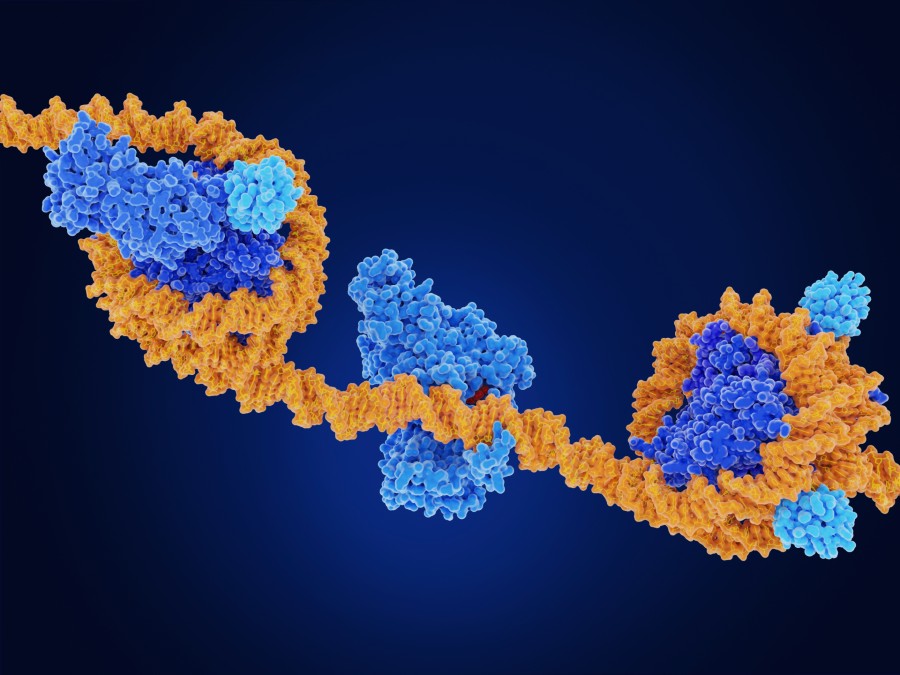
Chromatin confirmation data collected as part of the study revealed further changes that occur during aging. Notably, the researchers identified a new biomarker for brain aging: increased strength at topologically associating domain (TAD) boundaries and greater accessibility at related CTCF binding sites. In the body, TADs help with organizing information in the genome and CTCF is a protein that binds to either end of TADs helping them with their organization duties. The team also used spatial transcriptomics data to trace differences between aging in different brain regions and cell types.
“The same cell type ages differently depending on its location; for instance, non-neuronal cells in the back of the brain show more inflammation than those in the front parts,” Zeng noted. “This data really underscores the variability in aging even among the same cell type, emphasizing the importance of cell and brain region-level specificity in unraveling the complexities of aging.”
