

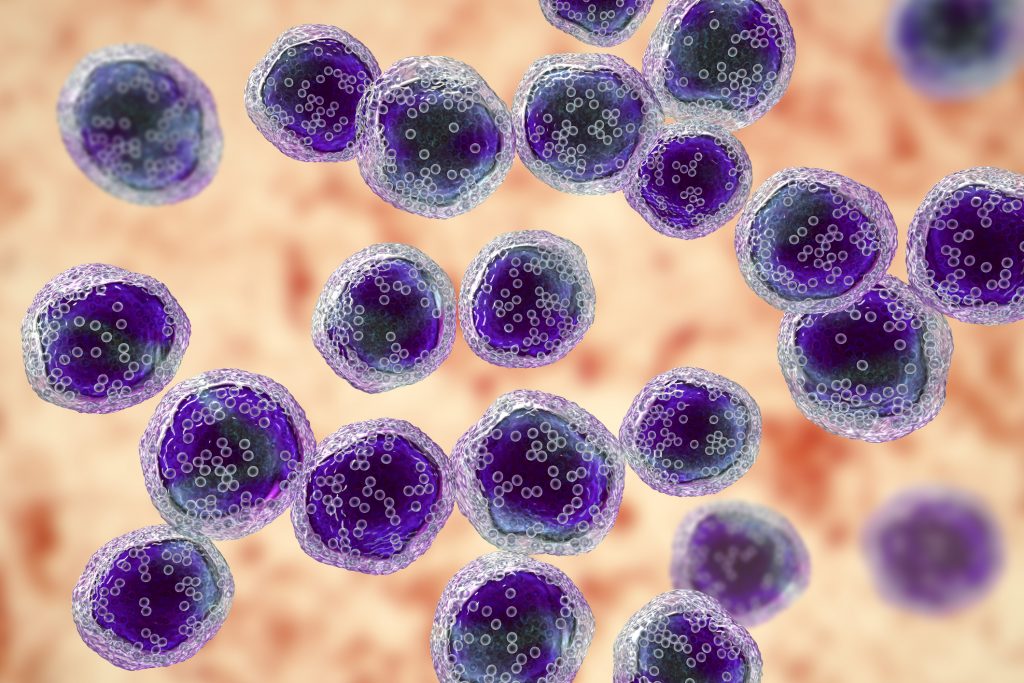
Researchers from the University of Oxford, U.K., and the Muhimbili University of Health and Allied Sciences (MUHAS) in Dar es Salaam, Tanzania, have shown that liquid biopsy can rapidly and accurately diagnose Burkitt lymphoma in children in Sub-Saharan Africa, where delays in traditional testing can be fatal.
Burkitt lymphoma is an aggressive cancer, commonly diagnosed in children, that is associated with Epstein–Barr virus (EBV) infection in 95% of cases in Sub-Saharan Africa.
Despite its aggressive nature, Burkitt lymphoma is often curable when treated quickly, with survival rates over 90%.
Treatment is widely available and free-of-charge in most Sub-Saharan countries, but the standard-of-care for diagnosis requires a combination of pathology tests that are not always readily available in many low-income countries.
Due to this, most children either remain undiagnosed or are diagnosed too late. In much of the region, survival rates can fall below 50%.
“There is an urgent need for new diagnostic methods that are practical and effective in the under-resourced settings where Burkitt lymphoma is most common,” said Anna Schuh, professor of molecular diagnostics at the University of Oxford and lead researcher on the study. “This is a highly treatable cancer, yet too many children and young adults are not diagnosed in time. As a minimally invasive and precise approach, liquid biopsy tests have enormous potential to transform diagnosis in Sub-Saharan Africa and significantly improve outcomes.”
To investigate this potential, Schuh and her team in Oxford, in collaboration with researchers at MUHAS, and the Central Public Health Laboratory in Kampala, Uganda, developed a minimally invasive liquid biopsy test for Burkitt lymphoma that incorporates circulating tumor DNA markers (MYC mutations, MYC–immunoglobulin translocations and EBV fragmentomics).
They compared its performance among 377 children and young adults with clinical signs of lymphoma across four hospitals in Uganda and Tanzania with a tissue biopsy-based approach that included tissue morphology, a limited validated immunohistochemistry panel and independent dual histopathologist review.
The researchers report in Nature Medicine, that when combined with clinical variables, the liquid biopsy distinguished Burkitt lymphoma from other conditions with 95–98% accuracy and had a sensitivity and specificity of 86% and 95%, respectively, when compared with tissue biopsy.
Importantly, the liquid biopsy approach substantially reduced the diagnostic turnaround time from 46.8 days to 6.5 days, on average, versus tissue biopsy.
“Introducing liquid biopsy into our multidisciplinary meetings transformed how quickly we could start treating our patients,” said Clara Chamba, head of hematology at MUHAS. “With liquid biopsy, 93% of cases were diagnosed within the first week of sample collection, compared to just 40% when we relied on tissue biopsy alone. For a cancer that progresses as quickly as Burkitt lymphoma, that time can be life-saving.”
While further work is needed to understand how to scale the test for clinical use, the study shows that liquid biopsy could serve as a complementary and timely diagnostic tool for Burkitt’s lymphoma, especially where tissue biopsy access is limited or delayed.
“The successful implementation and analytical work conducted in Tanzania and Uganda demonstrates that precision medicine research can and should be led from within low- and middle-income countries,” commented Bruno Sunguya, deputy vice chancellor, Research and Consultancy, at MUHAS. “Beyond lymphoma, this work opens new opportunities to apply genomic and liquid biopsy technologies to strengthen cancer diagnosis and improve outcomes more broadly across the region. This collaboration reaffirms our commitment to advancing innovation, accelerating timely diagnosis, and improving survival for children and adults affected by cancer.”
