

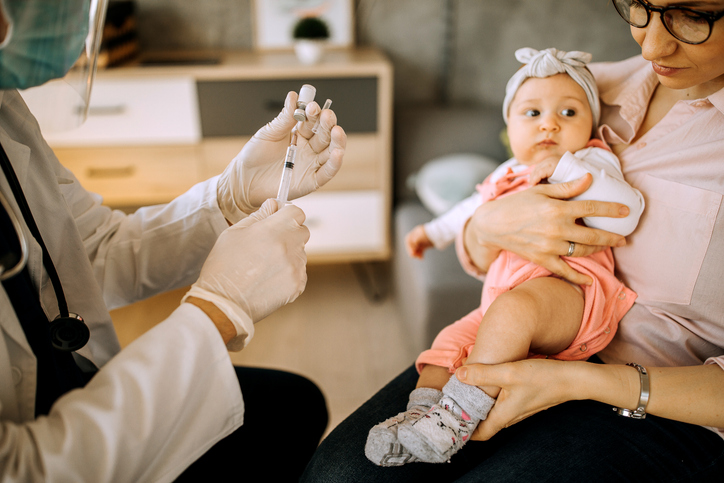
Brian Murphy, a U.S. District Judge in Massachusetts, recently temporarily blocked key parts of RFK Jr.’s plan to change the U.S. childhood vaccine schedule. Judge Murphy sided with medical groups who maintained that changes could reduce vaccination rates and threaten public health.
The vaccine issue represents the latest attempt by the Trump team that will further negatively impact U.S. healthcare and research. The administration has already slashed funding for scientific institutions, restricted research grants, and weakened public health infrastructure.
To get expert insight on the national importance of the judge’s decision, GEN spoke to Tyler B. Evans, MD, co-founder, CEO, and principal investigator at the Wellness Equity Alliance, a national group of public health leaders. He is also the author of Pandemics, Poverty, and Politics: Decoding the Social and Political Drivers of Pandemics from Plague to COVID-19.
GEN: What does this ruling mean for public health and vaccine confidence?
Evans: This ruling reinforces the foundational principle that vaccine policy in the U.S. must be developed through a structured, evidence-based process involving qualified independent experts, as defined by the Federal Advisory Committee Act. The court found that 13 of Secretary Kennedy’s 15 ACIP appointees likely lacked the scientific and medical qualifications required by federal standards, that the government offered no substantive scientific rationale for departing from decades of established immunization process, relying instead on a presidential directive, and that the CDC exceeded its authority by reducing recommended childhood vaccinations from 17 diseases to 11 without consulting the advisory committee.
The childhood vaccine schedule is the product of decades of rigorous, peer-reviewed science. It is not discretionary guidance. When the process used to develop it is bypassed, the integrity of the recommendations themselves is compromised. This ruling restores the requirement that the process be followed. Whether it holds through appeal will determine how much institutional credibility can be recovered.
For the vaccine development community specifically, this ruling has implications beyond the immediate policy question. The mRNA platform that produced the COVID-19 vaccines is the foundation for a generation of pipeline candidates targeting RSV, influenza, cancer, and rare diseases. When the federal advisory process that evaluates and recommends these products is destabilized, it introduces regulatory uncertainty that affects investment decisions, clinical development timelines, and the willingness of researchers and companies to commit resources to vaccine innovation.
GEN: Why are childhood vaccine schedules designed as population-level prevention systems, not individual consumer choices?
Evans: Vaccines work at two levels simultaneously. They protect the individual child who receives them, and they protect the community around that child by reducing the overall circulation of the pathogen. That second function, population-level immunity, is what prevents outbreaks. It is what keeps a child undergoing chemotherapy for leukemia, whose immune system is too compromised to receive a vaccine, from sitting next to a classmate carrying measles. It is what protects a two-week-old infant who is too young for their first dose but entirely dependent on everyone around them being vaccinated.
When we treat the vaccine schedule as a menu of personal preferences, we are not just accepting risk for one child. We are degrading the collective protection that keeps preventable diseases from regaining a foothold. The schedule is sequenced and timed the way it is because the data tells us when children are most vulnerable to specific diseases and when their immune systems will mount the most effective response. It is an engineered system, not a buffet. Reducing it from 17 recommended diseases to 11 without scientific justification does not give parents more choice. It gives pathogens more opportunity.
GEN: How can policy uncertainty around vaccine recommendations undermine public trust and lower vaccination rates?
Evans: The evidence on this point is already accumulating. Twenty-six states have rejected CDC vaccine guidance over the past year. Kindergarten DTaP [diphtheria, tetanus, and acellular pertussis] vaccination coverage has declined from 95% in the 2019-20 school year to 92.1% in 2024-25, falling below the threshold needed to sustain herd immunity for several vaccine-preventable diseases. A JAMA Network Open study examining 149,000 children in Ohio during the 2025 measles outbreak found MMR [measles, mumps, and rubella] vaccination rates below the 93% threshold needed to prevent sustained transmission. These are not projections. They are measurements of what is already happening.

I have spent four decades working in communities where trust in public health infrastructure was already fragile. What I can tell you from that experience is that uncertainty is more damaging than almost any specific policy decision. When parents see the federal government change the vaccine schedule, then a court blocks those changes, then the administration signals it will fight back, what registers is not the details of any single ruling. What registers is instability.
And in the absence of clarity, people default to inaction. They delay. They skip appointments. They wait to see what happens next. And as a result, we see vaccination rates decline. They decline, not through dramatic refusal but through quiet hesitation. The damage from this kind of policy whiplash is cumulative and difficult to reverse because once a parent decides to wait, re-engaging them requires a level of trust that the system has already spent.
GEN: What are the potential public health consequences, including the return of preventable diseases, if routine immunization coverage declines?
Evans: The consequences are not hypothetical. We are already seeing them. The measles outbreak that began last year now threatens elimination status in the Americas. The Pan American Health Organization (PAHO) has scheduled a formal review of the U.S. and Mexico’s elimination status for later this year after the region as a whole lost its measles-free designation in November 2025. As of March 2026, the CDC has confirmed over 1,300 measles cases in the U.S. this year alone, on top of more than 2,200 in 2025, the highest annual total in over three decades. Ninety-three percent of confirmed cases have been in unvaccinated individuals or those with unknown vaccination status.
Pertussis cases in the U.S. have surged from roughly 7,000 in 2023 to over 35,000 in 2024, with at least 13 deaths in 2025. The majority of pertussis deaths historically occur in unvaccinated or incompletely vaccinated infants, and the deaths reported in 2025 followed that pattern. These are not deaths caused by a novel pathogen we do not understand. They are deaths from a disease we effectively controlled for decades through the very immunization infrastructure that is now being undermined.
The math of herd immunity is precise. Measles requires roughly 95% vaccination coverage to prevent sustained transmission. When coverage drops even a few percentage points below that threshold, outbreaks become inevitable, and they concentrate in the communities with the lowest vaccination rates, which are often the same communities facing the greatest barriers to healthcare access.
I run street medicine and primary care programs for people living in shelters, encampments, and transitional housing. I have seen what happens when infectious disease enters a community with no buffer of population immunity, no reliable access to testing, and no clear pathway to treatment. It moves fast, and it moves through the people with the fewest options first.
If routine childhood immunization rates continue to decline, the consequences will not be distributed evenly. They will land first and hardest in the communities that were already underserved before the first dose was skipped. And when those communities need a public health response, they will be at the back of the line, because they always are.
