

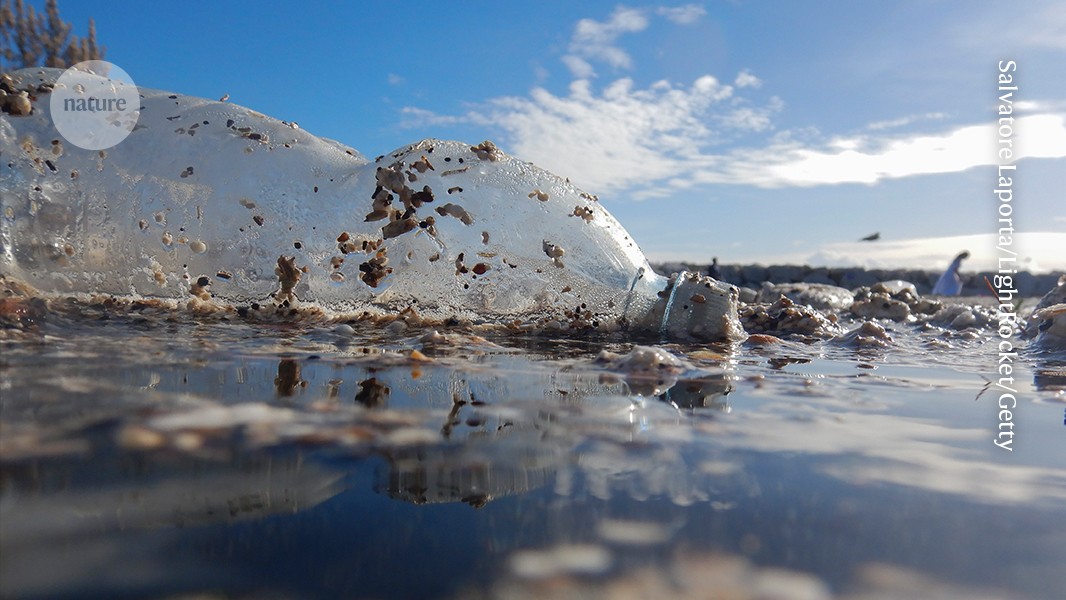
Plastics overwhelmingly end up in the ocean or at landfill sites.Credit: Salvatore Laporta/KONTROLAB/LightRocket/Getty
In August, the world should have been celebrating the first global agreement to end plastics pollution. Instead, negotiators from more than 180 countries ended the latest round of talks in Geneva, Switzerland, amid acrimony. And, as if that wasn’t bad enough, the chair of the talks, Luis Vayas Valdivieso, a diplomat from Ecuador, has resigned.
What now for the global plastics treaty?
The chair and the United Nations Environment Programme (UNEP), which organizes the talks, have failed to bridge the gulf between countries that want chemicals of concern to be regulated and plastics production to be decarbonized over time, and those who would prefer an agreement that focuses on a narrower range of measures, such as improved recycling. But this crisis can both be resolved and be prevented from happening again, suggest the authors of two articles in this week’s issue.
Plastics production and consumption cause growing — and in some ways existential — risks for people and ecosystems. More than 400 million tonnes of the material are produced annually, a number that has been rising sharply. Only around one-tenth of plastics are recycled; the rest winds up mostly at landfill sites or in the ocean. If current trends continue, plastics will be responsible for 15% of greenhouse-gas emissions by 2050. Moreover, an expanding body of knowledge is drawing attention to the health impacts that these products have (M. H. Lamoree et al. Nature Med. 31, 2873–2887; 2025).
This is why the international community began talks on ending plastics pollution three years ago. Despite five rounds so far, an agreement that all parties can abide by has remained elusive. The next chair and UNEP must now collaborate with member states to achieve this task.
Environmental treaties are paralysed — here’s how we can do better
Maria Ivanova, a social scientist at Northeastern University in Boston, Massachusetts, proposes that, to move forwards, negotiators must look back. The modern era of multilateral environmental agreements followed the landmark 1972 UN Conference on the Human Environment in Stockholm, the first time that heads of government were involved in such an event. Scholars have spent the subsequent five decades studying how this and other accords came to pass, the difficulties of implementing them and how states can do better.
Social scientist Rakhyun Kim at Utrecht University in the Netherlands and conservation scientist Peter Bridgewater at the University of Canberra propose that governments should use research tools to evaluate whether treaties are achieving their aims. “Scientists need an independent expert body, mandated by governments, to produce authoritative and binding recommendations for environmental bodies and treaties,” they write.
Ivanova studies the role of UNEP, which was created as a result of the Stockholm conference. A core problem with the plastics treaty, she notes, is that the talks have become mired in a ‘villains versus heroes’ narrative, obscuring a complex reality. Currently, nations’ disparate views are amplified through lobbying, influencing media reports. This then further polarizes discussions.
Science and diplomacy
Moreover, there is currently no mechanism for sharing reliable scientific information on plastics. Scientists can attend the talks as observers, and as members of official delegations. However, research is not currently used to formally inform the documents that are part of the talks.
The world’s first plastics treaty is in crisis: can it be salvaged?
UNEP, Ivanova writes, needs to “revive its role as an impartial steward for conveying reliable scientific data, and for creating structures and spaces in which states can seek alignment”, a part that it has played with notable success before. In 1988, UNEP was one of the two co-founders (along with the World Meteorological Organization) of the Intergovernmental Panel on Climate Change (IPCC). Since then, IPCC reports have helped to educate climate-treaty negotiators and establish a shared body of knowledge that has informed legally binding accords to reduce greenhouse-gas emissions, such as the 1997 Kyoto Protocol and the 2015 Paris agreement. Those accords took too long to be agreed on, and, as Kim and Bridgewater also note, there has been much backsliding in their implementation. However, the agreements, imperfect as they are, would probably not have been reached without the formal involvement of researchers.
The absence of an expert panel to inform the plastics negotiations is about to be remedied with the establishment of the Intergovernmental Science-Policy Panel on Chemicals, Waste and Pollution, which will have its first meeting in Geneva next February. The panel’s researchers must, as a priority, be asked to establish a consensus on the available data for issues related to the talks.
Equally important, as Ivanova says, is the need to expand informal diplomatic spaces, where negotiators who hold what might seem irreconcilable positions can meet and get to know each other as people, not just as representatives of their country’s official position.

Maurice Strong, secretary-general of the 1972 United Nations conference on the human environment, cycles through Stockholm.Credit: SCANPIX SWEDEN/AFP/Getty
The literature on the benefits of such an approach to treaty-making goes back a long way. Canada’s Maurice Strong, the secretary general of the 1972 Stockholm conference, had to navigate a divide that was wider than the current one. Back then, delegates from poorer countries, many of which had gained independence from colonial rule, were threatening to skip the conference. Some considered the idea of protecting the environment a new form of colonization, says Boston University environmental scientist Adil Najam, who studies the involvement of low- and middle-income countries (LMICs) in international environmental agreements (A. Najam Int. Environ. Agreements 5, 303–321; 2005). The representatives argued that, like richer countries, their nations should be allowed to industrialize before going green.
UN plastics treaty: don’t let lobbyists drown out researchers
Strong and his team understood that they couldn’t make progress without engaging with these concerns. Before the official talks, he worked with a group of researchers to organize a more informal meeting in Founex, Switzerland. One aim was for all sides to discuss environmental protection from the LMICs’ perspective in both a less formal and a less adversarial setting. That meeting went a long way in persuading LMIC delegates to participate in the official talks, Najam says.
For the plastics treaty talks to succeed, the incoming chair, hosts and delegates need to up their game. There is still time to find a way to include science and improve the overall mood of the talks. Everyone must have access to the best available knowledge, and the space to have honest conversations in an atmosphere of trust.
