

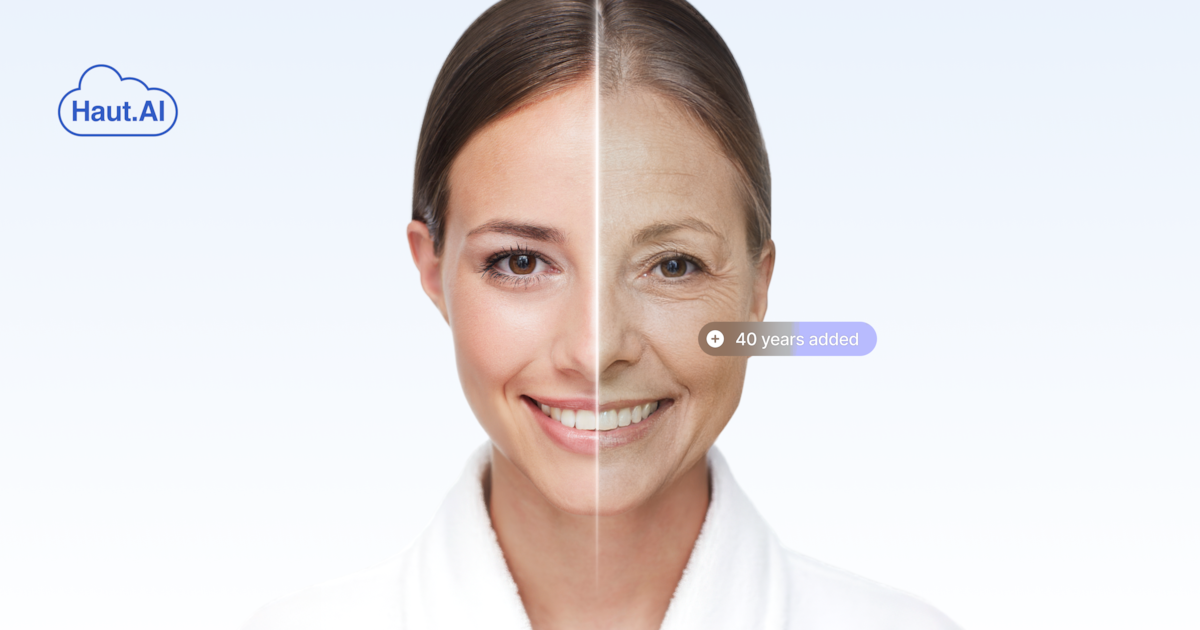
Designed to simulate up to 40 years of skin aging under various lifestyle, dietary and environmental conditions, the tool offers a new visualization layer for stakeholders across wellness, nutrition and dietary supplement sectors.
“This visualization turns abstract health advice into undeniable reality, motivating action today for a longer, healthier tomorrow,” Anastasia Georgievskaya, CEO and co-founder of Haut.AI shared in a statement, explaining that the tool allows consumers to “see their future selves—healthy or unhealthy—side by side.”
The SkinGPT Aging Model builds on Haut.AI’s existing platform for virtual try-ons and personalized skin analysis using the company’s proprietary skin analysis engine and introduces age-progression simulations that reflect both dermatological and facial changes associated with health, weight and UV exposure.
Noom is the first partner to integrate the model into a consumer-facing experience. Through its new “Future Me” feature, users can visualize how current habits may shape their appearance decades from now, forming a visual narrative that aligns with Noom’s personalized microhabits approach.
“Thanks to our partnership with Haut.AI, we’re helping people see the future in real time,” and “by visualizing how today’s habits can shape tomorrow’s health, we’re turning abstract goals into tangible motivation,” said Geoff Cook, CEO of Noom.
Benchmarking model accuracy and validation
The reliability of any predictive AI model rests on the quality and diversity of its training data. Speaking to NutraIngredients, Georgievskaya said the SkinGPT Aging Model is trained on “more than three million high-quality skin images, spanning ages 18 to 85, with balanced representation across ethnicities, skin tones and a wide range of skin concerns.”
The dataset includes dermatological variations and aging markers that can be simulated under both healthy and unhealthy conditions. Georgievskaya emphasized that this is what allows the model to reproduce subtle changes in “skin color, texture and volume” over time.
With concerns about AI reliability increasing across sectors, validation was a key focus for the SkinGPT team. Georgievskaya said the company “benchmarked it against other AI models that predict age” using comparative analysis.
“In practice, that means we take an image, evaluate the predicted age before and after applying the simulation and then measure whether the difference aligns with the expected biological aging process,” she explained. “This provides an objective way to confirm that the model is producing realistic, consistent outcomes.”
Haut.AI is also working with an undisclosed partner on a peer-reviewed scientific publication to support independent validation of the model.
Privacy-first design for biometric data
To protect user identity while working with sensitive facial data, Haut.AI developed and patented Skin Atlas, an anonymization system that retains skin-specific data while removing all identifiable features.
“When a user uploads an image, our patented process removes all personal identifiers and non-skin-related information—such as eyes, mouth, hair and background details—leaving only the essential skin pixels,” Georgievskaya told NI. This ensures analytical accuracy without compromising privacy or data compliance standards.
Visualizing ingredient efficacy and systemic health impacts
While the initial application is consumer-facing, Haut.AI positions SkinGPT as a tool that nutrition, supplement and healthspan brands can use to visualize and communicate evidence-backed product outcomes.
“In that case, we used peer-reviewed, clinically validated studies that describe the proven effects of certain ingredients on common skin concerns like pigmentation, redness, breakouts and more,” Georgievskaya said, referring to a public demo at generative.skin. “Each simulation is transparently linked to the underlying research—you can see the references right next to each experience.”
Brands can also provide proprietary clinical data to create tailored simulations.
“We help translate that knowledge into realistic simulations that make the science visible to consumers,” she added.
Skin as a biomarker for broader aging processes
Characterizing skin condition as a measurable expression of systemic aging, Georgievskaya explained that “our skin condition is deeply interconnected with overall health—it’s often described as a mirror of our internal state.”
Specifically, she noted correlations between the hallmarks of aging, including genomic instability and mitochondrial dysfunction, and visible skin changes such as elasticity loss.
“In our own research we’ve shown how advanced glycation end-products can be visualized under UV light, making their impact on skin both detectable and measurable,” she added.
This could open new use cases for supplement companies seeking to substantiate how their products may influence systemic or cellular aging. Haut.ai is actively exploring how skin biomarkers could guide nutritional recommendations and product personalization.
Strategic implications for supplement and wellness brands
By translating clinical effects into visual narratives, the SkinGPT platform offers a new form of consumer education for dietary supplement and longevity brands.
“Any brand—whether in nutrition, supplements or preventive health—can use it to create realistic virtual try-ons or visualizations of aging pathways, provided there is credible evidence of how those interventions affect the skin,” Georgievskaya said.
Collaboration with science-driven companies is also central to the model’s ongoing evolution.
“When brands bring us clinical data or validated research about specific effects, we can translate that knowledge into scientifically accurate visuals.” Georgievskaya said.
