
Close Menu
My Blog

    Subscribe to Updates

    Get the latest creative news from FooBar about art, design and business.

    What's Hot

    Nautilus debuts Voyager platform in push toward next-gen proteomics

    March 1, 2026

    First-in-Human Success for Prenatal Stem Cell Therapy in Spina Bifida

    February 28, 2026

    Pressure-Driven Pathway Links Liver Congestion to Fibrosis and Cancer

    February 28, 2026
    Facebook X (Twitter) Instagram
    X (Twitter) YouTube
    My BlogMy Blog
    Sunday, March 1
    • Home
    • About Us
    • Healthy Living
    • DNA & Genetics
    • Podcast
    • Shop
    My Blog
    Home»DNA & Genetics»AI-Engineered Peptides May Boost E. coli Protein Yields for Biomanufacturing
    DNA & Genetics

    AI-Engineered Peptides May Boost E. coli Protein Yields for Biomanufacturing

    adminBy adminOctober 30, 2025No Comments3 Mins Read
    Facebook Twitter Pinterest LinkedIn Tumblr WhatsApp VKontakte Email
    protein synthesis
    Share
    Facebook Twitter LinkedIn Pinterest Email

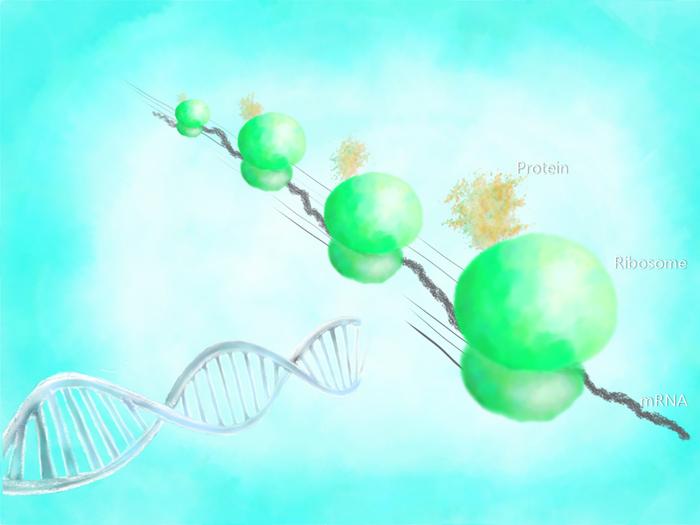
    Proteins are synthesized through two processes involving DNA: transcription, which converts DNA into mRNA; and translation, where ribosomes read the mRNA and sequentially link amino acids to form proteins. This image illustrates the translation process accelerated to produce proteins more efficiently. [Teruyo Ojima-Kato]

    Microbial protein production plays a central role in biomanufacturing, supporting the development of pharmaceuticals, industrial enzymes, diagnostic antibodies, and sustainable materials such as biofuels and bioplastics. Organisms like Escherichia coli are widely used in these processes due to their cost-effectiveness and efficiency. As demand grows for scalable and environmentally responsible production methods, improving the efficiency of microbial protein synthesis remains an important area of research.

    A recent study from researchers at Nagoya University describes a new approach to enhancing translation efficiency in E. coli. Published in RSC Chemical Biology under the title “Screening and machine learning-based prediction of translation-enhancing peptides that reduce ribosomal stalling in Escherichia coli,” the work combines peptide engineering with artificial intelligence to address a common limitation in protein expression: ribosome stalling.

     Tackling ribosome stalling

    Ribosome stalling occurs when the translation machinery halts prematurely, and “the synthesis of proteins of interest (POIs) can be affected by various factors, including promoter strength, the nucleotide sequence of mRNA, and tRNA availability, which can limit protein production yields and compromise the functionality of synthetic circuits,” the authors wrote. This phenomenon can severely limit protein yields in E. coli, undermining its utility in producing pharmaceuticals, industrial enzymes, and bio-based materials.

    To address this, Teruyo Ojima-Kato, PhD, associate professor, and Hideo Nakano, PhD, professor, in collaboration with researchers from the National Institute of Advanced Industrial Science and Technology and Waseda University, focused on short peptide sequences, or short translational-enhancing peptides (TEPs), that could mitigate stalling. Their previous work showed that appending a tetrapeptide—serine, lysine, isoleucine, and lysine (SKIK)—to the N-terminus of a protein significantly improved translation efficiency.

    “In our previous research, we found that adding a short peptide sequence composed of four amino acids—serine, lysine, isoleucine, and lysine—to the N-terminus of a protein reduces ribosomal stalling and significantly improves translation efficiency in E. coli,” said Ojima-Kato.

    Building a peptide library and predictive AI model

    To expand on this finding, the team constructed a comprehensive tetrapeptide library encompassing all 160,000 possible combinations of the 20 standard amino acids. The researchers then developed an artificial intelligence (AI) prediction model to evaluate the translation-enhancing effects of the possible combinations.

    Using data from approximately 250 experimental assays, they trained an AI model to predict which tetrapeptides would most effectively reduce ribosome stalling. The model underwent three rounds of refinement, ultimately demonstrating high accuracy in forecasting translation enhancement across the entire library.

    “We present a novel approach for efficient production of proteins using short peptide sequences,” said Kato. This technology may one day be used to improve efficiency in protein production and other areas, including biomanufacturing.

    Implications for sustainable manufacturing

    Microbial proteins are increasingly vital to biomanufacturing, offering alternatives to petroleum-based products. By integrating peptide design with AI-driven prediction, the team’s method offers a scalable solution to optimize protein expression in E. coli. Their work lays the groundwork for more reliable and cost-effective microbial manufacturing pipelines.

    AIEngineered Biomanufacturing Boost Coli peptides Protein Yields
    Share. Facebook Twitter Pinterest LinkedIn Tumblr WhatsApp Email
    Previous ArticleLow-Oxygen Leaves a Lasting Mark on the Immune System
    Next Article Beauty business women turned poo pundits aim to deliver regular relief
    admin
    • Website

    Related Posts

    A Video Report from AGBT

    February 27, 2026

    Novo Nordisk, Vivtex Ink Up to $2.1B Deal to Develop Oral Biologics for Metabolic Conditions

    February 27, 2026

    Increasing Rice Yields with Gene-Informed Selective Breeding

    February 27, 2026

    Mutant p53 Selective Reactivation Demonstrated in Advanced Solid Tumors

    February 27, 2026
    Leave A Reply Cancel Reply

    Our Picks

    9 Time-Saving Kitchen Gadgets for Fall at Amazon

    September 5, 2025

    Why Exercise Is So Important For Heart Health, From An MD

    September 5, 2025

    An Engineered Protein Helps Phagocytes Gobble Up Diseased Cells

    September 5, 2025

    How To Get Rid Of Hangnails + Causes From Experts

    September 5, 2025
    • Facebook
    • Twitter
    • Pinterest
    • Instagram
    • YouTube
    • Vimeo
    Don't Miss
    Longevity

    Nautilus debuts Voyager platform in push toward next-gen proteomics

    By adminMarch 1, 20260

    Company’s new benchtop system promises a clearer view of proteins following validation at a leading…

    First-in-Human Success for Prenatal Stem Cell Therapy in Spina Bifida

    February 28, 2026

    Pressure-Driven Pathway Links Liver Congestion to Fibrosis and Cancer

    February 28, 2026

    A cellular atlas of aging comes into focus

    February 28, 2026

    Subscribe to Updates

    Get the latest creative news from SmartMag about art & design.

    About Us

    At FineGut, our mission is simple: to enhance your self-awareness when it comes to your gut health. We believe that a healthy gut is the foundation of overall well-being, and understanding the brain–gut connection can truly transform the way you live.

    Our Picks

    9 Time-Saving Kitchen Gadgets for Fall at Amazon

    September 5, 2025

    Why Exercise Is So Important For Heart Health, From An MD

    September 5, 2025

    An Engineered Protein Helps Phagocytes Gobble Up Diseased Cells

    September 5, 2025
    Gut Health

    Nautilus debuts Voyager platform in push toward next-gen proteomics

    March 1, 2026

    First-in-Human Success for Prenatal Stem Cell Therapy in Spina Bifida

    February 28, 2026

    Pressure-Driven Pathway Links Liver Congestion to Fibrosis and Cancer

    February 28, 2026
    X (Twitter) YouTube
    • Contact us
    • Privacy Policy
    • Disclaimer
    • Terms and Conditions
    © 2026 finegut.com. Designed by Pro.

    Type above and press Enter to search. Press Esc to cancel.