

You have full access to this article via your institution.
Hello Nature readers, would you like to get this Briefing in your inbox free every day? Sign up here.
The bowhead whale (Balaena mysticetus) can live for more than 200 years, thanks in part to a highly effective DNA-repair protein.Credit: Tony Wu/Nature Picture Library
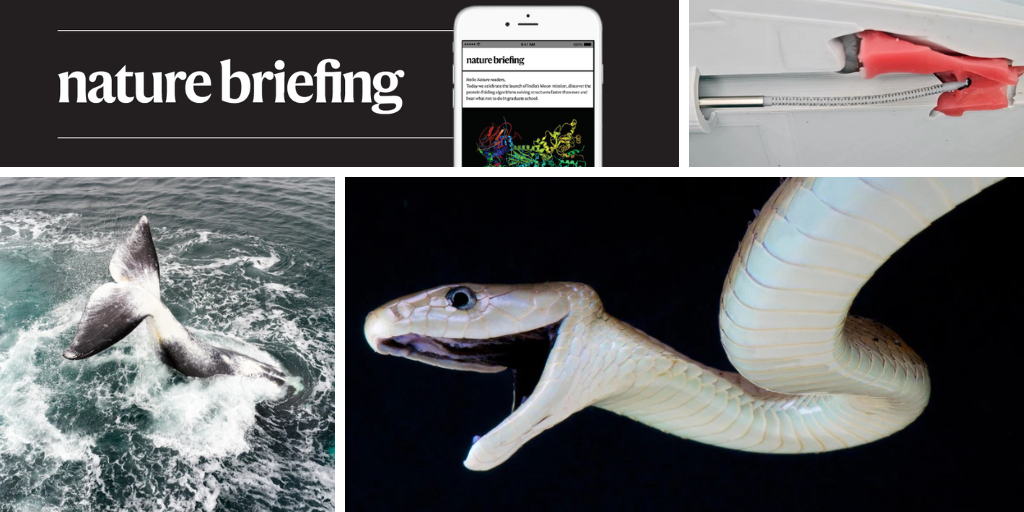
A cold-activated protein that helps to repair broken DNA could be the bowhead whale’s secret to living sometimes for more than 200 years. Researchers travelled to northern Alaska to collect samples of tissue from the whales (Balaena mysticetus) from Iñupiaq Inuit communities. The team found that the whale’s cells produce a protein called CIRPB, which helps to mend potentially cancerous DNA mutations. The results show that an efficient DNA repair system is “a very effective strategy to confer this extreme longevity”, says molecular biologist Zhiyong Mao.
A broad-spectrum antivenom that uses antibodies from a llama and an alpaca can neutralize venom from some of the world’s most venomous snakes. Researchers exposed the camelids to venoms from 18 sub-Saharan African snake species, including cobras and mambas. They then isolated nanobodies — small versions of antibodies that can penetrate tissues and bind to tissue-destroying toxins — from the animals and combined eight of them into a single cocktail. In mice, the treatment conferred protection against toxins from 17 of the snake species and reduced skin damage caused by venoms.
Using an artificial intelligence (AI) model developed by Google DeepMind, scientists have been able to accurately predict the trajectory and growth of Hurricane Melissa, a powerful and record-setting storm. The tool — used by the US National Hurricane Center, a leading source of hurricane information in the region — has helped to inform warnings to Jamaica and other nations that the storm has devastated. Its accuracy has been impressive, say researchers, but DeepMind cautions against reading too much into the predictions of a single storm.
Researchers have created what they say is the world’s smallest 3D bioprinter. The device, which sports a 2.7-millimetre-wide printhead at the end of a long, flexible arm, was inspired by an elephant’s trunk. It could one day be used to deliver healing hydrogels after surgeries such as the removal of cysts from vocal cords, the team says. They demonstrated that the device, guided remotely using a PlayStation controller, can precisely deliver dollops of hyaluronic-acid-based hydrogels to fill in gaps in artificial vocal folds.

Researchers tested their tiny 3D bioprinter in a surgeon’s training simulator. The device is shown snaking through a surgeon’s ‘scope’ from the left to deposit hydrogel onto artificial vocal cords (pink) on the right.Credit: Swen Groen
Features & opinion
The Turing test — a thought experiment that asks whether a computer’s written conversation can pass as a person’s — should be updated so that it can continue to be used as a benchmark for progress in artificial intelligence (AI), says AI researcher Vinay K. Chaudhri. He suggests that an AI system should be tested with an extensive interaction with specialists, for example legal scholars, on a topic in their area of expertise. In such scenarios, which could be generalized to any field as required, the model would need to not only reproduce information but apply it to unique and complex scenarios to demonstrate genuine understanding.
The International Space Station marks 25 years of continual occupancy this week — with only five years left in its trailblazing lifespan. Its first residents were from the United States and Russia, and while relations between the countries are at a low, “person to person and even space agency to space agency, they’re actually quite good,” says Bill Shepherd, who was the US astronaut on board. Almost 300 people from 26 countries have since made it a home. “You couldn’t ask for better accommodations,” says Shepherd. “At least in space.”
Infographic of the week

By filling thin strips of soft material with grids of microbubbles, researchers have designed artificial ‘muscles’ that move in response to specific ultrasound frequencies. Oscillations of the bubbles produce flows in surrounding fluid, which causes the materials to flex or stretch (a). Different sized microbubbles respond to different ultrasound frequencies, which allows control over which parts of the material move. The team behind the ‘muscle’ showed that it can be used to hold zebrafish larvae in place, which could be useful for biological research, without causing the larvae any observable harm (b). (Nature News & Views | 7 min read)
Tomorrow evening, to celebrate Halloween, I’ll be sitting down to watch a scary film. Probably 1996’s Scream, one of my favourites. In general, I’m not a huge fan of scary movies (I would definitely fail Ghostface’s life-or-death pop quizzes), but I can brace myself for a night of hiding behind my hands every now and then.
Paradoxically, sitting through two hours of scares might make me calmer after the fact. Some research suggests that exposing ourselves to fictional tales of terror can soothe some of the anxiety we might feel about the real world.
Maybe I’ll watch Scream 2 as well to really help me find my zen.
One thing that will never scare me is your feedback on this newsletter, which is always welcome at briefing@nature.com.
Thanks for reading,
Jacob Smith, associate editor, Nature Briefing
With contributions by Flora Graham
• Nature Briefing: Careers — insights, advice and award-winning journalism to help you optimize your working life
• Nature Briefing: Microbiology — the most abundant living entities on our planet — microorganisms — and the role they play in health, the environment and food systems
• Nature Briefing: Anthropocene — climate change, biodiversity, sustainability and geoengineering
• Nature Briefing: AI & Robotics — 100% written by humans, of course
• Nature Briefing: Cancer — a weekly newsletter written with cancer researchers in mind
• Nature Briefing: Translational Research — covers biotechnology, drug discovery and pharma
