

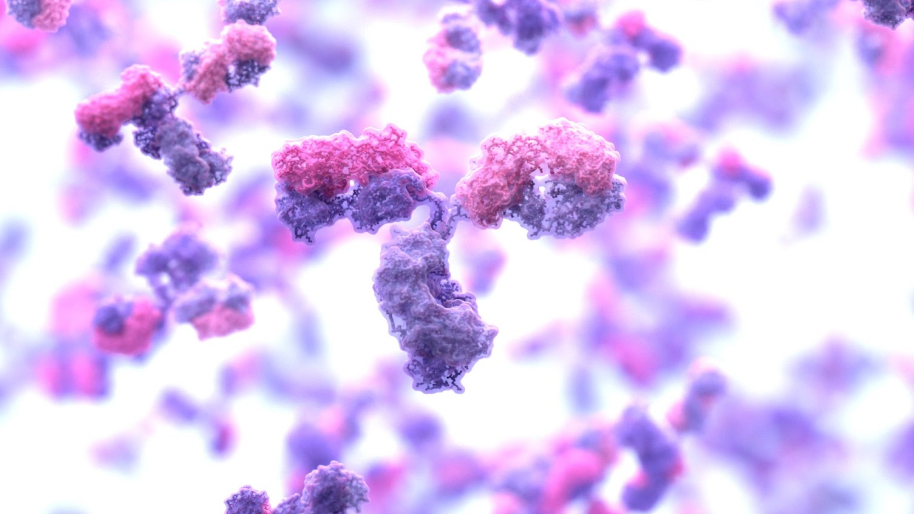
The antibody drug market value is expected to reach $445 billion in the next five years, with over 160 antibodies currently licensed globally for a wide breadth of conditions, including cancer, autoimmune diseases, and more. AI-guided rational antibody design that bypasses the need for labor intensive and time consuming experimental screens has long been a “holy grail” for protein therapeutics, says Nathaniel Bennett, PhD, co-founder of Xaira Therapeutics and former postdoctoral researcher in the lab of Nobel Laureate, David Baker, PhD, director of the Institute for Protein Design at the University of Washington (UW).
In a step toward this dream, the Bennett and UW colleagues have now fine-tuned AI protein design model, RFdiffusion, to generate full length antibodies from scratch (or de novo) that can successfully bind user-specified epitopes on a therapeutic target with atomic precision. The model makes the technological advance of accurately constructing antibody loops, the key region involved in binding that has been historically challenging to design due to the flexible nature.
Remarkably, binding poses of antibody designs were confirmed by cryo-electron microscopy (cryo-EM) for an array of therapeutically relevant targets, including hemagglutinin, a key protein found on the surface of influenza viruses, a potent toxin produced by the bacteria, Clostridium difficile, and PHOX2B, a peptide highly implicated in cancer.
The work is described in a new study published in Nature titled, “Atomically accurate de novo design of antibodies with RFdiffusion.” Co-lead authors of the study include Bennett, Joe Watson, PhD, fellow co-founder of Xaira, and Robert Ragotte, PhD, postdoctoral researcher in the Baker lab.
Xaira Therapeutics launched in April 2024 with a jaw-dropping $1 billion in committed capital and a star-studded leadership lineup—including Baker, Carolyn Bertozzi, PhD, 2022 Nobel Laureate in Chemistry, Scott Gottlieb, MD, former FDA head, Alex Gorsky, former CEO of Johnson & Johnson, and more.
Led by CEO Marc Tessier-Lavigne, PhD, formerly the president of Stanford University and CSO of Genentech, Xaira has publicly made big bets on the virtual cell and released the largest publicly available Perturb-seq dataset to power virtual cell models earlier this summer. In protein therapeutics, Xaira’s Seattle site is reported to be expanding Baker lab technology, including de novo antibody design.
When asked to unpack the hype vs. reality debate surrounding designing proteins from scratch in a recent interview with GEN, Baker emphasizes that designing new functional proteins on a computer is now a reality and anticipates de novo design to become the competitive method of choice for a wide array of applications in the coming years. At the same time, the human body is a complicated place.
“The hype is that for therapeutics, there’s a lot more than the basic activity of a protein binding or catalyzing a reaction,” explained Baker. “Whether de novo proteins will revolutionize medicine will require improving our understanding of the biology.”
Rational design
While traditional antibody development pipelines are limited by slow and low hit rate experimental approaches, such as animal immunizations and random library screens, de novo design has the potential to unlock access to a new trove of disease targets while speeding up drug discovery timelines by fine-tuning therapeutic properties in silico.
Baker emphasizes that the study’s antibody designs do not possess the clinical properties, such as sufficiently high binding affinity, to progress as a drug. However, the de novo proof-of-concept provides a powerful tool to augment rational therapeutic design workflows.
“When you select antibodies from a yeast library or animal immunization, you don’t have much control over [drug features]. With rational design, it will be possible to systemically incorporate beneficial properties,” Baker told GEN.
Bennett adds that while early RFdiffusion-designed proteins were small mini-binders characterized in the lab, full length therapeutic antibodies must function in the human body.
“You can imagine that developability is difficult to optimize if you only have a linear antibody sequence. It’s hard to know how mutations will disrupt binding or stability of the antibody,” explained Bennett in an interview with GEN. “We’re excited about what is now possible in improving developability properties with fully atomically accurate information.”
Additionally, structural precision can aid the targeting of key “hard to drug” classes, such as G-protein coupled receptors (GPCRs). GPCRs represent approximately one-third of drug targets, yet are notoriously hard to drug because achieving therapeutic function involves modulating very small structural differences to shift the protein between active and inactive states.
Ragotte highlights that another key offering of the study’s design pipeline is the modularity to accommodate new methods. As the original antibody workflow was constructed before the release of AlphaFold 3, which made the advance of modeling biomolecular complexes, the UW researchers showed that the workflow could be adapted to apply AlphaFold 3 to filter designs, which led to overall higher success rates.
“Swapping out one part of the pipeline with a new update is a value of this modularity because you can rapidly incorporate improvements both from within the lab and externally,” Ragotte told GEN.
Future directions of the work aim to further raise experimental success rates for computational antibody designs and improve binding affinity for clinical relevance.
