

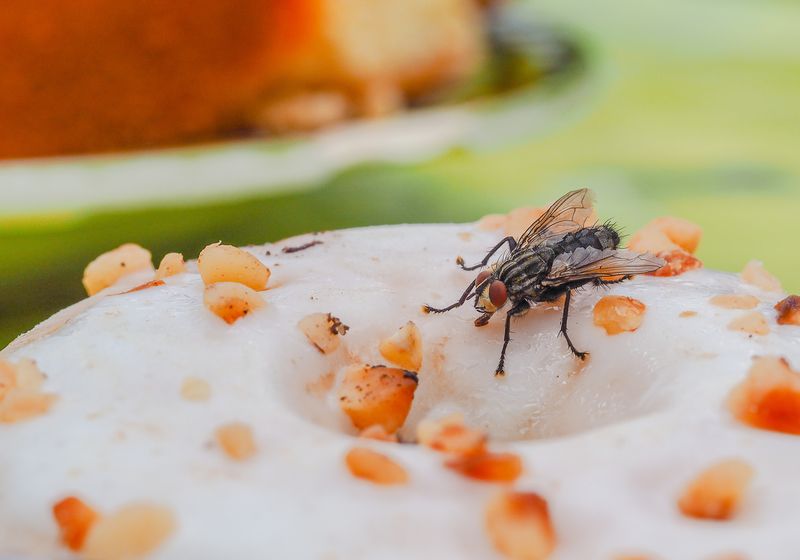
Depending on where the flies had been before, they can leave behind pathogenic microbes on the food they land on and get people sick.
Most people find it off-putting when flies land on the food they’re about to eat. But how much damage can a single housefly really do?
This question has two important components, said Kevin Verstrepen, a geneticist and microbiologist at the Flemish Institute for Biotechnology and the Catholic University of Leuven. First, how many microbes does a single fly typically carry? And second, how many microbes does it take to get people sick?
How Many Microbes Can One Housefly Transmit?
Several researchers have tried to address this question. In a 1999 study, Japanese researchers exposed houseflies pathogenic Escherichia coli, and then they quantified the number of bacterial cells the flies could disseminate up to four days after feeding.1 The team discovered that on day two, 80 percent of the flies seeded about 100 E. coli colonies on agar plates. The researchers observed both small and large bacterial colonies, which they hypothesized to have originated via contact with the flies’ mouthparts and legs or from the flies’ droppings, respectively. The researchers’ findings indicated that bacteria could survive in flies’ digestive system for days and that the flies could spread microbes either by contact or through feces.
Several years later, a different group led by US FDA researcher Antonio De Jesús investigated how much E. coli a single housefly could transfer from contaminated food to a clean surface.2 In this study, the researchers exposed between 40 to 60 houseflies to E. coli-contaminated milk, steak, and potato salad. Then, they calculated how much bacteria the flies could transfer to a sterile jar. The team discovered that about half of the flies carried a detectable amount of bacteria: more than 50 viable cells, or colony forming units (CFU). Among these flies, each could transmit anywhere from approximately 30 to 40,000 CFU each time they land.
How Many Microbes Does It Take to Get People Sick?
Verstrepen said that theoretically, “it only takes one [bacterial] cell [for someone] to become ill,” but experimentally this question is more difficult to answer. “You probably cannot do this in humans—infect them with one microbe and see if they get sick,” he said.
Kevin Verstrepen, a geneticist and microbiologist at the Flemish Institute for Biotechnology and the Catholic University of Leuven, is interested in how microorganisms attract insects to carry them as cargo and help them get to places.
Kevin Verstrepen
In a 2011 study, Japanese researchers analyzed data from foodborne illness outbreaks in Japan to estimate the infectious dose of bacterial pathogens, including two types of E coli.3 They found that people likely need to ingest between 25 and 1,000 CFU of enterotoxigenic E. coli, the most common cause of traveler’s diarrhea, to become ill. On the other hand, the infectious dose of Shiga-toxin producing E. coli is much lower—between two and nine CFU—which is not far from Verstrepen’s prediction.
Besides the type of bacteria, other factors may also affect the risk of getting sick from fly-transported microbes, such as how much time the bacteria had to grow before it was ingested. For instance, Verstrepen said, if a fly “lands on your food while you’re eating, it’s not a problem because the food is warm, and [the microbes] won’t have time to multiply.” But if the fly lands while the food sits in a store, and it stays there for a while, “that can be a way to get ill because you’ll get more microbes growing, and they might produce toxins.”
The places where a fly has been also likely matter. In a 2019 study, Versterpen’s team analyzed the microbiomes of flies that lived in houses, hospitals, and farms in two distinct countries, Belgium and Rwanda.4 The researchers found that the flies’ internal microbiomes were relatively similar across the different environments. On the other hand, bacterial populations on the surface of the flies’ bodies varied depending on their environment, “which probably means that wherever the fly lands, whatever microbes are growing there can hitch a ride on the outside of their bodies,” said Verstrepen.
All in all, Verstrepen said, for people with well-functioning immune systems, if a fly lands on their food—even if they accidentally swallow a fly whole—they likely don’t need to be too concerned.
“You might spend a night or a few hours in the bathroom, but you likely won’t have to fear for your life,” he said.
