

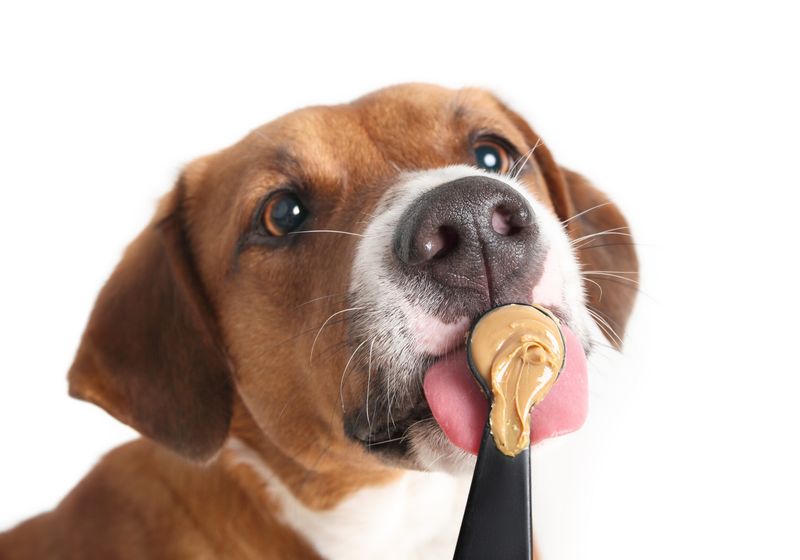
Most dogs love peanut butter, but the reasons for this nutty attraction range from biological to behavioral.
When pet parents stroll down the store aisle looking for snacks for their canine companions, many meaty flavors greet them among the treat options. Amidst these umami-rich choices often sits another dog-favorite taste: peanut butter.
While offering a pup a meat treat may feel like harkening them back to their wild ancestors who would have regularly eaten such meaty meals, why dogs love peanut butter is far less obvious. Instead, this attraction appears to be due to a blend of biology and behavior.
Canines Feel an Evolutionary Pull to Protein
Breaking peanut butter down into its most basic components, this creamy treat packs peanuts rich in protein and fat as well as, in many varieties, added sugar. These three macronutrients each contribute to possible biological drivers for dogs’ peanut butter preferences.
Kate Shoveller and her team study ingredients for pet foods and products to optimize their nutrition and metabolism in companion animals.
Kate Shoveller
“There’s palatability of foods, but there’s also things in foods that animals seek out for really strong evolutionary reasons. And like most mammals, dogs will select for things that are selectively higher in protein, and peanuts fall in that category,” said Kate Shoveller, a nutritional physiologist at the University of Guelph. Her group studies dog and cat nutrition and physiology, and they conduct research and consult on projects related to animal food ingredients.
Indeed, in self-selected food studies, dogs preferred options with greater amounts of protein, though they also chose foods with a high-fat content when it was offered; this could have been because fat is an energy-dense resource.1-3 In these studies, dogs frequently ate more calories than what their metabolic needs required.3 For protein in particular, Shoveller could see a strong evolutionary reason to overconsume the macronutrient. “In contrast to carbohydrates and fat, dogs—just like humans—have no storage of protein,” she said.
Dogs Have a Sweet Tooth
The canine craving for peanut butter may involve more than just biology, but a love of sweets too. Unlike many other ancestral carnivores that lost their sweet taste receptors, dogs retained them.4,5
“We have to remember that, if there’s added sugar they might be preferring [peanut butter] not because it has protein and fat, which all animals like, but they also like sugar. So that might be why they like it so much,” Shoveller said. “When we have something really palatable and really acutely hedonistic, all mammals, unless they’re consciously thinking about it, will choose that.”
For the biological driven factors, Shoveller said, “If I was to put my money on something, my money would be evolutionarily it’s based on protein, but I think palatability-wise it’s sugar.”
Puppies Are Trained to Prefer Peanut Butter
Aside from innate instincts pushing dogs to go bananas over peanut butter, Shoveller said, “It’s also a co-evolution with us.” Although the exact path to canine domestication remains up for debate, Shoveller said that dogs’ ancestors were likely eating peanuts as long as humans have been. Thus, as humans eventually created peanut butter, Shoveller hypothesized, “[Dogs] developed maybe that taste alongside us.”
Alternatively, Shoveller said, “It might also be something that we teach them and in the way that we use peanut butter.” Since peanut butter is often in treats, which are used for positive reinforcement in animal training, dogs may draw an association between peanut butter and positive experiences.
Ultimately, as for why dogs love peanut butter, Shoveller said, “It might be smell. It might be taste. It might be physiological feedback which is positive.” But what all dog owners know to be true is that every good dog deserves a tasty peanut butter treat.
- Roberts MT, et al. Macronutrient intake of dogs, self-selecting diets varying in composition offered ad libitum. J Anim Physiol Anim Nutr. 2018;102(2):568-575.
- Geary EL, et al. Effects of chicken slurry inclusion on apparent total tract macronutrient digestibility, palatability, and fecal characteristics, microbiota, and metabolites of healthy adult dogs. J Anim Sci. 2024;102:skae313.
- Hewson-Huges AK, et al. Geometric analysis of macronutrient selection in breeds of the domestic dog, Canis lupus familiaris. Behav Ecol. 2013;24(1):293-304.
- Wolsan M, Sato JJ. Role of feeding specialization in taste receptor loss: Insights from sweet and umami receptor evolution in Carnivora. Chem Senses. 2022;47:bjac033.
- Batchelor DJ, et al. Sodium/glucose cotransporter-1, sweet receptor, and disaccharidase expression in the intestine of the domestic dog and cat: Two species of different dietary habit. Am J Physiol Regul Integr Comp Physiol. 2011;300(1):R67-R75.
