

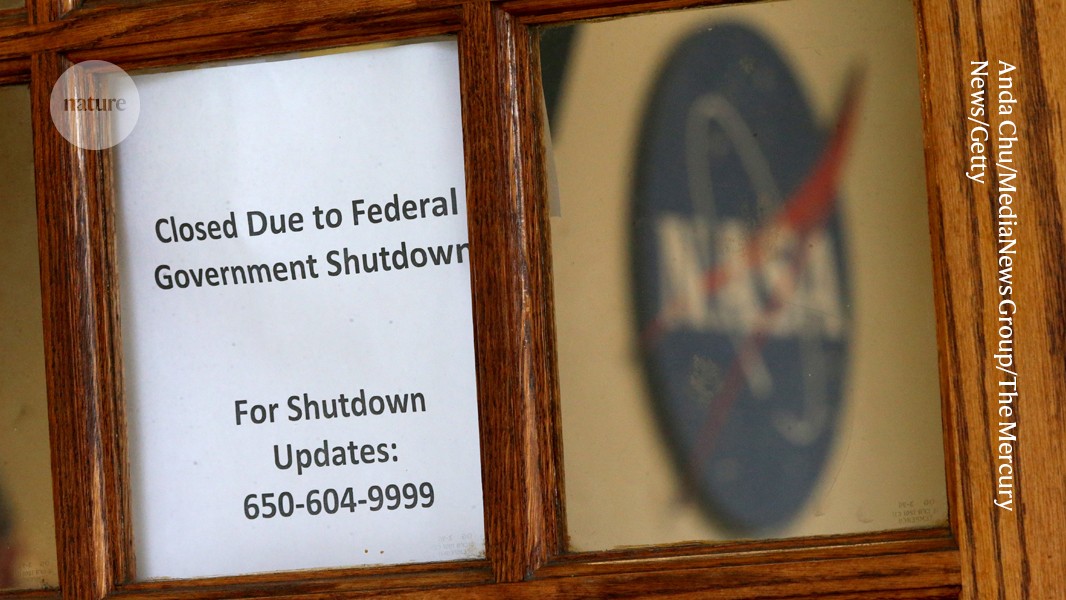
NASA and other science-oriented federal agencies were closed for more than six weeks as lawmakers wrangled.Credit: Anda Chu/MediaNews Group/The Mercury News/Getty
The historic shutdown of the US government, which shuttered science agencies, halted grant operations and left tens of thousands of federal scientists without paychecks, ended on 12 November after lasting a record-breaking 43 days. A deal approved by Congress and signed by US President Donald Trump funds most government agencies through to 30 January. Science advocates expressed hope that Congress will use the intervening time to finalize research budgets for the 2026 fiscal year — which could help to ward off massive cuts proposed by the Trump administration.
The shutdown began on 1 October due in part to a Congressional dispute over federal spending on health care. Most work ground to a halt, including activities related to the issuing of federal research grants. That work will now restart. Under the terms of the deal, federal scientists will be paid what they would have earned during the furlough, and those who were laid off will be rehired — at least for now.
The prospective ramp-up of activities after such a long hiatus has been welcomed by science-advocacy groups. Any interruption in science activities slows research and innovation that bolsters the US economy, national security and public health, says Joanne Carney, chief government-relations officer for the American Association for the Advancement of Science in Washington DC. “We’re in a global competition, and we cannot wait any longer.”
The White House did not respond to Nature’s request for comment.
Here Nature looks at what comes next for science as the US government reopens for business.
How quickly will science agencies get back to work — especially on grant activity?
During the shutdown, scientists whose activities were considered essential, such as the ‘hurricane hunters’ who collect data by flying into storms, kept working, though without pay. Other research activities also continued. NASA’s Mars rovers, for example, continued to operate through the shutdown, funded in advance by contracts run by non-federal workers who were not affected by the lapse in Congressional funding.
But activities deemed non-essential, such as review of research grant proposals, stopped. Now that the government has reopened, programme officers will reschedule such reviews.
Trump moves to slash NSF: why are the proposed budget cuts so big?
At the US National Science Foundation (NSF), for example, more than 300 grant-review meetings will need to be rescheduled. Each grant-review panel consists of about six to ten researchers, so rescheduling all of the panels before the end of the year would be ‘miraculous’, says an NSF programme officer who requested anonymity out of concerns about retaliation for speaking without authorization. The delay in reviewing will almost certainly lead to a delay in getting grants out the door, they say. (After requesting comment from the NSF on 12 November, Nature received an automated response that the agency is not answering emails during the shutdown.)
Federal workers “will do what it takes to keep things on track,” says Eleanor Dehoney, who heads policy and advocacy for Research!America, a science advocacy group in Arlington, Virginia. “The staff at science agencies, the rank and file, are complete workhorses.”
What’s the funding outlook for science agencies in the 2026 fiscal year?
In the budget proposal it released in May for the 2026 fiscal year, which began 1 October, the Trump administration called for unprecedented cuts to US science agencies, including a 40% cut for the NIH. The budget for the NSF, one of the country’s main providers of grants for basic science, would be slashed by more than 50%, and NASA’s science budget would be cut nearly in half.
But draft legislation moving through Congress in the months before the shutdown rejected the president’s most drastic cuts. For example, lawmakers in the US House of Representatives proposed an 18% cut for NASA science, and lawmakers in the Senate called for no cut at all. The Senate sought an overall increase of more than 10% for research unrelated to defence, according to AAAS.
Trump proposes unprecedented budget cuts to US science
This week’s deal to end the shutdown finalized 2026 funding for the US Department of Agriculture and the US Food and Drug Agency (FDA). The agreement slashed support for climate programmes at the agriculture department but cut the FDA budget only 1% below the 2025 level. “Hopefully this is a good sign for science agencies”, Dehoney says.
