

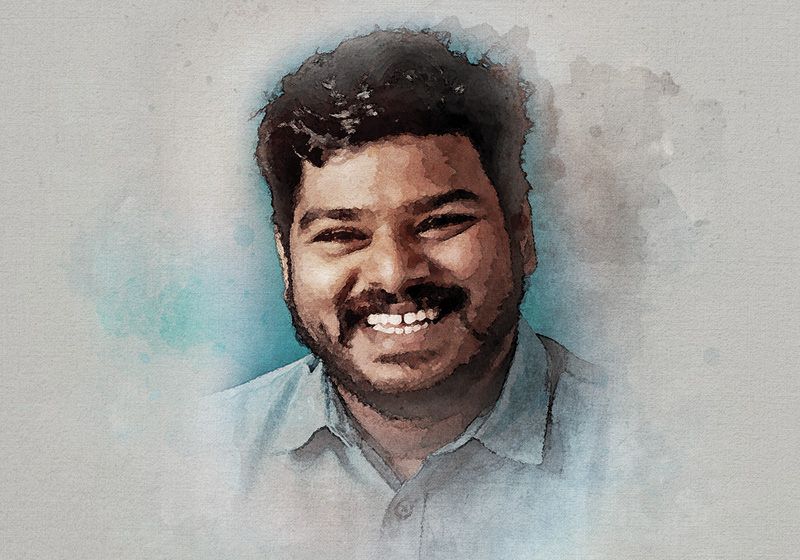
This researcher explores how RNA regulation enables stem cells to heal, adapt, and protect themselves under stress.
Q | Write a brief introduction to yourself including the lab you work in and your research background.
My name is Sudheesh Allikka Parambil, an associate research scientist in the Department of Molecular, Cellular, and Developmental Biology at Yale University. My research focuses on non-coding RNA regulation in innate immunity in stem cells, exploring how RNA regulation supports stem cell function and resilience during stress and regeneration.
Q | How did you first get interested in science and/or your field of research?
I first became interested in RNA while studying RNA viruses and the outbreaks they cause. I wanted to understand how these viruses use RNA to copy themselves and avoid the immune system. This made me curious about the many roles RNA plays in living things. At the same time, I was fascinated by how some animals can heal and regrow lost body parts. I learned about planarians, flatworms that can regenerate their whole head and brain from their tail regions using specialized cells, called stem cells. This amazing ability made me want to understand how we can use the knowledge of RNA to understand how regeneration works at the molecular level.
RNA plays an important role in controlling gene activity during regeneration. It helps stem cells stay healthy, respond to damage, and protect the genome. My research studies how RNA controls these processes in adult pluripotent stem cells and mammalian embryonic stem cells. By learning how the RNA guides stem cell behavior, I hope to uncover new ways to improve healing and develop better treatments in regenerative medicine. This connection between RNA and regeneration inspires my work and passion for biology.
Q | Tell us about your favorite research project you’re working on.
My favorite project focuses on isolating viruses from planarians. So far, only three to four viruses have been reported in these flatworms, but I suspect that many more remain undiscovered. Planarians live in diverse environments and have complex cell systems, so it seemed unlikely that they would harbor so few viruses.
To explore this, I am using advanced RNA sequencing and molecular techniques to search for viral genomes within planarian tissues. Identifying new viruses will help us understand how these infections affect cell functions and regeneration. It also sheds light on virus-host interactions in a simple yet powerful model organism.
This project excites me because it challenges the current understanding of viral diversity in planarians and opens new avenues to study innate immunity and RNA-based antiviral defense. Discovering novel viruses can reveal how stem cells recognize and respond to infection, which has implications for broader stem cell biology and immunity research. It’s a unique blend of virology, RNA biology, and regeneration that drives my curiosity and passion.
Q | What do you find most exciting about your research project?
The most exciting part of my scientific journey has been working with people from diverse backgrounds who bring unique expertise and perspectives. Collaborating across disciplines enriches my research and leads to creative solutions I couldn’t find alone, pushing me to grow and think differently.
Mentorship is another deeply rewarding aspect. Training undergraduate students and early-career scientists lets me share knowledge while learning from their fresh ideas and enthusiasm. Watching them develop critical thinking and independence reminds me that science is a shared effort across generations, where we are both mentees and mentors.
These experiences have shaped my growth and fueled my passion for discovery. The community, collaboration, and chance to support future scientists make this journey meaningful beyond the experiments themselves.
Q | If you could be a laboratory instrument, which one would you be and why?
This is a tough question since every instrument plays an important role. However, if I had to choose, I would be a microscope. Like a microscope, I strive to reveal insights hidden from the naked eye, transforming the invisible into clear, understandable discoveries that help advance our science, reminding us not to judge a book by its cover!
I admire how a microscope connects the big picture with the smallest details, much like my research approach, linking broad biological questions to molecular and biochemical mechanisms. It embodies precision, patience, and curiosity, qualities I deeply value in science.
Also, being a microscope means empowering others to see more clearly and understand better, symbolizing my passion for exploration, clarity, and uncovering the unknown.
Are you a researcher who would like to be featured in the “Postdoc Portraits” series? Send in your application here.
