

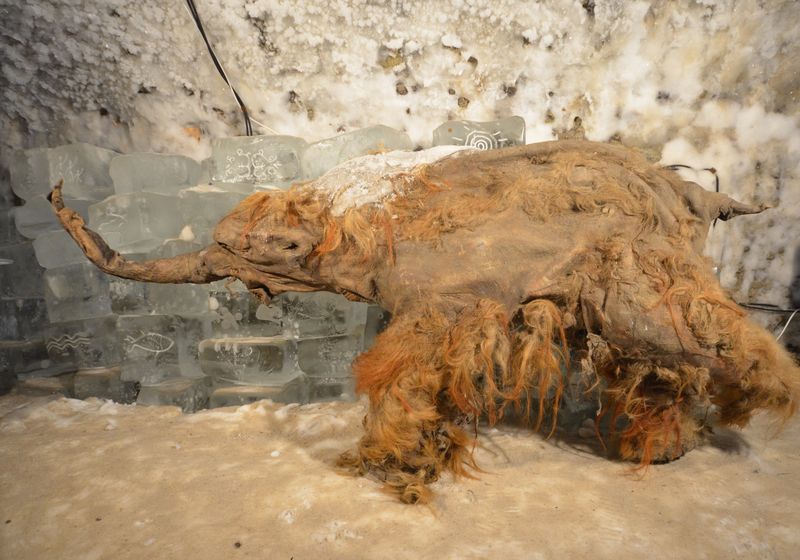
Scientists recently recovered and sequenced the oldest RNA ever from a 39,000-year-old woolly mammoth called Yuka, which has been on display in frozen conditions at the Yakutsk State Museum in Moscow since 2014.
Image credit:Valeri Plotnikov
Scientists are consistently one-upping each other when it comes to finding the oldest molecules from fossils. The race even includes the notoriously fragile RNA.
In a recent Cell study, researchers recovered and sequenced RNA from an extraordinarily preserved 39,000-year-old woolly mammoth called Yuka, which was discovered in the Siberian permafrost more than a decade ago.1 This sample was nearly three times older than the previous record holder, an approximately 14,000-year-old wolf puppy.2
“It’s groundbreaking,” said Oliver Smith, a paleontologist now at Micropathology Ltd. Smith led the wolf puppy study when he was a postdoctoral researcher at the University of Copenhagen but was not involved in the new work. “I think a lot of people would be surprised that you can get RNA that old.”
Under the Right Conditions, RNA May Last Much Longer Than Expected
For decades, ancient RNA discoveries “were mostly disregarded or just considered low profile or not really useful,” said Emilio Mármol-Sánchez, a paleogeneticist at Stockholm University and the Centre for Palaeogenetics who led the present study on woolly mammoths.
Emilio Mármol-Sánchez, a paleogeneticist at Stockholm University and the lead author of the study, develops and optimizes techniques to recover and analyze ancient RNA.
Emilio Mármol-Sánchez
In contrast, ancient DNA research has exploded so much that it birthed an entirely new field: paleogenetics. The abundance of ancient DNA samples has allowed scientists to estimate a theoretical limit for the how long DNA could last.3 The number is 6.8 million years—so, finding dinosaur DNA seems unlikely, unfortunately—but recent discoveries are already creeping towards this limit.
There are nowhere near as many studies on ancient RNA, so such analysis is not yet feasible, but Mármol-Sánchez said, “I would not expect the age [limit] to be that different [from DNA] because they’re chemically very, very similar, though maybe it’s not going to be as old as DNA.”
From a biophysical and biochemical perspective, RNA is more fragile than DNA because it is single-stranded and is chemically more reactive than DNA. Mármol-Sánchez also said that “biology is modeled to create and destroy RNA more easily than DNA.” Cells need to preserve its “code for life,” but RNA levels change constantly, he added. Despite this, Smith thinks that RNA’s “fragility is overestimated.”

Oliver Smith is a paleontologist who led the work on the RNA recovery and sequencing from a 14,300-year-old wolf puppy. He was not involved in the new study.
Oliver Smith
Certain circumstances, such as the cold and dry conditions of permafrost, are especially well-suited to help RNA molecules persist. For instance, the 14,000-year-old wolf puppy from which Smith and his colleagues isolated RNA had been found in the Siberian permafrost. Before then, the oldest RNA molecules to be recovered and sequenced were from 5,000-year-old Ötzi the Iceman and 700-year-old corn.4,5
“People thought it was not possible to [get RNA] from anything that old, and I kind of wanted to prove them wrong,” Smith said.
Mármol-Sánchez, who described Smith’s paper as “seminal,” noted that his work helped inspire later studies involving more detailed bioinformatics analyses of ancient RNA, including Mármol-Sánchez’s latest study.6,7
Ancient RNA Uncovers the Lives of Extinct Animals Like the Woolly Mammoth
In the present study, Mármol-Sánchez and his colleagues extracted ancient RNA from 10 permafrost-preserved woolly mammoths. Based on the quality of the samples, they only performed detailed analyses on RNA from the 39,000-year-old Yuka, which tusk hunters unearthed in northern Siberia in 2010. Since 2014, Yuka has been on display in freezing conditions (−10°C) at the Yakutsk State Museum in Moscow.
When Mármol-Sánchez’s team sequenced RNA from Yuka’s muscle tissue, they discovered that the mammoth had a Y chromosome, indicating that it was male. This finding, which the researchers corroborated using DNA sequencing, contrasted with a previous report suggesting that Yuka was female based on how its hide looked in the genital area.8
Yuka’s muscle transcriptome also revealed the expression of genes linked to stress, such as ankyrin 1 (ANKRD1), which according to Mármol-Sánchez, suggested a “traumatic end of the animal’s life.” This was consistent with the claw marks on Yuka’s carcass, which indicated that cave lions or other predators might have hunted it.
In addition, the researchers discovered two novel microRNAs, whose presence had never been reported in any animal. microRNAs do not encode proteins, but they can have important roles in regulating gene expression via epigenetics.
Epigenomic modifications can reveal an animal’s rapid adaptations to the environment, said Smith, and these changes can then be passed down to its offspring. “It’s a different method of evolution compared to DNA mutating over time,” Smith added. “I think it’s really cool, and I’d like to see that in the future.”
To Mármol-Sánchez, non-coding RNAs, such as microRNAs, represent a layer of complexity that is not visible when researchers study DNA or proteins alone. He hopes that RNA can join DNA and proteins in helping scientists understand the lives of extinct animals.
Disclosure of Conflicts of Interest: Love Dalén, a coauthor of the study, is a member of the scientific advisory board at Colossal Biosciences.
- Mármol-Sánchez E, et al. Ancient RNA expression profiles from the extinct woolly mammoth. Cell. 2025;189:1-18.
- Smith O, et al. Ancient RNA from Late Pleistocene permafrost and historical canids shows tissue-specific transcriptome survival. PLoS Biol. 2019;17(7):e3000166.
- Allentoft ME, et al. The half-life of DNA in bone: measuring decay kinetics in 158 dated fossils. Proc Biol Sci. 2012;279(1748):4724-4733.
- Keller A, et al. miRNAs in ancient tissue specimens of the Tyrolean Iceman. Mol Biol Evol. 2017;34(4):793-801.
- Fordyce SL, et al. Deep sequencing of RNA from ancient maize kernels. PLoS One. 2013;8(1):e50961.
- Fromm B, et al. Ancient microRNA profiles of 14,300-yr-old canid samples confirm taxonomic origin and provide glimpses into tissue-specific gene regulation from the Pleistocene. RNA. 2021;27(3):324-334.
- Mármol-Sánchez E, et al. Historical RNA expression profiles from the extinct Tasmanian tiger. Genome Res. 2023;33(8):1299-1316.
- Maschenko EN, et al. Morphology, individual age, DNA and sex of the Yuka mammoth (Mammuthus primigenius) from Northern Yakutia, Russia. Paleontol J. 2021;55:1230-1259.
