

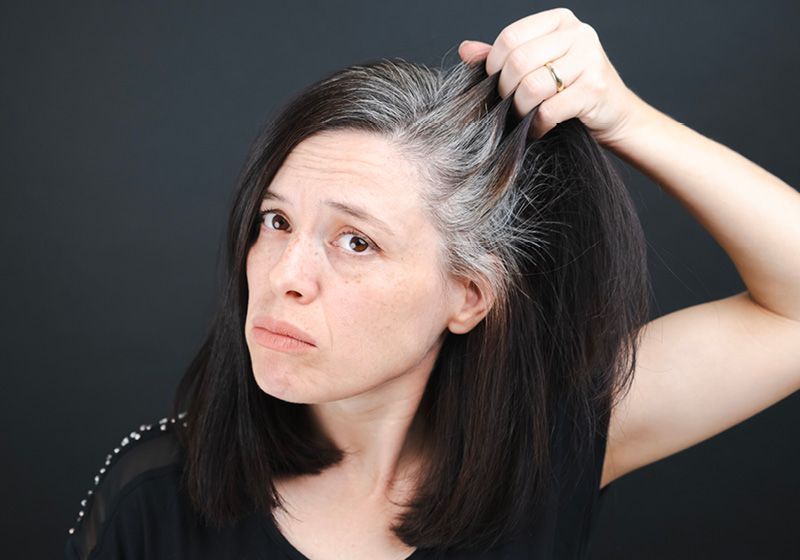
Marie Antoinette’s hair allegedly turned white overnight, just before her execution. Many later suggested that this account was likely exaggerated—her hair probably grayed gradually due to the stressful living conditions behind bars.
For centuries after that, many people have observed that stress seemed to make their hair as well as others’ go gray. However, scientists didn’t uncover the biological mechanisms that underlie this process until recently.
Fight-or-Flight Hormone Drives Irreversible, Stress-Induced Hair Graying in Mice
In a 2020 study, a team led by Ya-Chieh Hsu, a stem cell biologist at Harvard University, discovered that in mice, stress—whether it was physical or psychological—accelerated the proliferation of a group of undifferentiated stem cells.1 These cells eventually become melanocytes, which produce the pigment melanin. Fast division of melanocyte stem cells in turn led to their depletion. Without this reservoir, mice hair follicles could no longer produce melanin, resulting in irreversible hair graying.
“This is compelling and appealing to most scientists because it’s aligned with what’s been thought of in the last several decades,” said Martin Picard, a mitochondria biologist at Columbia University who was not involved in the study.
But what drove the depletion of melanocyte stem cells was less expected. Based on previous reports in the literature, Hsu’s team had anticipated the mice’s immune cells or the stress hormone corticosterone (cortisol in humans) to be responsible. But when they stressed mice that lacked immune cells or adrenal glands, their hair still grayed, which pointed to a different culprit.
Hair grays naturally during aging because the pool of melanocyte stem cells (magenta) gets depleted. In mice, stress activates the sympathetic nerves (green), which innervate the hair follicle and mediate the flight-or-flight response, accelerating this process.
Ya-Chieh Hsu
The researchers’ next suspect was noradrenaline, also known as norepinephrine or the fight-or-flight hormone. The team had observed that stress increased the levels of both corticosterone and noradrenaline in the mice’s blood. The surgical removal of the adrenal glands had no effect on stress-induced hair graying. However, inactivating sympathetic nerves, which mediate the fight-or-flight response by promoting the release of noradrenaline, with neurotoxin administration suppressed the loss of melanocyte stem cells and hair graying. Conversely, artificial activation of the sympathetic nerves using genetically engineered cell receptors induced melanocyte stem cell loss and hair graying, mimicking the effects of stress.
Hsu and her colleagues also found that blocking melanocyte stem cell proliferation could prevent hair graying due to stress. But once the stem cell pool had been depleted, hair graying could not be reversed.
“What surprised me the most was realizing that an adverse experience—stress—can directly cause such damage that led to a permanent change,” Hsu said.
But just a year later, findings from a study led by Picard indicated that in humans, hair graying due to stress may be reversible.
In Humans, Stress-Induced Hair Graying May Be Reversible
In a 2021 study, Picard’s team collected hair from 14 volunteers aged nine to 65, imaged them using a digital camera, and then quantified their pigmentation pattern using image analysis software.2 The researchers annotated the direction of pigmentation: For instance, a dark root and white tip indicated reversal of hair graying.

Martin Picard, a mitochondria biologist at Columbia University, studies metabolic responses to stress.
Martin Picard
The researchers asked several study participants who exhibited notable hair graying or reversal patterns to retrospectively assess their stress levels over the past year. The individuals briefly described significant life events and rated the intensities on a scale from 0 to 10. Using this account, the researchers aligned the selected participants’ “stress profiles” to their hair pigmentation patterns while assuming a hair growth rate of one centimeter each month. This allowed the researchers to map specific hair segments to life events.
The team discovered that the timeline for hair graying and reversal coincided closely with those of high- and low-stress periods, respectively. For example, in a 30-year-old female who went through a marital separation, the researchers observed graying in specific segments of her hair that corresponded to the event, which she rated as the most stressful in the past year. Strikingly, the change reversed at the end of the two months of the high-stress period. Similarly, a 35-year-old male’s graying hair exhibited a reversal pattern that coincided with the time he took a two-week vacation.
Picard deemed that the discrepancy between his findings and Hsu’s was likely due to inherent differences between mice and humans. He noted that there are key distinctions between how human hair and mice fur grow. He added, “The little creatures’ life in cages doesn’t align with human lives in the world. We should be careful about translating and extending results in mice to humans.”
According to Hsu, the reversibility of hair graying that Picard’s team observed was likely because the melanocyte stem cell pool had not been depleted. Instead, the differentiated melanocytes likely ceased to produce pigment temporarily. “Because the stem cells remain intact, the color changes are not permanent,” she said.
As melanocyte stem cell populations naturally decline over time, age is an important determinant of whether hair graying is reversible. “In midlife, when hair just started graying, it looks like that it has the potential to go back. But when people are in their 80s, hair don’t just go back to being dark again,” Picard said.
Both Hsu and Picard think that hair graying due to stress seemed to accelerate a process that naturally occurs during aging. And to Picard, the possibility of hair graying reversal indicates that, in contrary to the current dogma, on a molecular level, “life is much more dynamic and flexible, and aging is not a linear, irreversible process.”
