

You have full access to this article via your institution.
Hello Nature readers, would you like to get this Briefing in your inbox free every day? Sign up here.
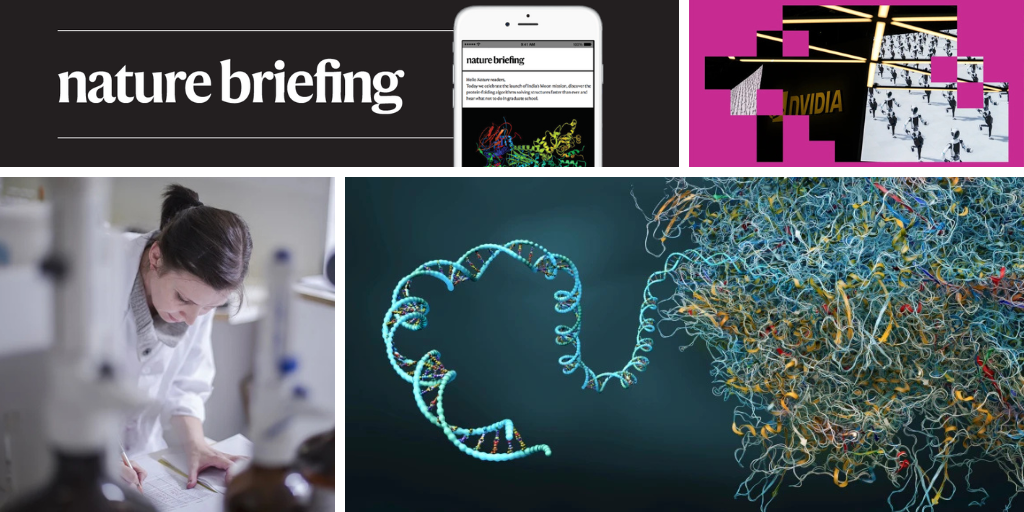
A cell’s protein-making machinery (artist’s illustration) can be instructed to ignore mutations that would otherwise result in shortened proteins. Credit: Christoph Burgstedt/Science Photo Library
A multipurpose gene-editing tool can correct several genetic conditions in mice by restoring proteins that have been cut short by disease-causing mutations. The method, called PERT, uses engineered RNA molecules that allow protein synthesis to continue even when a DNA mutation tells it to stop prematurely. These ‘nonsense mutations’ comprise nearly one-quarter of known disease-causing DNA variants. As such, if PERT proves effective in humans, it could overcome the need to design bespoke treatments for individual diseases.
Female authors made up just 23% of those in a sample of nearly 900 retracted medical studies published between 2008 and 2017, a new study has found. For first- and last-author slots, the percentage drops to 16.5% and 12.7%, respectively. Why this pronounced gender disparity emerges is unclear. One possible explanation is that the underrepresentation of women in senior academic roles in medical sciences means they’re less exposed to the risks that are more commonly associated with retractions, suggests study author and internal medicine specialist Paul Sebo.
The boom in artificial intelligence (AI) technology is starting to show signs of strain, which many financial analysts speculate could indicate an upcoming market crash. Some say that an AI-market collapse would be even more catastrophic than the dot-com crash in the early 2000s, which could suggest that mass lay-offs of AI researchers and developers are on the horizon. But there might be a silver lining, says economist Josh Turner. Scientists forced out of one sector can take innovation into another. Redundancies in the tech industry could also drive AI researchers back into academia, which has struggled to attract top AI talent.
Features & opinion
Brain implants that allow people with disabilities to control assistive technologies — such as robotic arms — are being trialled outside the motor cortex. Picking up signals from a larger number of brain areas could improve the performance of brain–computer interfaces (BCIs), but also give them access to private or ‘preconscious’ thoughts. Such advances would raise ethical red flags if left unregulated. That, along with growing interest in consumer products that monitor activity from outside the brain, leaves ethicists and neurotech developers asking how previously inaccessible brain information should be handled and used.
Since the introduction of the h-index — a metric that quantifies a researcher’s impact based on the number of their publications that have reached a certain number of citations — academic research has become awash with metrics that scrutinize every area of publication, and have slowly morphed into unhelpful assessment targets, says management researcher Dariusz Jemielniak. As an alternative, Jemielniak proposes a tongue-in-cheek new metric — the j-index — calculated as the total weight, in kilograms, of all publications a scientist has authored, over the number of years since the author earned their doctorate. “The j-index recognizes what we all know but seldom acknowledge: that real scholarship has weight,” he says.
In a business-as-usual scenario of continued high greenhouse-gas emissions, researchers have identified thousands of toxic sites, such as coastal power plants, sewage treatment facilities and defunct defence installations, that are at risk of increased flooding because of sea-level rise. People from marginalized communities — those with very low incomes, for example — are most likely to be vulnerable. “Ideally we would have a federal government that was enabling communities to plan and respond and proactively address these risks,” says environmental-health researcher and study co-author Rachel Morello-Frosch. But the administration of US President Donald Trump has cut disaster relief and related programmes, and cancelled grants designed to help rectify such inequalities.
Inside Climate News | 16 min read
Reference: Nature Communications paper
Today I’m admiring the beauty of the world from above. No, I haven’t grown overnight, I’m enjoying a selection of photos from the 2025 Drone Photo Awards.
Despite the name, the competition welcomes photos taken from any kind of unmanned aerial object, which this year capture oft-photographed landscapes from new perspectives, close encounters of the marine kind and the occasional precarity of successful sheep herding.
When I land back on solid ground, I’d be delighted to read your feedback on this newsletter. Please send your thoughts to briefing@nature.com.
Thanks for reading,
Jacob Smith, associate editor, Nature Briefing
With contributions by Flora Graham
• Nature Briefing: Careers — insights, advice and award-winning journalism to help you optimize your working life
• Nature Briefing: Microbiology — the most abundant living entities on our planet — microorganisms — and the role they play in health, the environment and food systems
• Nature Briefing: Anthropocene — climate change, biodiversity, sustainability and geoengineering
• Nature Briefing: AI & Robotics — 100% written by humans, of course
• Nature Briefing: Cancer — a weekly newsletter written with cancer researchers in mind
• Nature Briefing: Translational Research — covers biotechnology, drug discovery and pharma
