

- Vibration plates may boost bone density, muscle strength and balance.
- They may also reduce post-workout muscle soreness, especially for beginners.
- Be sure to consult a health care professional before using vibration plates.
Picture this: You’re wandering around the gym trying to figure out what exercise to do next when you spot someone standing on a platform while their body visibly vibrates. You stop and wonder: What the heck is that?
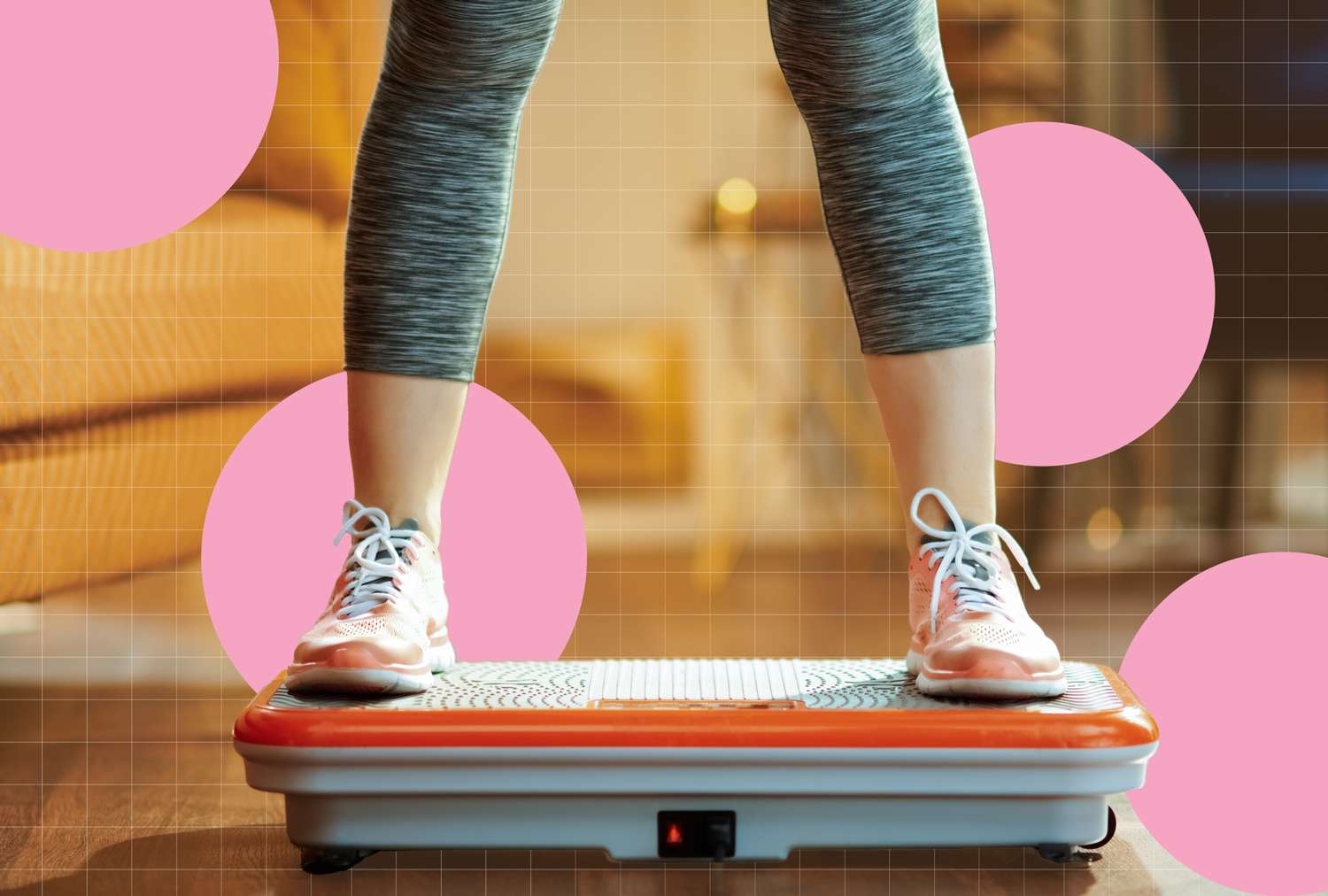
That odd-looking platform is a vibrating plate, also called a whole-body vibration (WBV) machine. It’s been causing quite a buzz on social media lately and may have appeared recently at your local gym.
But what does a vibrating plate even do? “Because of the vibration, a larger number of muscle fibers are engaged while working on the apparatus, and the muscles must remain in constant contraction to absorb the vibration,” explains Sue Talbert, M.S., NASM, CPT. “This can yield a variety of potential benefits such as improved bone health, reduced pain and stiffness, improved flexibility, muscle strengthening, improved circulation, increased calorie burn and more.”
Still, you might be wondering whether vibrating plates are truly worth your time or if they’re just another overhyped fitness fad. To find out, we spoke with fitness experts and dug into the research to break down the actual science behind vibrating machines to help you learn whether they’re helpful or just hype.
Potential Benefits of Vibrating Plates
While research on vibrating plates is still emerging, evidence suggests they may offer some potential benefits.
May Improve Bone Mineral Density
You probably already know that lifting weights and eating calcium-rich foods like yogurt and milk can help keep bones strong, but vibrating plates may offer an extra boost.
“Based on the research, training using whole-body vibration set at or above 20 Hz has resulted in improved bone mineral density of the lumbar spine in postmenopausal women,” says Melissa Hatton, M.S., NASM-CPT, CES, PES, CNC.
Why might it work? The mechanical vibrations generate small, repeated forces through the bones similar to weight-bearing exercise. This stimulates bone-forming cells (osteoblasts) and can help slow or prevent bone loss, explains Tara Phaff, D.P.T. “When used consistently, it may improve bone mineral density in areas prone to loss, such as the hips.”
Adding vibration training to your routine may be especially helpful for people at higher risk of osteoporosis or sarcopenia—age-related muscle loss. It’s also a smart option for anyone who struggles with traditional resistance training, offering a low-impact, time-efficient way to strengthen bones.
May Improve Stability, Balance and Posture
Standing on a vibration plate can train your body to stabilize itself better, helping to support balance and posture. “Because of the vibration, your body learns how to steady itself on an unstable surface. This is great training for everyday situations when your balance may be challenged,” shares Talbert.
Research backs this up, particularly for groups who benefit most from balance-focused training. One review found that whole-body vibration training led to significant improvements in step length, walking speed, balance and overall functional movement in stroke patients—while the control group showed no improvements.
Another randomized controlled study found significant improvements in balance and muscular power in individuals with chronic obstructive pulmonary disease (COPD) after using whole-body vibration three days per week for three weeks.
There’s also promising evidence of benefits for older adults. “Training that includes whole-body vibration has been shown to improve stability, postural control and sit-to-stand test results in older adults when the vibration frequency and amplitude of the vibrating plates were configured based on the individual instead of following a set protocol,” shares Hatton.
She explains that these improvements are a result of increased muscle spindle activation and enhanced neuromuscular efficiency—the speed in which signals are sent and received between muscles and the central nervous system. “These improvements can have a dramatic positive impact on balance, which can lessen an individual’s risk of falling.”
The benefits also extend to younger individuals and athletes. Research suggests that vibration plates can also enhance lower-limb neuromuscular activation and explosive power in younger athletes, supporting performance and potentially reducing injury risk.
May Improve Strength
Although some research suggests vibration plates may not significantly increase muscle mass, they have shown to improve muscle strength and physical function in older adults with muscle loss.
“Studies show that when combined with exercise, WBV (whole-body vibration) enhances lower-limb strength, particularly in older adults,” explains Sami Ahmed, D.P.T., CMTPT.
Phaff adds, “In a rehab setting, it’s especially useful for patients who can’t tolerate heavy loading, offering a low-impact way to rebuild strength [and] stability without overstressing healing tissues.”
May Reduce DOMS (Delayed Onset Muscle Soreness)
For anyone starting a new workout or pushing their limits, vibration plates may help ease the dreaded muscle soreness that usually follows.
“When used as a warm-up before exercise, vibration plate training has been shown to reduce the perception of delayed onset muscle soreness (DOMS)—measured by less post-workout perceived soreness and pain,” says Phaff. She points out that the effect appears strongest in untrained individuals, which may be helpful for newbies easing into new or more intense training programs.
Who Shouldn’t Use Vibrating Plates
While vibration plates offer several benefits, there are certain situations where they shouldn’t be used unless cleared by a health care provider:
- Recovering from a recent surgery
- History of gallstones, kidney stones or bladder stones (due to the potential risk of stones becoming dislodged and getting stuck, advises Hatton)
- Heart conditions, including a recent heart attack, stroke or having a pacemaker
- Recent joint replacement (Hatton suggests waiting at least six months before using, and getting medical clearance)
- Neurological conditions, such as epilepsy or frequent migraines
- Pregnancy
- Benign paroxysmal positional vertigo (BPPV) or positional dizziness.
Top-Rated Picks
- Lifepro Waver Vibration Plate Exercise Machine, $159.99 (was $199.99) at amazon.com
- Lifepro Rhythm Vibration Plate Exercise Machine with Handles for Balance Support, $305.97 (was $359.99) at amazon.com
- Sunny Health & Fitness Fitboard Vibration Platform Exercise Machine, $252.82 (was $297.49) at amazon.com
Our Expert Take
The buzz around vibration plates isn’t just hype—they do show real promise. Research and expert insights suggest that using them may help increase bone density and muscular strength, improve stability, posture and balance and even reduce post-workout muscle soreness.
However, vibrating plates aren’t a requirement to achieve fitness goals, nor should they replace traditional aerobic or strength-based training. They work best as a complement to your current routine. As with any new exercise, it’s best to consult your health care provider to make sure they’re safe and right for you.
