

Phytoplankton are microalgae that are integral to oxygen production and the ocean food web. Studying these organisms in Antarctica can inform researchers about how climate change affects this ecosystem, but its remote location presents many challenges. One of these is access to the study site to collect samples.
Allison Cusick and Martina Mascioni extracted DNA and RNA from phytoplankton samples to study the species present from the samples.
Allison Cusick
“As polar scientists, we have access maybe to one ship or no ships,” said Allison Cusick, a biological oceanographer and postdoctoral researcher at the University of California, San Diego.
In 2015, polar ecologist Maria Vernet at the University of California, San Diego received an email from polar tour guides wondering how they could help scientists in Antarctica conduct research at one site. After a successful pilot project, Cusick and her colleague, Martina Mascioni, a phytoplankton ecologist, both graduate students in Vernet’s group, expanded this project the next year to include more tour operators, allowing the team to study phytoplankton communities in more fjords. From this, the citizen science project FjordPhyto was born to study how melting glaciers affect phytoplankton communities.
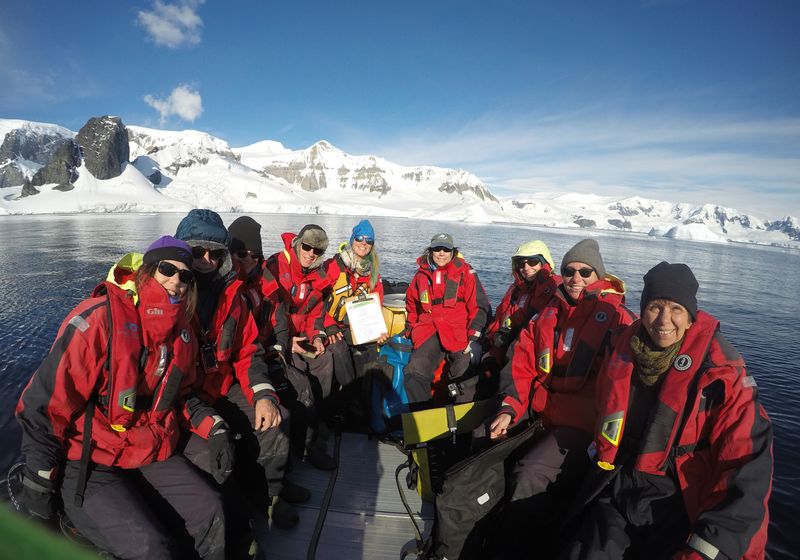
The team teaches the polar guides about phytoplankton and their role in the region and trains the guides on how to use equipment to collect water samples and take measurements on its salinity, temperature, and phytoplankton density. The guides then invite tourists on the cruises to join them in an inflatable boat to collect samples and tell the visitors about the microbial communities that the researchers are studying. “There’s a lot of things that you can do just with simple equipment, and that’s where FjordPhyto leads,” said Mascioni, currently a postdoctoral researcher at the National University of La Plata.
After returning to the tour ship, the guides can also put some of the samples under a microscope to show guests the phytoplankton living in the water. “Most of them say they didn’t know that [the citizen science project] was available, but it was [a] highlight on their trip,” Mascioni said.

Martina Mascioni uses microscopy to study the physical features of different phytoplankton collected from regions around Antarctica.
Martina Mascioni
After the cruise returns, the operators send the water samples to the FjordPhyto team. Mascioni studies the carbon biomass in the water and conducts cell counts with microscopy. Meanwhile, Cusick explores the species’ diversity and behavior using genetic techniques.
“I don’t think any of us realized how big this program could get and how much impact it would have beyond just our own theses,” Cusick said. Beyond their own research questions, Mascioni and Cusick said that the samples and data collected through FjordPhyto have opened new research avenues and collaborations with other scientists. The repeated collections provided them with time series of these communities that did not exist before. Next, the researchers are also interested in exploring other regions of Antarctica and even other parts of the southern oceans.
The FjordPhyto team is currently uploading their data to the public domain so that it is accessible for other researchers, and they are also creating materials in Spanish to reach a wider audience. Cusick said that the team hopes that FjordPhyto helps people understand how changes in Antarctica are important beyond the remote ecosystem. In the future, they hope to expand the engagement with citizen scientists by allowing them to track a sample’s progression through the research pipeline.
