

Close Menu
My Blog

    Subscribe to Updates

    Get the latest creative news from FooBar about art, design and business.

    What's Hot

    Nautilus debuts Voyager platform in push toward next-gen proteomics

    March 1, 2026

    First-in-Human Success for Prenatal Stem Cell Therapy in Spina Bifida

    February 28, 2026

    Pressure-Driven Pathway Links Liver Congestion to Fibrosis and Cancer

    February 28, 2026
    Facebook X (Twitter) Instagram
    X (Twitter) YouTube
    My BlogMy Blog
    Sunday, March 1
    • Home
    • About Us
    • Healthy Living
    • DNA & Genetics
    • Podcast
    • Shop
    My Blog
    Home»Microbiome»First Detailed Look at a Tsunami From Space Reveals Unexpected Feature : ScienceAlert
    Microbiome

    First Detailed Look at a Tsunami From Space Reveals Unexpected Feature : ScienceAlert

    adminBy adminDecember 3, 2025No Comments2 Mins Read
    Facebook Twitter Pinterest LinkedIn Tumblr WhatsApp VKontakte Email
    First Detailed Look at a Tsunami From Space Reveals Unexpected Feature : ScienceAlert
    Share
    Facebook Twitter LinkedIn Pinterest Email

    A satellite has tracked a tsunami in greater detail than ever before, which could help improve models of these giant waves and allow for better prediction and warning systems.

    Launched in 2022 by NASA and the French space agency Centre National d’Etudes Spatiales (CNES), the Surface Water and Ocean Topography (SWOT) satellite was designed to monitor the movement of the world’s waters based on changes in surface height. But after a few years of capturing data on small currents, SWOT fluked a major event.

    On 29 July 2025, a magnitude 8.8 earthquake struck the Kuril-Kamchatka subduction zone, off the southeastern coast of Russia. That sent a tsunami racing through the Pacific Ocean – just as SWOT happened to pass overhead.

    Related: Skyscraper Tsunami Unleashed by Seismic Anomaly Never Seen Before

    The leading edge of the tsunami visualized from sea surface height data from SWOT. (NASA/JPL-Caltech)

    Using data from the satellite, as well as three buoys floating in the area as part of the Deep-ocean Assessment and Reporting of Tsunamis (DART) project, researchers were able to capture a pattern of propagation and scattering that was more complex than previously thought.

    One major factor differed from existing models. It has long been assumed that big tsunamis are non-dispersive, meaning they mostly hold together as a single wave as they travel.

    But the SWOT data suggest the tsunami broke up, forming a relatively large leading wave followed by smaller trailing waves.
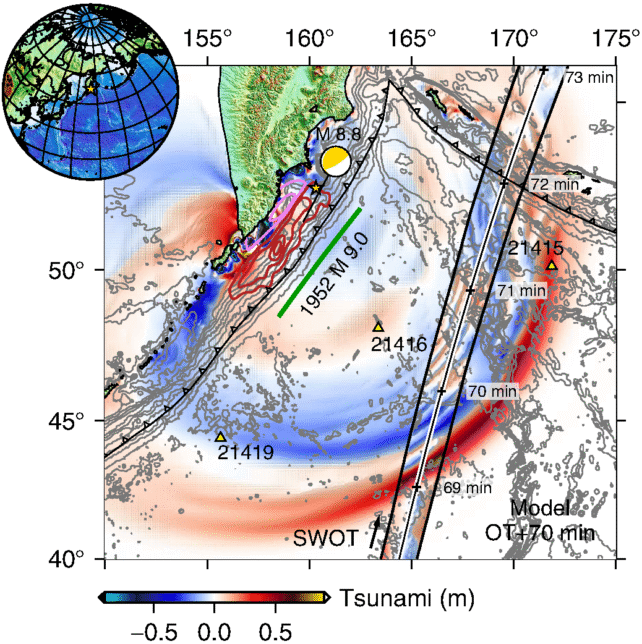
    Satellite Captures Details of Tsunami Racing Through Pacific Ocean
    SWOT data on the tsunami. The star is the hypocenter of the event. The leading wave of the tsunami, shown in red, exceeded 45 centimeters (1.5 feet) in height. (Ruiz‐Angulo et al., TSR, 2025)

    “I think of SWOT data as a new pair of glasses,” says Angel Ruiz-Angulo, first author of the study and physical oceanographer at the University of Iceland. “Before, with DARTs we could only see the tsunami at specific points in the vastness of the ocean. There have been other satellites before, but they only see a thin line across a tsunami in the best-case scenario.

    “Now, with SWOT, we can capture a swath up to about 120 kilometers [75 miles] wide, with unprecedented high-resolution data of the sea surface.”

    Win a $10,000 Space Coast Adventure Holiday

    With some fortunate timing, SWOT and other satellites could be useful for spotting and tracking future tsunamis in real time as well, allowing for as much warning as possible for coastal communities that may be affected.

    The research was published in the journal The Seismic Record.

    Detailed feature Reveals ScienceAlert Space tsunami Unexpected
    Share. Facebook Twitter Pinterest LinkedIn Tumblr WhatsApp Email
    Previous ArticleIs Tree Sap Safe to Eat? Risks and Benefits Explained
    Next Article Practical alternative to explosive reaction will improve lab safety
    admin
    • Website

    Related Posts

    First-in-Human Success for Prenatal Stem Cell Therapy in Spina Bifida

    February 28, 2026

    Pressure-Driven Pathway Links Liver Congestion to Fibrosis and Cancer

    February 28, 2026

    Genetic Biomarkers to Predict Efficacy of GLP-1 Therapies Uncovered

    February 28, 2026

    Mapping the Cellular Architecture of Aging Across 21 Organs

    February 28, 2026
    Leave A Reply Cancel Reply

    Our Picks

    9 Time-Saving Kitchen Gadgets for Fall at Amazon

    September 5, 2025

    Why Exercise Is So Important For Heart Health, From An MD

    September 5, 2025

    An Engineered Protein Helps Phagocytes Gobble Up Diseased Cells

    September 5, 2025

    How To Get Rid Of Hangnails + Causes From Experts

    September 5, 2025
    • Facebook
    • Twitter
    • Pinterest
    • Instagram
    • YouTube
    • Vimeo
    Don't Miss
    Longevity

    Nautilus debuts Voyager platform in push toward next-gen proteomics

    By adminMarch 1, 20260

    Company’s new benchtop system promises a clearer view of proteins following validation at a leading…

    First-in-Human Success for Prenatal Stem Cell Therapy in Spina Bifida

    February 28, 2026

    Pressure-Driven Pathway Links Liver Congestion to Fibrosis and Cancer

    February 28, 2026

    A cellular atlas of aging comes into focus

    February 28, 2026

    Subscribe to Updates

    Get the latest creative news from SmartMag about art & design.

    About Us

    At FineGut, our mission is simple: to enhance your self-awareness when it comes to your gut health. We believe that a healthy gut is the foundation of overall well-being, and understanding the brain–gut connection can truly transform the way you live.

    Our Picks

    9 Time-Saving Kitchen Gadgets for Fall at Amazon

    September 5, 2025

    Why Exercise Is So Important For Heart Health, From An MD

    September 5, 2025

    An Engineered Protein Helps Phagocytes Gobble Up Diseased Cells

    September 5, 2025
    Gut Health

    Nautilus debuts Voyager platform in push toward next-gen proteomics

    March 1, 2026

    First-in-Human Success for Prenatal Stem Cell Therapy in Spina Bifida

    February 28, 2026

    Pressure-Driven Pathway Links Liver Congestion to Fibrosis and Cancer

    February 28, 2026
    X (Twitter) YouTube
    • Contact us
    • Privacy Policy
    • Disclaimer
    • Terms and Conditions
    © 2026 finegut.com. Designed by Pro.

    Type above and press Enter to search. Press Esc to cancel.