

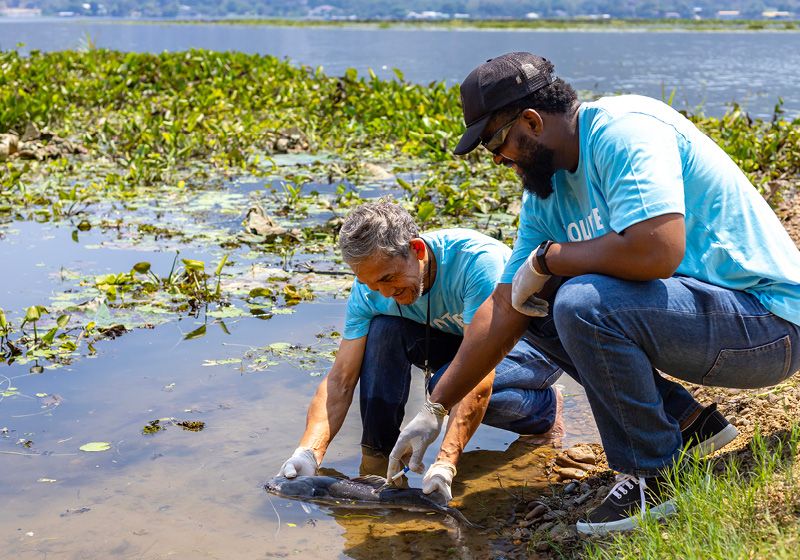
Curiosity comes alive when citizen scientists help map microbes, track wildlife, and uncover the unexpected.
Across the globe, citizen scientists are lending their eyes, hands, and curiosity to research. In some of these efforts, volunteers play the role of colorful creatures to study social behavior and disease. In others, they send photos and samples of mysterious household slime to help uncover new microbes. Many citizen scientists head outdoors to catch insects that will enrich global DNA databases, while others contribute vaginal swabs that expand our understanding of what a healthy human microbiome looks like. These initiatives demonstrate the power of collective curiosity. Get ready to explore the diverse and dazzling world of citizen science—and discover how anyone, anywhere, can help push science forward.
Citizen scientists can become “catchers” by identifying flowing or blocked blood vessels in Alzheimer’s disease mouse models.
Human Computation Institute
Tiny blood vessel blockages, or “stalls,” can slow blood flow in brains affected by Alzheimer’s disease. At Cornell University, researchers found that freeing these stuck cells improved blood flow, memory, and cognition in mice. But with millions of capillary images to sort, they needed help. This prompted researchers to develop Stall Catchers, an online game where volunteers peer through a virtual microscope and view videos of mouse brains to score blood vessels as “flowing” or “stalled.” Learn more about how, since its launch in 2016, over 130,000 participants have helped create a database of annotated flowing and stalled vessels, contributed to research papers, and led to other new developments. Insights from this data and volunteer feedback could help scientists test new conditions and better understand their influence on stalls.
While rabbits can evoke a chorus of ‘awws’ from pet lovers, Australian farmers see them as a serious agricultural pest. Since their introduction to Australia in the 19th century, rabbits rapidly spread across the continent and have had a devastating impact on farming land. This prompted researchers to use viruses, such as rabbit hemorrhagic disease virus (RHDV), as a biocontrol agent; subsequently, the Center for Invasive Solutions launched FeralScan and RabbitScan as free community resources to monitor the activity and disease spread of RHDV in rabbit populations. Since then, pet owners and farmers alike have submitted samples from their area, aiding scientists to track virus evolution and seasonal and geographical shifts. “We definitely would not have had this insight into the virus distribution genetic diversity without this project,” said Maria Jenckel, a molecular biologist at the Commonwealth Scientific and Industrial Research Organization. These findings will help inform researchers as they develop the next biocontrol virus in curbing feral rabbit populations.
Microbes thrive everywhere, from garden soil to seemingly inhospitable hydrothermal vents at the ocean floor. Because of their unique resilience, Braden Tierney, a microbiologist at Harvard Medical School, co-founded the nonprofit organization Two Frontiers Project (2FP) to explore how extremophiles might be solutions for climate change, sustainable agriculture, and human health. They launched The Extremophile Campaign: In Your Home in October 2024, which tasked citizen scientists to investigate the nooks and crannies of their household in search of unusual sights, from persistent sink slimes to stringy growths in the dark recesses of the dishwasher. By sequencing these ooey gooey samples, the researchers aim to catalogue and find potentially valuable microbes that thrive in harsh environments.

Players become little Nergal creatures and navigate a world of making friends, staying healthy, and avoiding sickness.
Then Try This; University of Edinburgh
Imagine entering a virtual world as a Nergal, a small blob with a potentially big appetite for making new friends and chowing down on delicious snacks—or not, the choice is entirely up to the player. Inspired by how researchers struggle to collect real-time responses during developing outbreaks, disease ecologists Matthew Silk and Nitara Wijayatilake at the University of Edinburgh worked with the nonprofit group Then Try This to develop the game Nergal. In this game, players are encouraged to navigate the risk and reward of social interactions and spreading an unknown sickness to one’s social circle. After five minutes of gameplay, players receive a report of how sociable and sickly their Nergal was and whether they infected others. “Our hope is that [Nergal] is this combination of being really beneficial as a communication tool, but also as a way of collecting data that actually informs [a] kind of scientific modeling around social behavior and disease,” said Silk.

Citizen scientists can learn about DNA barcoding while capturing and helping characterize creepy crawlies.
Cold Spring Harbor Laboratory DNA Learning Center
DNA barcoding enables researchers to identify species using short regions of their DNA. The Cold Spring Harbor Laboratory DNA Learning Center launched an educational program to do just that, focusing on creepy crawly insects. Starting with ants, participants collected hundreds of specimens, each with its own unique DNA barcode. The project has since expanded into the Citizen DNA Barcode Network (CDBN), including mosquitoes, beetles, and other elusive insects on their radar. By building this growing DNA database, citizen scientists are helping researchers uncover new species and track shifts in insect habitats, proving that even the smallest creatures can reveal big discoveries.
Tiny microbes can have a huge impact on fertility, pregnancy, and women’s health—but the vaginal microbiome has long been overlooked. Microbiologist Sarah Lebeer at the University of Antwerp launched a citizen science project to change that, inviting thousands of women to send in vaginal swabs. Named Isala after Belgium’s first female doctor, Isala Van Diest, the project created a reference map of the healthy vaginal microbiome, which helped open a new window into women’s health. Analysis revealed that factors like diet, age, and menstrual cycle phases influence microbiome composition, but many questions remain. How might menstrual products, supplements, or fasting affect it? Researchers are now looking into these aspects. “We hope that others are inspired and will also research in their home country to help women have better diagnostics and better therapeutics,” said Lebeer.
Subscribe to The Scientist to stay up to date on the latest news in life sciences.
