
Close Menu
My Blog

    Subscribe to Updates

    Get the latest creative news from FooBar about art, design and business.

    What's Hot

    Nautilus debuts Voyager platform in push toward next-gen proteomics

    March 1, 2026

    First-in-Human Success for Prenatal Stem Cell Therapy in Spina Bifida

    February 28, 2026

    Pressure-Driven Pathway Links Liver Congestion to Fibrosis and Cancer

    February 28, 2026
    Facebook X (Twitter) Instagram
    X (Twitter) YouTube
    My BlogMy Blog
    Sunday, March 1
    • Home
    • About Us
    • Healthy Living
    • DNA & Genetics
    • Podcast
    • Shop
    My Blog
    Home»DNA & Genetics»Next-Gen Brain-Computer Interface Packs 65,000 Electrodes on One Chip
    DNA & Genetics

    Next-Gen Brain-Computer Interface Packs 65,000 Electrodes on One Chip

    adminBy adminDecember 10, 2025No Comments3 Mins Read
    Facebook Twitter Pinterest LinkedIn Tumblr WhatsApp VKontakte Email
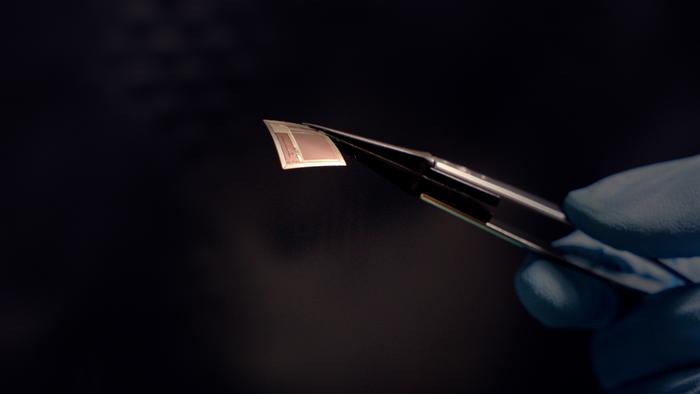
    The BISC implant shown here is roughly as thick as a human hair.
    Share
    Facebook Twitter LinkedIn Pinterest Email

    Could a future exist where the brain and artificial intelligence systems communicate as effortlessly as a smartphone connecting to Wi-Fi? This may sound like science fiction, but researchers are taking steps toward that reality. A team from Columbia University, New York Presbyterian Hospital, Stanford University, and the University of Pennsylvania has developed a brain–computer interface (BCI) called the Biological Interface System to Cortex (BISC), described in Nature Electronics in a paper titled, “A wireless subdural-contained brain–computer interface with 65,536 electrodes and 1,024 channels.” The device promises ultra-high resolution neural recording and wireless operation in a very small form compared to conventional devices.

    Current BCIs often rely on larger electronics housed in canisters implanted in the skull or chest, tethered by wires to the brain. These designs increase surgical complexity and risk of tissue damage, but there is a trade-off: invasiveness versus quality. “In electrophysiology, a fundamental trade-off exists between the invasiveness of the recording device and the spatiotemporal resolution and signal-to-noise ratio characteristics of the acquired neural signals,” the authors wrote.

    BISC takes a different approach: a single silicon chip, just 50 μm thick, that can slide “into the space between the brain and the skull, resting on the brain like a piece of wet tissue paper,” said senior author Ken Shepard, PhD, Lau Family professor of electrical engineering at Columbia. “Semiconductor technology has made this possible, allowing the computing power of room-sized computers to now fit in your pocket,” he added. “We are now doing the same for medical implantables, allowing complex electronics to exist in the body while taking up almost no space.”

    The chip integrates 65,536 electrodes and 1,024 simultaneous recording channels, along with wireless power and data telemetry—all on a single substrate. “This is a fundamentally different way of building BCI devices,” said co-author Nanyu Zeng, PhD.

    Preclinical studies in pigs and nonhuman primates demonstrated chronic, reliable recordings for weeks to months from motor, sensory, and visual cortices. These experiments decoded complex patterns such as stimulus orientation and feature predictions for wrist velocity. “The key to effective brain–computer interface devices is to maximize the information flow to and from the brain, while making the device as minimally invasive in its surgical implantation as possible,” said chief clinical collaborator Brett Youngerman, MD, a neurosurgeon at Columbia. Youngerman and colleagues recently received NIH funding to explore BISC for drug-resistant epilepsy, underscoring its potential clinical impact.

    Beyond therapy, the technology could eventually expand its uses. “BISC turns the cortical surface into an effective portal, delivering high-bandwidth, minimally invasive read–write communication with AI and external devices,” said Andreas Tolias, PhD, professor at the Byers Eye Institute at Stanford University. “Its single-chip scalability paves the way for adaptive neuroprosthetics and brain–AI interfaces to treat many neuropsychiatric disorders, such as epilepsy.”

    Studies in human patients for short-term inoperative recordings are already underway, according to the researchers. “By combining ultra-high resolution neural recording with fully wireless operation, and pairing that with advanced decoding and stimulation algorithms, we are moving toward a future where the brain and AI systems can interact seamlessly—not just for research, but for human benefit,” Shepard said. “This could change how we treat brain disorders, how we interface with machines, and ultimately how humans engage with AI.”

    BrainComputer Chip Electrodes Interface NextGen Packs
    Share. Facebook Twitter Pinterest LinkedIn Tumblr WhatsApp Email
    Previous ArticleCRISPR-Based Liquid Biopsy Method Detects Low-Frequency Cancer Mutations
    Next Article Base Edited CAR Ts Show Off-The-Shelf Promise for T-Cell Leukemia
    admin
    • Website

    Related Posts

    Nautilus debuts Voyager platform in push toward next-gen proteomics

    March 1, 2026

    A Video Report from AGBT

    February 27, 2026

    Novo Nordisk, Vivtex Ink Up to $2.1B Deal to Develop Oral Biologics for Metabolic Conditions

    February 27, 2026

    Increasing Rice Yields with Gene-Informed Selective Breeding

    February 27, 2026
    Leave A Reply Cancel Reply

    Our Picks

    9 Time-Saving Kitchen Gadgets for Fall at Amazon

    September 5, 2025

    Why Exercise Is So Important For Heart Health, From An MD

    September 5, 2025

    An Engineered Protein Helps Phagocytes Gobble Up Diseased Cells

    September 5, 2025

    How To Get Rid Of Hangnails + Causes From Experts

    September 5, 2025
    • Facebook
    • Twitter
    • Pinterest
    • Instagram
    • YouTube
    • Vimeo
    Don't Miss
    Longevity

    Nautilus debuts Voyager platform in push toward next-gen proteomics

    By adminMarch 1, 20260

    Company’s new benchtop system promises a clearer view of proteins following validation at a leading…

    First-in-Human Success for Prenatal Stem Cell Therapy in Spina Bifida

    February 28, 2026

    Pressure-Driven Pathway Links Liver Congestion to Fibrosis and Cancer

    February 28, 2026

    A cellular atlas of aging comes into focus

    February 28, 2026

    Subscribe to Updates

    Get the latest creative news from SmartMag about art & design.

    About Us

    At FineGut, our mission is simple: to enhance your self-awareness when it comes to your gut health. We believe that a healthy gut is the foundation of overall well-being, and understanding the brain–gut connection can truly transform the way you live.

    Our Picks

    9 Time-Saving Kitchen Gadgets for Fall at Amazon

    September 5, 2025

    Why Exercise Is So Important For Heart Health, From An MD

    September 5, 2025

    An Engineered Protein Helps Phagocytes Gobble Up Diseased Cells

    September 5, 2025
    Gut Health

    Nautilus debuts Voyager platform in push toward next-gen proteomics

    March 1, 2026

    First-in-Human Success for Prenatal Stem Cell Therapy in Spina Bifida

    February 28, 2026

    Pressure-Driven Pathway Links Liver Congestion to Fibrosis and Cancer

    February 28, 2026
    X (Twitter) YouTube
    • Contact us
    • Privacy Policy
    • Disclaimer
    • Terms and Conditions
    © 2026 finegut.com. Designed by Pro.

    Type above and press Enter to search. Press Esc to cancel.