

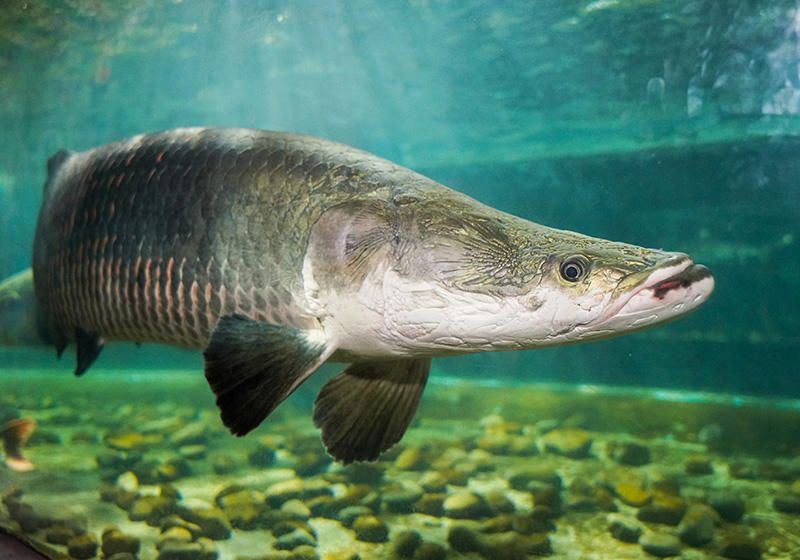
Protecting freshwater fish biodiversity in the Amazon is a top goal for conservation scientists. Genomic sequencing is redefining these efforts for the Amazonian carnivorous pirarucu fish.
©iStock, Pham Hung
Protecting Amazonian Biodiversity
The Amazon River basin is larger than any other on the planet, covering an expanse of over six million square kilometres and is home to a vast abundance and variety of freshwater fish species.1 While many of these species remain unidentified, this biodiversity serves important ecological and economic roles. Amazonian fish biodiversity is sensitive to human influence, including deforestation, pollution, tributary dam construction, overfishing, and climate change.1 As such, there is an increasing need to protect freshwater fish biodiversity in the Amazon.
The Case of the 100 kg Carnivorous Fish
Pirarucu, known scientifically by its Latin name Arapaima gigas, is the biggest Amazonian freshwater fish.2 Weighing in at a whopping 100 kg or more, these carnivorous fish help sustain local communities and commercial fishing industries. As a result of rising national and international demand, pirarucu went through periods of serious decline due to overfishing, rendering them an endangered species and necessitating sustainability practices.3
Raimundo Nonato Barbosa, a local fisherman whose father was also a fisherman, has witnessed changes in pirarucu over the decades. “We feel very bad now because there’s a lot of pollution,” Barbosa said. “I used to catch juveniles 30 years ago, some weighing 180 kilos…Nowadays, most are 25, 30, 40 kilos…There’s so much plastic, so many plastic bags…disposable cups, too much comes in the net and the fish get scared.”
Pirarucu were brought back from the brink of extinction through sustainable fishing practices, including breeding farms, and they remain an intense topic of study for scientists engaged in species conservation and biodiversity research. A Brazilian research group from the Institute of Biological Sciences at the Federal University of Pará (UFPA) is engaged in a genetic sequencing project of Amazonian fish and other species that focuses on pirarucu as a model for biodiversity preservation. Led by Sidney Emanuel Batista dos Santos, a professor of human and medical genetics, the group’s aim is to mitigate pirarucu overfishing in the Amazon through strategies that support sustainable breeding practices in captivity.
“Pirarucu has a complex natural reproduction system. It forms a pair only after a long period of coexistence and only then begins to reproduce,” Santos said. “First, we facilitated reproduction using a specific hormone, GnRH. [Then], through genetic sequencing, we needed to demonstrate that the meat being sold and exported came from broodstock raised in a specific farm. To achieve this, we developed specific paternity tests to verify the product’s origin—in other words, to confirm whether it comes from a particular farm or from the wild,” Santos explained. In doing so, the researchers provided a reliable and reproducible approach to tracking pirarucu bred in captivity, supporting local sustainable fishing programs that aim to reduce overfishing. The benefit to local communities is that as the number of fish reproducing naturally in rivers is bolstered, so too are native fishing activity and local food security.
Using Genomics and Collaboration to Preserve and Enrich Biodiversity
According to Santos, this model can be replicated for a variety of aquatic species. “The most important aspect is that, since DNA is universal, we can apply the same model to all Amazonian species, including the fish known as filhote, which can also weigh over 100 kilograms and suffers from overfishing, as well as certain turtle species,” Santos said. Moreover, knowledge of species diversity through genetic sequencing can help create a comprehensive operational manual for species that assists environmental preservation efforts. “With this knowledge, we can apply customized solutions for the reproduction, growth, and preservation of any animal,” Santos said.
In this way, the latest genetic sequencing technology plays a critical role in securing a future rich with biodiversity, including animals, plants, and minerals. For example, the Amazon’s only public sector genetic sequencer is housed at UFPA, reinforcing the positive potential of collaborations between tech and academia. Developed by MGI Tech, the DNBSEQ-T7 high-throughput DNA sequencer provides a rapid, high-performing, flexible, and cost-effective technology to enable environmental genomics research and discovery.
As part of UFPA’s efforts in the field, this sequencer has enabled the genetic analysis of over one hundred fish, including the full sequencing of two. Through collaborative efforts with other regional research centers, this work is shining a light on the essential role that the Amazon region plays as home to the greatest hub of biodiversity on Earth. In other research efforts, UFPA is also using genomic data to detect species population decline before visible ecological collapse.
UFPA is a member of the Integrated Center for Amazonian Sociobiodiversity (CISAM), an initiative that aims to strengthen research, teaching, and university outreach in the Amazon through partnerships among thirteen federal universities, promoting solutions for the region’s socioenvironmental challenges. “We are aware of the vast dimensions of the Amazon, and CISAM contributes to improving collaboration among researchers,” said Luciano Fogaça de Assis Montag, an associate professor of biological sciences at UFPA.
Local Message, Global Impact
For Amazonian locals in the region, these research efforts are a bridge to livelihood, food security, and the protection and development of ecological niches affected by climate change. The voices of researchers and locals alike rise to affect change, including at the 2025 COP30 United Nations Climate Change Conference in Belém, where the global importance of Amazon biodiversity and the collaborations that make environmental protection and sustainable development possible take center stage.

Sahara sandstorms have global impact. Dust that travels to distant locations such as Portugal can affect soil microbiota and crop health.
©iStock, Pavliha
Using Genomics for Agroresilience and Biological Security
Desert dust and sandstorms can contribute to deterioration in human health, the environment, and the economy both locally and in regions far removed from the storm by reducing air quality, negatively affecting agriculture, and upsetting transportation.4 Climate change is increasing the frequency and intensity of such events by enabling the contributing factors of dry conditions and lack of vegetation. Researchers around the world are studying bioaerosol samples from sandstorms to better understand their human health and environmental effects and mitigate the damage they may cause.
Tracking Saharan Dust Storms in Portugal
Portugal is situated at the western edge of the Iberian Peninsula. When Saharan dust clouds make their way northwest across Spain, they often settle over Portugal as well.5 Scientists are interested in Saharan dust deposited over Portugal because it serves as an example of long-distance transport, which is understudied. Long-distance bioaerosols carried into Portugal from the Sahara Desert can have significant impact on agriculture, contributing to detrimental changes in the soil microbiota, crop health, and potentially human health as well.5,6
Miguel Cachão, a grape farmer and member of the Association of Wine Growers of the Municipality of Palmela (Associação de Viticultores do Concelho de Palmela), describes the soil conditions in the area. Palmela vineyards are situated 40 km south of Lisbon in what is known as a wine-producing region of Portugal. “It has sandy soils, [and is] low in organic matter and quite poor. That has always created challenges for farmers when establishing their crops,” Cachão said. “We now know that with this new information about microorganisms we can provide support to farmers beyond the purely physical and chemical aspects of the soil, offering a better service.”
Exploring the Genomics of Bioaerosols
A research team from the University of Lisbon is studying the genomes of bioaerosols collected following Saharan dust intrusions, as an approach to biological surveillance and management in Portugal. “Bioaerosols are microparticles. Due to their size, they have the ability to be carried by winds to the atmosphere and travel thousands of kilometers. That’s exactly the main problem,” said Ricardo Dias, a microbiologist at the University of Lisbon and one of the researchers involved in this study.
Dust sample genetic sequencing provides information about the microbial composition of bioaerosols, how they may affect local agricultural ecosystems, and how best to develop agricultural management strategies. In some cases, certain dust-borne microorganisms can benefit soil health. In this way, genomic information can also help scientists leverage beneficial microorganisms to support soil and crop integrity.
“Portugal is exposed to various storms, coming to the South of the country or through the East. There is a historical record of various diseases associated with plants or animals, [which] are linked to these particles from North Africa. So, it was extremely important to monitor what was actually happening,” Dias said. “These dusts also have an interesting biotechnological potential, so there is a dual aspect of the research. Not only the issue of risk assessment, but also of the biotechnological potential, how they can also be beneficial for the agri-food sector,” he said.
To explore the genomics of these bioaerosols, the research team uses MGI’s DNBSEQ-G99 mid-low throughput sequencer—another example of academia-industry collaborations done right. “We already had a previous relationship with MGI. We already had…MGI extractors, such as the SP 960 and SP 100, and in fact, there was a point in which we felt it was time to reinforce our capacity with small fragment sequencers,” Dias said. MGI’s district manager, Hélder Barbosa, is excited about the potential of such collaborations to positively affect farmers in the region. “We expect that farmers, researchers, investigators, and the scientific community in particular can generate information to have a higher impact in the biological resilience,” he said. “What motivates us is that these tools may help farmers make more assertive decisions regarding climate change, but also to implement decisions that make their crops more sustainable and also more productive.”
Fostering Agricultural Resilience
Following Saharan sandstorm Celia, Dias’ team identified a genus of bacteria in Portugal that could function as a natural fertilizer in support of the fresh produce sector. “We have developed several studies, so that we not only gain knowledge, but also understand which are the main variables that are associated with increased productivity in these same systems,” Dias said.
Andreia Figueiredo is a cellular and molecular biologist at the University of Lisbon who studies grapevine plant-pathogen interactions. “We have been researching and testing some non-native microbiomes, [their] impact on the native microbiome of the plant, and [their] improvement of the plant’s resilience to pathogens,” Figueiredo said. In doing so, her team has been able to improve the quality of sustainable grape production while avoiding pesticide use. Figueiredo also acknowledges the important contributions of farmers in fostering agricultural resilience. “Thinking about the role that farmers should have regarding the knowledge of the impact of soil biodiversity on the response of crops to climate change and to the new challenges that arise associated with them, it will involve partly precision agriculture. In other words, farmers having the desire to know what are the soil microbiomes in a specific region and trying to make a change in these microbiomes to promote the resilience of the plant, its growth, and its nutrition,” Figueiredo said. In this way, decoding the hidden messages in dust using cutting-edge genomics holds the key to understanding and managing the long-distance effects of Saharan sandstorms on the agricultural microbiome, bolstering agroresilience and biosecurity.
The significant contribution of the latest genomics technology to environmental scientific research is opening doors for other scientists to follow the lead and apply these insights to their own research. While sandstorm dust continues to take flight, the sky’s the limit for genomic-based environmental science breakthroughs.

