

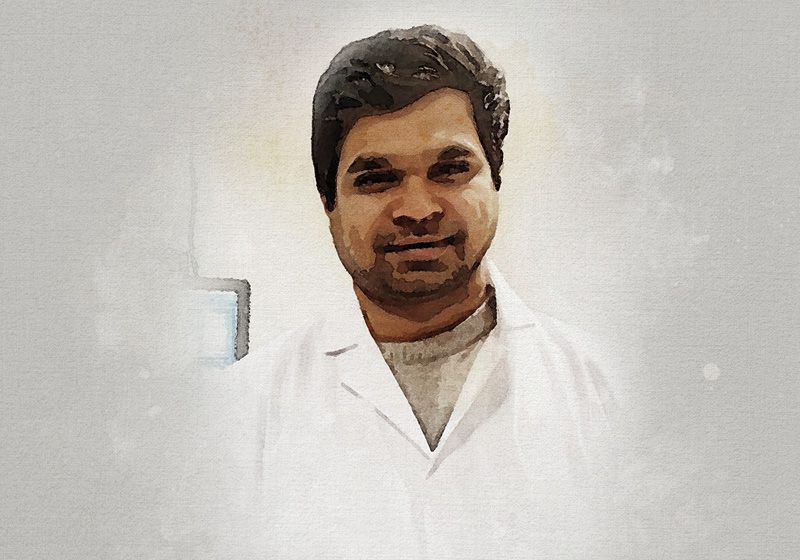
This postdoc pushes liquid-biopsy innovation by merging chemistry, imaging, and machine learning.
Q | Write a brief introduction to yourself including the lab you work in and your research background.
I am Dinesh Medipally, an interdisciplinary scientist at the Centre for Radiation and Environmental Science, Technological University Dublin. My research focuses on developing innovative liquid biopsy technologies for cancer diagnosis and prognosis, integrating body fluid analysis, advanced spectroscopy, and artificial intelligence to enable accurate, non-invasive, and early disease detection.
Q | How did you first get interested in science and/or your field of research?
My interest in research began during my undergraduate studies, where I was fascinated by the intricate mechanisms of human biology and the potential to translate scientific discoveries into real-world health solutions. Early exposure to laboratory research deepened my curiosity, especially in understanding disease at the cellular and molecular levels. As I progressed through my academic career, I became particularly interested in cancer research, given its profound societal impact and the urgent need for improved diagnostic tools. This led me to explore interdisciplinary approaches, combining biology, analytical chemistry, spectroscopy, and later, artificial intelligence. I was drawn to the challenge of developing non-invasive, accurate, and rapid diagnostic methods that could improve patient outcomes and reduce healthcare burdens. Over the years, my passion has evolved into a commitment to advancing liquid biopsy technologies, where body fluid analysis is paired with advanced AI models for cancer diagnosis and prognosis. This integration of multiple disciplines allows me to innovate at the intersection of science, technology, and healthcare, driving my continued enthusiasm for impactful research.
Q | Tell us about your favorite research project you’re working on.
My favorite research project is “Development of Vibrational Spectroscopy of Liquid Biopsies for Prostate Cancer Detection and Prediction of Treatment Outcomes.” This work combined advanced vibrational spectroscopy techniques, body fluid analysis, and machine learning to improve cancer diagnosis and prognosis. Our findings demonstrated the potential of this technology as a powerful tool for early detection, treatment monitoring, and predicting outcomes in patients undergoing radiotherapy. The project resulted in several publications in reputed journals and has laid the groundwork for further advancements in this field, with the ultimate goal of achieving clinical translation. This research not only showcased the impact of integrating multidisciplinary approaches but also strengthened my commitment to developing innovative, non-invasive diagnostic technologies that can transform cancer care.
Q | What do you find most exciting about your research project?
The most exciting part of my scientific journey has been witnessing my research evolve from a conceptual idea to a validated technology with real-world potential. My work on developing vibrational spectroscopy-based liquid biopsies, combined with artificial intelligence, for the detection and prediction of prostate cancer outcomes, has been a defining milestone. Seeing the first results showing positive outcomes in detecting cancer and predicting treatment response was a moment of genuine excitement. It reflected the culmination of years of interdisciplinary effort across biology, spectroscopy, and machine learning. Equally thrilling was the professional recognition that followed, including securing highly competitive Irish research grants. These achievements not only validated the scientific merit of my work but also provided the resources to advance the technology towards clinical translation. Knowing that this research could one day enable earlier diagnosis, guide treatment decisions, and improve patient outcomes continues to fuel my passion and commitment to impactful, innovative science.
Q | If you could be a laboratory instrument, which one would you be and why?
If I could be a laboratory instrument, I would be a Raman spectrometer. Much like my own research philosophy, a Raman spectrometer is curious, precise, and thrives on uncovering hidden details. It works quietly yet powerfully, using light to reveal the molecular “fingerprints” of a sample without altering it, something I value in research: making an impact without causing harm. I admire its versatility. It can study anything from delicate biological samples to complex materials, mirroring my interdisciplinary approach that bridges biology, chemistry, and artificial intelligence. A Raman spectrometer is also future-focused, continuously finding new applications in medicine, environmental monitoring, and material science. If I were this instrument, I would take pride in helping researchers see the invisible, decode the complex, and make discoveries that could change lives, illuminating the path from fundamental science to transformative real-world solutions.
Are you a researcher who would like to be featured in the “Postdoc Portraits” series? Send in your application here.
