

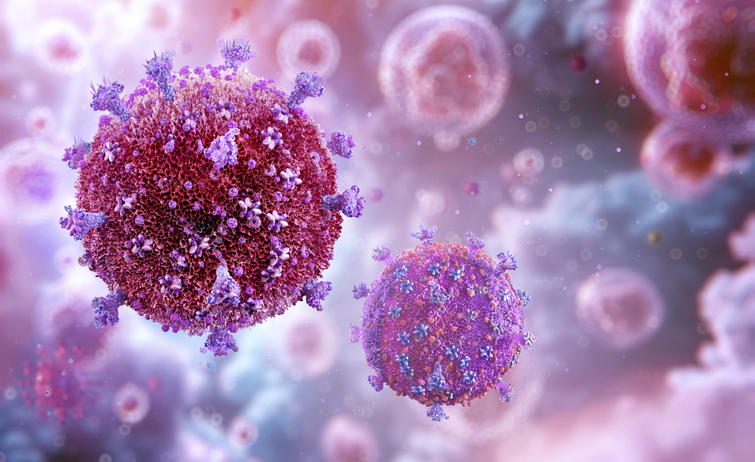
A Johns Hopkins Medicine–led research team have demonstrated that the use of chemotherapy drugs to fight cancer are associated with a significant reduction in CD4+ T cells carrying HIV provirus in a person living with HIV. The findings, published in the Journal of Clinical Investigation, indicated that HIV-infected CD4+ T cell clones may be susceptible to antiproliferative drugs and could potentially be a new strategy to significantly reduce the populations of immune cells carrying the HIV provirus.
“CD4+ T cells with dormant HIV proviruses make it difficult to eradicate the virus from the body, because the potential is always there for a renewed HIV infection,” said study co-senior author Joel Blankson, MD, PhD, professor of medicine at the Johns Hopkins University School of Medicine. “It’s vitally important for us to learn why there were significantly fewer clonally expanded, infected CD4+ T cells in the patient who received chemotherapy. If we can understand the mechanism by which that happened, perhaps it can be translated into a means of curing HIV.”
HIV remains present in the body because viral DNA becomes integrated into the genome of CD4+ T cells where they become a permanent part of the cell’s genetic makeup. This allows for the HIV provirus to be passed along to daughter cells when the parent cell divides, which is referred to as clonal expansion. These proviruses can then stay dormant for long periods of time, thus avoiding immune detection and drug treatments, while infected cells divide and pass the viral DNA to daughter cells through clonal expansion.
If antiretroviral treatments are stopped or conditions change, the dormant HIV proviruses can reactivate and produce a new virus. This activity has made developing an HIV cure very difficult, since these mechanisms make the virus so elusive and proliferative. To date, only a few people have been totally cleared of HIV as a result of high-risk bone marrow transplants for blood cancers.
The new study grew out of earlier observations in an individual described as an elite controller, someone who maintains undetectable viral loads without antiretroviral therapy. The researchers had previously documented that this patient experienced a marked reduction in the most clonally expanded HIV-infected CD4+ T cells after starting chemoradiation for metastatic lung cancer that included the chemotherapeutic agents paclitaxel and carboplatin. When chemotherapy was stopped and immunotherapy began, clonally expanded infected cells increased, raising the possibility that chemotherapy was responsible for the reduction in infected immune cells.
“Clonal expansion of HIV-infected CD4+ T cells is a barrier to HIV eradication,” the researchers wrote. They hypothesized that drugs targeting dividing cells could preferentially affect infected clones sustained by proliferation, without requiring activation of viral gene expression.
To test this, the team isolated an HIV-infected CD4+ T cell clone from the patient that carried a replication-competent provirus that was integrated into the ZNF721 gene. They used the HIV Gag peptide to stimulate this clone and induce proliferation in vitro. After stimulation, the cells were exposed to paclitaxel and carboplatin, or to the antiproliferative drug mycophenolate mofetil, with untreated stimulated cells serving as controls.
The results showed that stimulation alone led to marked expansion of the infected clone, but stimulation followed by exposure to paclitaxel or mycophenolate mofetil halted this expansion. Other CD4+ T cell clones not specific for the peptide were not affected by the drugs. “This strategy of antigen-specific stimulation followed by treatment with an antiproliferative agent may lead to the selective elimination of clonally expanded HIV-infected cells,” the researchers wrote.
Paclitaxel and carboplatin were chosen for this study since they were the two chemotherapies the patient received for lung cancer treatment, and the researchers suspected that HIV-infected CD4+ T cells were prevented from proliferating by them.
This research was informed by earlier studies that showed latency reversal strategies have not led to reductions in the HIV reservoir in immune cells because immune activation does not always result in viral protein production. “There is a need for alternate cure strategies that do not rely on latency reversal,” the researchers wrote.
Since this study only involved a single patient, the Johns Hopkins team consider it proof-of-concept research to see if targeting proliferation of antigen-specific, infected T cell clones could complement other treatment approaches. Francesco Simonetti, PhD, co-senior author and assistant professor of medicine at Johns Hopkins, said the team plans to examine CD4+ T cells from other people living with HIV to see whether similar susceptibility to antiproliferative drugs can be replicated. “Showing this happens in other people living with HIV will provide evidence that this suspicion is correct, and in turn, direct future research toward HIV cure strategies,” he said.
