

Chai Discovery has completed a $130 million Series B financing that the artificial intelligence (AI)-based de novo antibody designer says will help it accelerate its research and product development, as well as grow its commercialization efforts toward creating the equivalent of a computer-aided design suite for molecules.
Chai—a portmanteau for “chemistry” and “AI”—creates de novo antibodies through its Chai-2 platform. The company says Chai-2 is the first zero-shot generative platform to achieve double-digit success rates in experiments focused on de novo antibody design.
Chai unveiled Chai-2 in June with a preprint posted in bioRxiv that reported a 16% success rate in fully de novo antibody design of ≤20 antibodies or nanobodies to 52 diverse targets—a more than 100-fold improvement over previous computational methods. Chai researchers completed the workflow from AI design to wet-lab validation in under two weeks.
“We actually tested as few as 20 molecules for each one of those targets. Most papers in this space were putting out data on 2 or 3 molecules,” Josh Meier, Chai’s co-founder and CEO, as well as the preprint’s corresponding author, told GEN. “Given the really high success rates of the models, we’ve actually now been able to test this at a really large scale. We published a benchmark on over 50 targets, and since then, we’ve done way more than 100.”
Earlier this month, Chai posted an updated preprint highlighting the company’s expansion of de novo antibody design by applying Chai-2 to design therapeutic full-length monoclonal antibodies across conventional and challenging target classes.
“We find that >86% of these full-length mAbs have strong developability profiles on par with therapeutic antibodies. We further show that resolved structures of designs match in silico predictions, demonstrating that Chai-2 provides atomistically-accurate models of designed antibodies,” Chai researchers wrote in the updated preprint, for which Meier also served as corresponding author.
“With Chai-2, it is possible to design full-length mAbs with therapeutic attributes and function, before a single experiment is ever run in the wet-lab. This programmability heralds a new era of therapeutics design and could open entirely new frontiers for unmet clinical challenges,” the researchers added.
Riding the wave
Just as Chai-2 represented a major upgrade to the company’s Chai-1 open-source foundation model for molecular structure prediction unveiled last year, the company aims to further double down on research breakthroughs with its latest financing, Meier told GEN.
“If you look at how much progress has been made in the past year, we don’t see any signs of the model development slowing down. If anything, it actually seems to be accelerating,” Meier explained. “We just want to continue riding that wave, and that, I’d say, is the critical thing that we’re focused on with this round of financing.”
Chai has raised more than $225 million in total financing, some $30 million in seed financing, a $70 million Series A round announced in August, and now the Series B, which values the company at $1.3 billion. VC funding for AI drug development totaled $2.7 billion through the first three quarters of 2025, and AI-native biotechs enjoy a nearly 100% valuation premium over conventional biotechs, with a median valuation of $78 million, according to a PitchBook report released last month.
Among Chai’s investors since its seed round days is OpenAI, the developer of the AI assistant ChatGPT. After graduating from Harvard, Meier started work as a researcher at OpenAI during its development of GPT-1 and GPT-2, two foundational models that were improved through greatly expanded scaling and training into the GPT models incorporated into ChatGPT.
“We really had a front-row seat to language modeling and everything that was happening there,” Meier recalled, adding that the work persuaded him to direct his career back toward biotech, having studied both chemistry and computer science at Harvard.
“The question was, if these AI models can understand natural language processing, why can’t they understand the real natural language, like DNA and proteins? Let’s try to train language models on that kind of data as well,” Meier concluded. “It’s really that research question, I think, that’s been carrying us forward since then, this question of, can AI models understand the molecules of life?”
After OpenAI, Meier worked at the generative biology group of Facebook’s parent company Meta, where he co-led development of ESM1, the first transformer protein-language model. Meier next became chief AI officer at Absci, which engineers biologic drugs based on its own generative AI platform, overseeing the company’s AI efforts with Matthew McPartlon, who served as tech lead for de novo antibody design modeling.
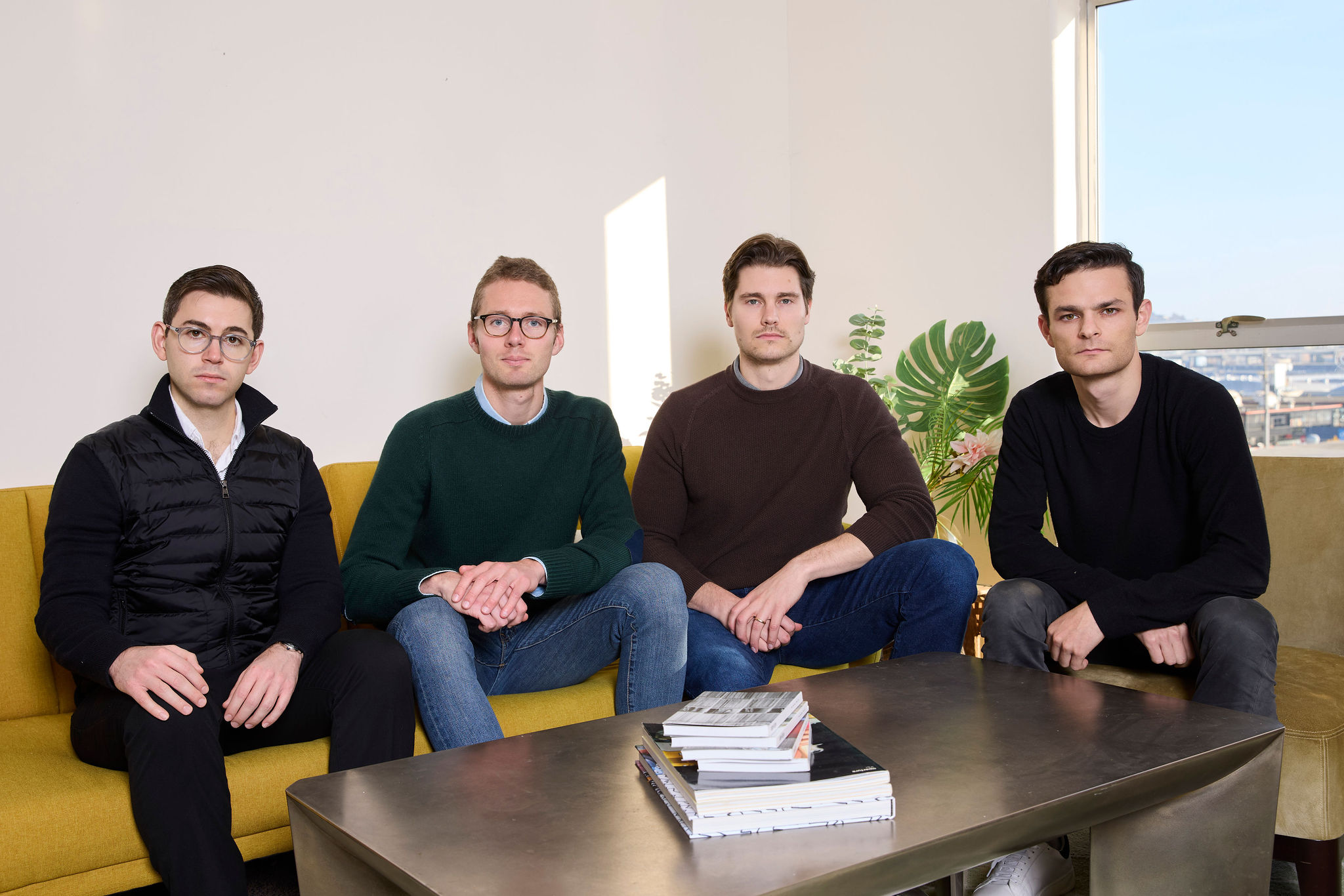
Last year, Meier co-founded Chai Discovery with McPartlon, Jacques Boitreaud, and Jack Dent, a longtime friend whom he met on their first day of computer science classes at Harvard University. Boitreaud previously led AI at Aqemia, “productionizing” machine language tools for small molecule discovery by making them robust, scalable, and reliable enough for real-world use, while Dent—who is Chai’s president—earlier built out and led the product and engineering teams at the financial infrastructure platform developer Stripe.
Betting on models
“We made a bet that these language models would reach an inflection point where they would become really useful across the board for drug discovery,” Meier recalled. “If you realize that these models are going to work at a scale that they can impact most drug discovery programs, you start to realize that, five years from now, this is just how everyone is going to be discovering drugs.”
“We started the company in order to make that vision a reality,” he said. “We want to make biology look less like science and look more like engineering and then usher in as much progress as we can on drug discovery and try to create the most impact we can in the world.”
Less like science means less of the scavenger hunt aspect of making changes to a molecule to make it better, only to end up with a molecule that doesn’t hit all of the properties needed for it to be a safe and effective therapeutic.
“We’re trying to turn that paradigm on its head. What we’d like to do instead is to be able to specify all the properties up front that you need in order to make a molecule a drug, and then have the model actually figure out those pieces and give you that perfect molecule,” Meier explained.
Chai Discovery has grown its workforce to about 25 people. “We’re a small team, but we’ve got a lot of work to do,” Meier acknowledged. “We have a very high bar for the people that we bring here, but we’re always looking out for exceptional talent across AI, biology, and product engineering.”
Chai strengthened its board in August by adding Mikael Dolsten, MD, PhD, Pfizer’s former CSO. And in tandem with its latest financing, Chai added to the board two representatives from its co-lead investors: Annie Lamont, co-founder and managing partner of Oak HC/FT; and Hemant Taneja, CEO of General Catalyst.
Oak HC/FT and General Catalyst co-led the Series B. Joining them and OpenAI as participants in the round were Thrive Capital, OpenAI, Dimension, Menlo Ventures, Lachy Groom, Yosemite, Neo, and SV Angel. Also joining the round were two new investors, Emerson Collective and Glade Brook Capital Partners.
“Nowhere is AI transformation more needed than in drug development—the process is slow, expensive, and imprecise. It can take over a decade and cost upwards of a billion dollars to bring a medicine from bench to bedside,” stated Lamont. “The Chai Discovery team is rewriting that story, fusing world-class AI and biological expertise to dramatically accelerate how medicines are discovered. We’re thrilled to support them as they push the boundaries of what’s possible in this field.”
