
Close Menu
My Blog

    Subscribe to Updates

    Get the latest creative news from FooBar about art, design and business.

    What's Hot

    Nautilus debuts Voyager platform in push toward next-gen proteomics

    March 1, 2026

    First-in-Human Success for Prenatal Stem Cell Therapy in Spina Bifida

    February 28, 2026

    Pressure-Driven Pathway Links Liver Congestion to Fibrosis and Cancer

    February 28, 2026
    Facebook X (Twitter) Instagram
    X (Twitter) YouTube
    My BlogMy Blog
    Sunday, March 1
    • Home
    • About Us
    • Healthy Living
    • DNA & Genetics
    • Podcast
    • Shop
    My Blog
    Home»DNA & Genetics»Engineered Dendritic Cells Harness Tumor EVs to Boost Cancer Immunotherapy
    DNA & Genetics

    Engineered Dendritic Cells Harness Tumor EVs to Boost Cancer Immunotherapy

    adminBy adminDecember 19, 2025No Comments3 Mins Read
    Facebook Twitter Pinterest LinkedIn Tumblr WhatsApp VKontakte Email
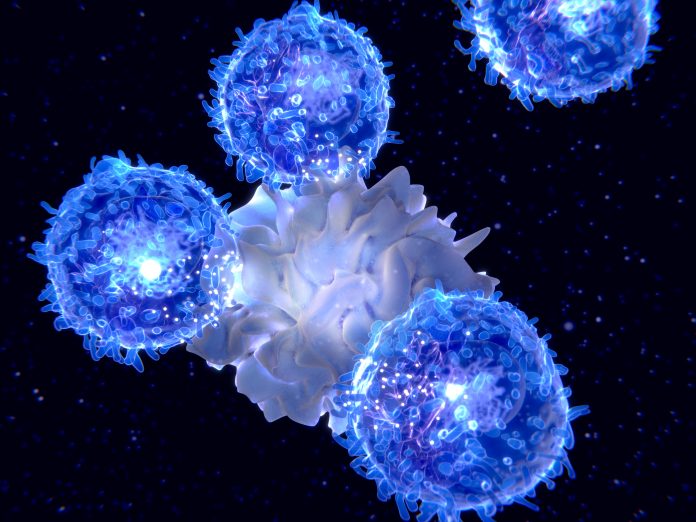
    Dendritic cell and T-lymphocytes, illustration
    Share
    Facebook Twitter LinkedIn Pinterest Email

    Source: Juan Gaertner/Science Photo Library

    Cancer immunotherapy transforms a patient’s immune cells into a “search‑and‑destroy” force against tumors. But many cancers learn to camouflage themselves from dendritic cells—the immune system’s scouts—making them harder to detect and target.

    Dendritic cells normally collect tumor antigens and present them to T cells, which then attack cancer cells. Clinicians have tried to overcome tumor evasion by harvesting dendritic cells from patients, loading them with tumor antigens in the lab, and reinfusing them in an effort to train dendritic cells to better identify the tumor. Yet this approach is limited: lab‑grown dendritic cells often lack key activation molecules, and the antigens supplied ex vivo represent only a fraction of those present in tumors.

    Tumor cells release extracellular vesicles (EVs)—tiny packets carrying proteins and antigens. If dendritic cells could capture these vesicles inside the body, they might trigger more precise and effective immune responses. Researchers at the Ecole Polytechnique Fédérale de Lausanne (EPFL), led by Michele De Palma, PhD, have developed two bioengineering strategies to exploit EVs and enhance dendritic‑cell immunotherapy.

    In work published in Nature Communications in October 2025 titled, “Dendritic cell progenitors engineered to express extracellular-vesicle–internalizing receptors enhance cancer immunotherapy in mouse models,” the team introduced the EV‑internalizing receptor (EVIR) into dendritic cell progenitors. EVIR enabled dendritic cells to efficiently take up tumor‑derived EVs and present their antigens to T cells. In mouse models of melanoma resistant to mainstream immunotherapy, EVIR‑engineered dendritic cells elicited robust immune responses and slowed tumor growth.

    Building on this foundation, a new paper titled “Coordinate tumor-antigen uptake and dendritic cell activation by chimeric antigen receptors,” published in Science Translational Medicine, describes an engineered, ubiquitination-resistant instructive chimeric antigen receptor (iCAR). The authors explain that iCAR‑engineered dendritic cells can recognize molecules on cancer cells or their extracellular vesicles—such as GD2 in melanoma or HER2 in epithelial tumors—promoting antigen uptake. They also activate to prime antigen-specific T cells through cross‑dressing and cross‑presentation and induce cytokine interleukin-12 (IL-12) expression in response to antigen capture. In preclinical melanoma models, iCAR‑engineered dendritic cells delayed tumor progression and expanded T‑cell diversity—without requiring ex vivo antigen loading or maturation.

    Together, these advances bring dendritic‑cell engineering into the preclinical realm, demonstrating proof of concept for antigen‑agnostic immunotherapy. By integrating antigen uptake with programmable dendritic cell activation, EVIR and iCAR platforms may overcome longstanding limitations of dendritic‑cell‑based therapies.

    Ali Ghasemi, PhD, and Yahya Mohammadzadeh, PhD—both former doctoral students on the project—have co‑founded EVIR Therapeutics, a biotechnology startup focused on advancing engineered dendritic‑cell therapies into clinical applications. The company will focus on engineered dendritic cells designed for improved performance in vivo, bridging the gap between laboratory breakthroughs and patient care. De Palma added, “Our goal is to relaunch the clinical potential of dendritic-cell-based therapies through engineering them for improved performance in vivo—enhanced antigen uptake coupled to cell activation, without the need for antigen exposure ex vivo.”

    Boost Cancer Cells Dendritic Engineered EVs harness Immunotherapy Tumor
    Share. Facebook Twitter Pinterest LinkedIn Tumblr WhatsApp Email
    Previous ArticleBrain Care Score Shows Greater Stroke Prevention Benefits in Black Adults
    Next Article Genetic Variation Affects Monoclonal Antibody Therapy
    admin
    • Website

    Related Posts

    Pressure-Driven Pathway Links Liver Congestion to Fibrosis and Cancer

    February 28, 2026

    A Video Report from AGBT

    February 27, 2026

    Novo Nordisk, Vivtex Ink Up to $2.1B Deal to Develop Oral Biologics for Metabolic Conditions

    February 27, 2026

    Advanced Brain Cancer Survival Rates Double with LITT

    February 27, 2026
    Leave A Reply Cancel Reply

    Our Picks

    9 Time-Saving Kitchen Gadgets for Fall at Amazon

    September 5, 2025

    Why Exercise Is So Important For Heart Health, From An MD

    September 5, 2025

    An Engineered Protein Helps Phagocytes Gobble Up Diseased Cells

    September 5, 2025

    How To Get Rid Of Hangnails + Causes From Experts

    September 5, 2025
    • Facebook
    • Twitter
    • Pinterest
    • Instagram
    • YouTube
    • Vimeo
    Don't Miss
    Longevity

    Nautilus debuts Voyager platform in push toward next-gen proteomics

    By adminMarch 1, 20260

    Company’s new benchtop system promises a clearer view of proteins following validation at a leading…

    First-in-Human Success for Prenatal Stem Cell Therapy in Spina Bifida

    February 28, 2026

    Pressure-Driven Pathway Links Liver Congestion to Fibrosis and Cancer

    February 28, 2026

    A cellular atlas of aging comes into focus

    February 28, 2026

    Subscribe to Updates

    Get the latest creative news from SmartMag about art & design.

    About Us

    At FineGut, our mission is simple: to enhance your self-awareness when it comes to your gut health. We believe that a healthy gut is the foundation of overall well-being, and understanding the brain–gut connection can truly transform the way you live.

    Our Picks

    9 Time-Saving Kitchen Gadgets for Fall at Amazon

    September 5, 2025

    Why Exercise Is So Important For Heart Health, From An MD

    September 5, 2025

    An Engineered Protein Helps Phagocytes Gobble Up Diseased Cells

    September 5, 2025
    Gut Health

    Nautilus debuts Voyager platform in push toward next-gen proteomics

    March 1, 2026

    First-in-Human Success for Prenatal Stem Cell Therapy in Spina Bifida

    February 28, 2026

    Pressure-Driven Pathway Links Liver Congestion to Fibrosis and Cancer

    February 28, 2026
    X (Twitter) YouTube
    • Contact us
    • Privacy Policy
    • Disclaimer
    • Terms and Conditions
    © 2026 finegut.com. Designed by Pro.

    Type above and press Enter to search. Press Esc to cancel.