

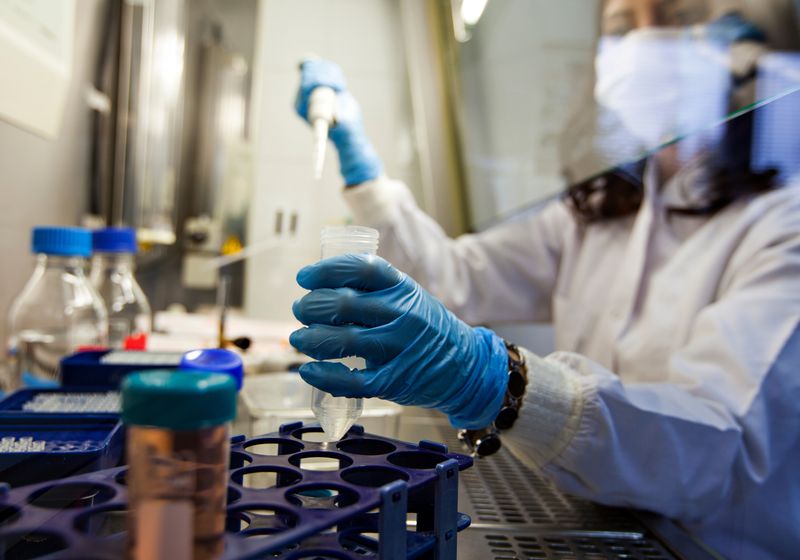
Scientists studied various aspects of cancer, including leveraging lessons from animals that don’t get the disease to developing non-invasive diagnostic tests for colorectal cancer.
Cancer research this year reshaped how scientists understood, detected, and treated the disease. Researchers figured out how viral infections could reawaken dormant cancer cells, leveraged lessons from animals that don’t get cancer, and made new discoveries to better understand and detect colorectal cancer. Take a look at the top cancer stories of the year 2025.
Influenza virus caused dormant cancer cells (green) in mouse lungs to reawaken and begin dividing, determined by expression of a proliferation marker (pink).
James DeGregori
During the first two years of the COVID-19 pandemic, Albert Einstein College of Medicine cancer biologist Julio Aguirre-Ghiso noticed a trend of increased cancer deaths. He suspected that viral infections could be activating dormant cancer cells. By combing through two datasets, he and his team observed that people with a history of cancer had an increased risk of deaths in the months following a SARS-CoV-2 infection. By using mouse models, Aguirre-Ghiso and his team observed that viral infection did indeed activate dormant cancer cells and increased metastasis. They observed that these reawakened cancer cells impaired T cell activation, hampering their antitumor effect. According to Aguirre-Ghiso, the findings suggest that people with a history of cancer must take extra precautions against viral infections.
With colorectal cancer (CRC) rates rising globally, University of California, San Diego cancer geneticist Ludmil Alexandrov and his team analyzed people’s genomes to uncover patterns that may contribute to the disease. By carrying out whole-genome sequencing and cataloging mutational patterns from more than 900 people with CRC across 11 countries, the researchers found a common link: Early-life exposure to colibactin, a DNA-damaging toxin produced by certain strains of Escherichia coli in the gut, was strongly linked to early-onset CRC. While E. coli is part of the healthy gut microbiome, some strains of the bacteria produce colibactin. According to Alexandrov, this type of research could be critical in the global effort to prevent and treat early-onset CRC.
Elephants, with their quadrillions of cells and 60-70 year-long lifespan rarely get cancer, despite a chance for the cells to acquire oncogenic mutations over decades. First described by epidemiologist Richard Peto in 1977, Peto’s Paradox is the observation that between species, there is not a strong correlation between cancer risk and body size. Comparative oncologists dove into studying large animals and found that they have elegant mechanisms that protect them from cancer. For instance, elephants carry extra copies of genes encoding tumor suppressor proteins. Their cells are also more sensitive to DNA damage compared to human cells and are more likely to undergo apoptosis when exposed to radiation. By studying species with unusually low cancer incidence, scientists could potentially develop methodologies to prevent or treat cancer in humans.
Traditionally seen in older adults, CRC is rising sharply among Generation X and Millennials, with cases in people under the age of 50 increasing. While scientists observed a link between known risk factors like obesity, diet, smoking, alcohol, and sedentary lifestyles and CRC, many young patients lack these, indicating unknown contributors. To look for potential explanations, scientists turned to the exposome—lifelong environmental exposures, including ultra-processed foods, chemicals, antibiotics, and lifestyle shifts—which are increasingly recognized as shaping disease risk. By using bioanalytical techniques, scientists aim to track changes in the exposomes of young people, which could help identify risk factors that predispose them to early-onset CRC. Researchers hope these insights will inform prevention strategies and precision medicine approaches that could help the generations most affected by this trend and reverse it for the future.
While colonoscopies are the gold-standard for colon cancer screening, they are time-intensive and require a day of prep and anesthesia. This causes many people to skip screening, increasing their chances of getting diagnosed with CRC at a more advanced stage. This motivated several researchers to develop non-invasive CRC screening tests based on biomarkers found in the stool. Despite several such tests with a high sensitivity and specificity getting FDA approval in 2024, physicians are unsure whether the tests can replace traditional colonoscopies and note that a positive non-invasive test would still require a follow-up colonoscopy for confirmation.

Lloyd Trotman explores the space between discovery and basic research to develop cancer models for functional analysis of how cancer arises and how clinicians can treat it.
Cold Spring Harbor Laboratory
Prostate cancer is often linked to harmful oxidative stress due to an imbalance between antioxidants and pro-oxidants. This prompted Lloyd Trotman, a molecular biologist at Cold Spring Harbor Laboratory to explore whether pro-oxidants, specifically menadione sodium bisulfate (MSB)—a precursor to vitamin K—could be a viable strategy to slow prostate cancer. By treating mice with the pro-oxidant, Trotman and his team found that MSB promotes prostate cancer cell death by targeting a key lipid kinase in the endosomal pathway. Because the kinase is also involved in X-linked myotubular myopathy, a severe muscle disease, the researchers tested MSB’s potential to tackle this condition in mice. The treatment greatly extended the animals’ lifespan and improved muscle health, highlighting the broader potential of pro-oxidants’ therapeutic benefits.
