

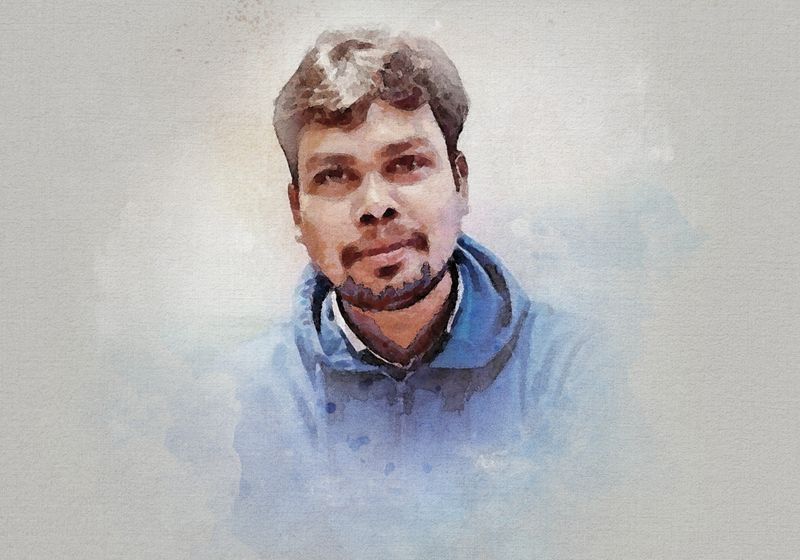
Working at the intersection of optics and plasma physics, this postdoc explores laser-driven nanostructuring
Q | Write a brief introduction to yourself including the lab you work in and your research background.
I am Md Abu Taher. I am currently an Institute Postdoctoral Fellow at the Center for Laser and Photonics in the Indian Institute of Technology Kanpur. My research spans ultrafast laser–matter interaction, nonlinear optics, and plasma physics, with expertise in laser-based nanostructuring, high-density plasma generation, and beam propagation modeling for advanced materials processing and scientific applications.
Q | How did you first get interested in science and/or your field of research?
From an early age, I was fascinated by how light interacts with matter—whether it was watching sunlight refract through water or seeing vivid colors from thin films. This curiosity deepened during my undergraduate studies, where courses in optics and quantum physics revealed the elegance and complexity of light–matter interactions. My master’s research on nonlinear optics introduced me to the power of lasers as tools for both fundamental science and practical applications. The turning point came during my PhD, when I began working with high-intensity femtosecond lasers to explore ultrafast processes in solids and generation of laser-induced sub-wavelength periodic nanogratings. The ability to probe and manipulate matter on femtosecond timescales felt like opening a window into a hidden world of extreme physics. Since then, my passion has been driven by the challenge of understanding and controlling these phenomena—from generating ultra-dense plasmas to designing advanced laser-based material processing techniques. This blend of fundamental discovery and technological innovation continues to inspire my research journey.
Q | Tell us about your favorite research project you’re working on.
Two of my favorite research projects reflect the versatility of ultrafast laser applications.
The first involved fabricating dual-scaled, laser-induced surface gratings using femtosecond laser writing. By precisely controlling fluence, pulse overlap, and scanning parameters, I achieved periodic structures beyond the diffraction limit, down to 40 nanometers. These hierarchical patterns offered unique optical and physical properties for photonics, sensing, and functional surfaces.
The second focused on CPU thermal management via laser-based aluminum heat sink fabrication. Using ultrafast laser processing, I engineered surface topographies to improve heat dissipation and reduce device temperatures. A reinforcement learning algorithm autonomously optimized laser parameters and geometries, delivering higher cooling efficiency with a smaller form factor.
Though distinct, both projects shared a unifying theme—merging precise laser–material interactions with advanced computational optimization to push performance boundaries, from nanoscale structuring to intelligent thermal management solutions for next-generation microelectronics.
Q | What has been the most exciting part of your scientific career/journey so far?
The most exciting part of my scientific journey has been achieving breakthroughs in ultrafast laser–material interactions. I fabricated dual-scaled, laser-induced surface gratings with features as small as 40nm, surpassing the diffraction limit, and developed laser-induced circular gratings in silicon for advanced light manipulation. Equally rewarding was applying femtosecond laser processing to fabricate aluminum CPU heat sinks, where a reinforcement learning algorithm optimized surface designs for superior cooling efficiency and reduced size. These milestones reflect my passion for combining precision laser fabrication with intelligent optimization, transforming fundamental science into practical solutions that advance both photonics and microelectronics technologies.
Q | If you could be a laboratory instrument, which one would you be and why?
If I were a laboratory instrument, I would be a spatial light modulator (SLM). Though not the most expensive piece of equipment, it is an incredibly powerful tool capable of shaping and modulating laser light into any desired pattern or phase profile. Just as an SLM adapts to create complex beam shapes for diverse applications, I thrive on flexibility, precision, and creativity in my research. An SLM’s strength lies not in its price, but in its ability to unlock the full potential of a laser system.
Are you a researcher who would like to be featured in the “Postdoc Portraits” series? Send in your application here.
