

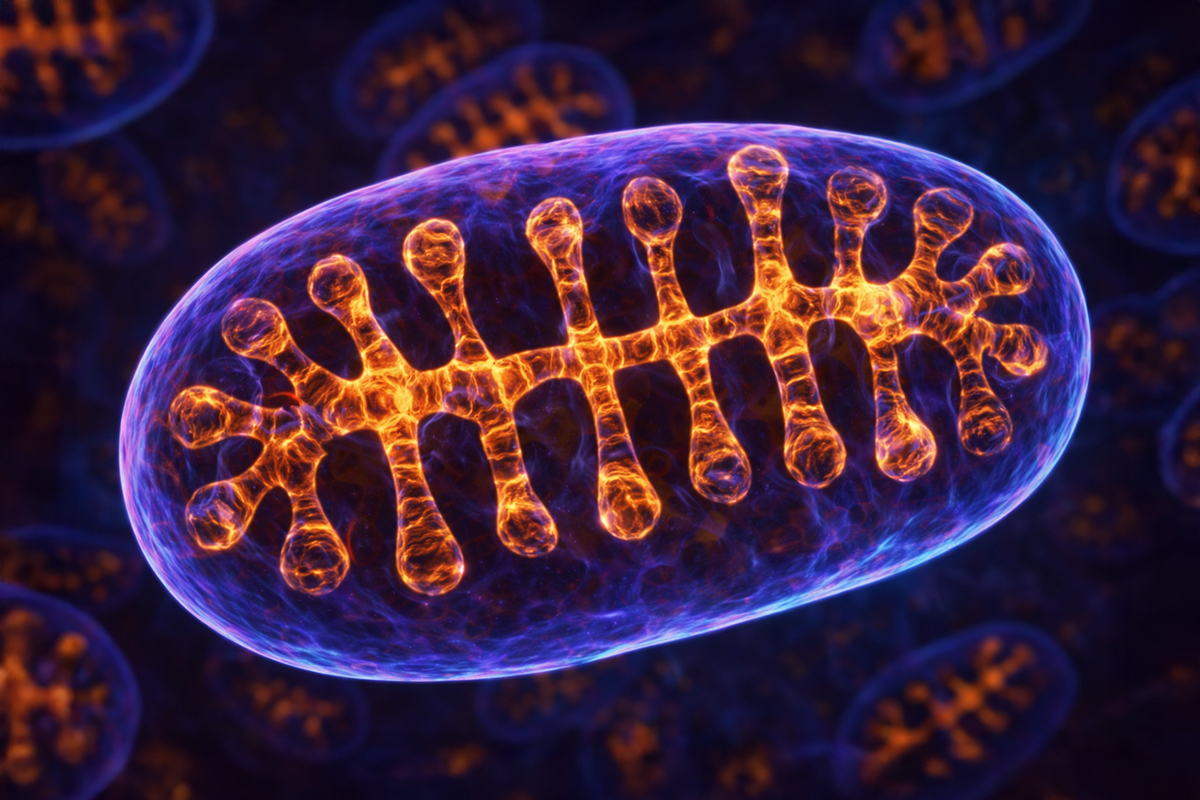
Boosting mitochondrial supercomplex assembly improves metabolic health and extends lifespan, opening new avenues for therapeutic exploration.
Mitochondria have long been celebrated as the powerhouses of the cell, but in aging research they have also emerged as central hubs where metabolic health, reactive oxygen species (ROS) and cellular signaling converge; when their efficiency falters with age, tissues and organs follow suit. In a new study published in Aging Cell, researchers from the Tokyo Metropolitan Institute for Geriatrics and Gerontology and collaborators have investigated whether reinforcing the organizational infrastructure of these organelles can influence aging and longevity. They focused on COX7RP, a mitochondrial protein that assists the assembly of respiratory chain complexes into so-called supercomplexes – higher-order structures thought to streamline electron flow and improve ATP production [1].
“We previously identified COX7RP, a mitochondrial protein, as a key factor that promotes the formation of mitochondrial respiratory supercomplexes, thereby enhancing energy production and reducing reactive oxygen species (ROS) that cause oxidative stress in cells,” explained Team Leader, Dr Satoshi Inoue. “Based on this, we investigated the role of COX7RP and mitochondrial respiratory supercomplexes in regulating aging and antiaging processes [2].”
The authors engineered transgenic mice that expressed elevated levels of COX7RP throughout life; compared with wild-type controls, male COX7RP-Tg mice exhibited a modest but statistically significant increase in average lifespan – about 6.6 percent longer – alongside a suite of healthier metabolic traits, including improved glucose homeostasis, greater insulin sensitivity, lower triglycerides and total cholesterol, and increased muscle endurance. At the cellular level, tissues from these mice showed increased ATP production, reduced ROS and enhanced mitochondrial efficiency, while white adipose tissue displayed higher nicotinamide adenine dinucleotide levels and lower markers of senescence such as β-galactosidase. Single-nucleus RNA sequencing revealed downregulation of senescence-associated secretory phenotype (SASP) genes in aged adipocytes, a pattern consistent with slower inflammatory aging in this depot [1].
Longevity.Technology: This work lands squarely in the heart of one of geroscience’s most persistent questions: whether aging is driven less by dramatic molecular failures than by the slow erosion of biological coordination. By showing that lifespan extension in mice can be nudged through improved mitochondrial supercomplex assembly rather than brute-force metabolic acceleration, the study rather reframes longevity as an issue of efficiency, not excess. COX7RP does not appear to make cells hyperactive or unnaturally resilient; instead, it helps them do familiar work with less friction – producing ATP with lower oxidative cost, preserving NAD⁺ levels and, crucially, muting the inflammatory noise of senescent adipose tissue. The emphasis on white adipose tissue is particularly telling. Once treated as passive storage, it increasingly looks like a command center for metabolic aging, broadcasting either dysfunction or restraint to the rest of the organism. Suppressing SASP without clearing cells outright also hints at a gentler future for senescence interventions – modulation over eradication, maintenance over shock therapy.
The translational implications are intriguing, but constrained by reality. This is a clean genetic model, male-biased and murine, and no one should pretend that a supercomplex assembly factor is about to become a consumer-facing longevity solution. Yet as a piece of target validation, it is unusually coherent. Mitochondrial architecture is emerging as a legitimate therapeutic surface, one that sits upstream of many familiar longevity tropes – exercise mimetics, NAD⁺ biology, insulin sensitivity – rather than downstream of them. For biotech, this points toward interventions that restore order rather than impose stress, and toward therapies designed to stabilize aging systems at scale rather than optimize individuals at the margins. In this framing, longevity is less about youth than about maintaining functional order through a long negotiation with entropy – a direction that rewards balance, structure and restraint over drama.
Metabolic resilience and tissue context
The COX7RP-Tg model draws attention to the central role of tissue-specific mitochondrial health. Adipose tissue, far from being inert, exerts significant influence on systemic metabolism through endocrine and inflammatory signaling. In the engineered mice, improved mitochondrial supercomplex assembly correlated with reduced expression of SASP genes in older adipocytes, suggesting that more efficient electron transport chains may dampen age-associated inflammatory signaling. The paper reports that ATP and NAD⁺ levels were elevated across tissues in COX7RP-Tg animals, while ROS production declined; these are hallmarks of healthier mitochondrial function that, in human observational studies, are linked with slower metabolic aging and preserved cellular resilience [1].
Importantly, some of these effects mirror adaptations seen in endurance training and caloric restriction, yet here they arise from structural enhancement of mitochondria themselves. The results speak to a theme increasingly discussed in geroscience: that interventions which shape how cellular systems organize and communicate can yield broader benefits than those that simply push individual pathways harder.
Translational outlook
Despite its elegant design, this study remains a proof-of-concept. Genetic overexpression models often illuminate interesting biology but can be remote from typical human interventions. Importantly, the lifespan extension observed was modest, and only male mice showed a significant effect – a reminder of sex-specific biology in aging research and the need for broader validation. Future endeavors must explore whether small molecules or biologics can safely mimic COX7RP’s influence on supercomplex assembly; this is far from straightforward, given the complexity of mitochondrial dynamics and the intricate balance between ROS signaling, energy production and cellular adaptation.
“Our study elucidated novel mitochondrial mechanisms underlying antiaging and longevity, and provided new insights into strategies for promoting healthspan and extending lifespan,” said Inoue.
“For instance, supplements and medications that enhance the assembly and function of mitochondrial respiratory supercomplexes may contribute to longevity expansion,” he added, framing mitochondrial supercomplex assembly as a therapeutic direction rather than an imminent intervention [2].
Nonetheless, the research demonstrates just what a multifaceted therapeutic target mitochondria are. It suggests that rather than chasing ever higher energy throughput, stabilizing structural organization within mitochondria may yield more sustainable health gains; this resonates with broader shifts in longevity biotech, where nuance and system-level thinking increasingly supplant single-target optimism.
A longer view
As scientists and biotech innovators seek interventions that extend healthspan in humans, studies such as this one elegantly reinforce that aging is not a single switch to be flipped but a network of concerted processes that must be understood in their tissue and systemic contexts; mitochondrial architecture may be one of the levers in that network, but its translation from mouse to human will require further research and validation.
[1] https://doi.org/10.1111/acel.70294
[2] https://www.tmghig.jp/research/en/etopics/archives/016907/index.html
