

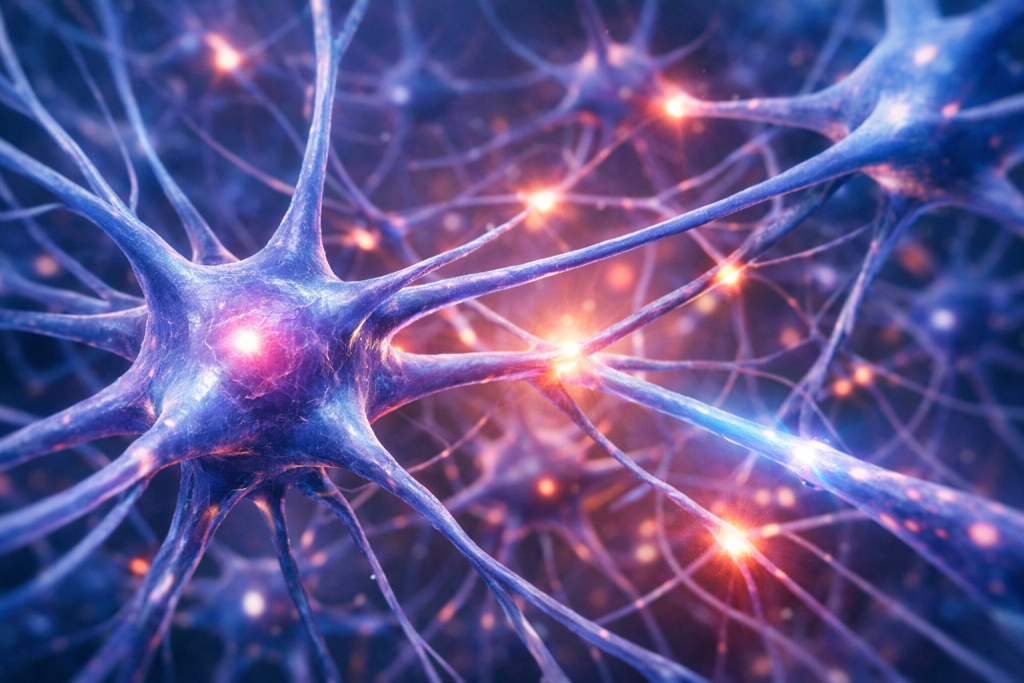
A collaborative study reports a multi-target nanoparticle therapy that dramatically improves neuron survival in Alzheimer’s models.
Alzheimer’s disease remains one of the most complex and costly challenges in global health, with existing treatments largely focused on managing symptoms rather than slowing or reversing underlying damage. A new study involving Gujarat Biotechnology University (GBU) suggests that a multi-pronged, nanoparticle-based approach could mark a meaningful shift in how the disease is tackled at a cellular level.
Researchers from the Institute of Nano Science and Technology (INST), Mohali, the National Institute of Pharmaceutical Education and Research (NIPER), Raebareli, and GBU have reported a therapeutic strategy that boosts the survival of damaged brain cells from roughly 40%–50% to nearly 90% in experimental models [1].
Unlike most Alzheimer’s therapies, which typically address a single biological pathway, the newly reported approach is designed to work on several fronts simultaneously.
“Unlike conventional treatments that address a single aspect of the disorder, the new strategy simultaneously targets toxic protein accumulation, neuronal damage, inflammation and brain repair – offering renewed hope against one of the most complex neurodegenerative diseases,” said Professor Nisha Singh, Assistant Professor of Bioinformatics at GBU.
At the center of the research are amyloid-beta (Aβ) plaques, harmful protein clumps that accumulate in the brains of people with Alzheimer’s and disrupt normal brain function. These plaques are widely considered a key driver of memory loss and cognitive decline.
“Alzheimer’s disease happens when harmful protein clumps (called Aβ plaques) build up in the brain and damage brain cells, leading to memory loss and thinking problems,” Singh explained.
Researchers reported that a new treatment approach using multi-target nanoparticles shows promise by simultaneously clearing toxins, protecting neurons, reducing brain inflammation and promoting recovery.
The team developed nanoparticles made from three biologically active components: EGCG, a natural antioxidant found in green tea; dopamine, a chemical critical for normal brain function; and tryptophan, an essential amino acid. Together, these form complexes known as EDTNPs.
“These complexes are called EDTNPs. They help by-stopping harmful protein clumps from forming, helping the brain clear already-formed plaques, reducing stress and damage inside brain cells, protecting brain cells and helping them survive,” Singh said.
To further enhance their effectiveness, the researchers added brain-derived neurotrophic factor (BDNF), a protein known to support neuron growth and survival. The upgraded formulation, called B-EDTNPs, produced significantly stronger results.
“To make the treatment even stronger, we added BDNF, a protein that helps brain cells grow and stay healthy,” she said. “These improved nanoparticles are called B-EDTNPs.”
Laboratory tests using brain-like cells showed that cells severely damaged by Alzheimer’s-related proteins recovered at far higher rates with B-EDTNPs than with EDTNPs alone.
In animal studies, the nanoparticles reduced plaque buildup, lowered brain inflammation, and led to marked improvements in memory, learning and behavior.
A notable feature of the study is its reliance on advanced computational biology alongside laboratory and animal testing. Singh, who holds a PhD in Plant Genomics and completed postdoctoral research at Cornell University, led the computational modelling and molecular simulation work.
Her analysis helped validate how the nanoparticles physically interact with amyloid-beta plaques, showing that they can directly attach to and destabilize these toxic protein structures.
“Computer studies also confirmed that these nanoparticles directly attach to the harmful proteins and help break them apart,” she added.
The work was led by Dr Jiban Jyoti Panda and his team at INST, with key contributions from Dr Ashok Kumar Datusalia of NIPER and Prof Singh at GBU, highlighting the interdisciplinary nature of next-generation neurodegenerative research.
Gujarat Biotechnology University, located near GIFT City in Gandhinagar, was established by the Government of Gujarat’s Department of Science and Technology and is focused exclusively on biotechnology.
With an emphasis on research-led education, innovation, and entrepreneurship, GBU aims to translate laboratory discoveries into real-world solutions for health and longevity.
As Alzheimer’s research increasingly attracts long-term investment interest, multi-target therapies such as this nanoparticle approach may represent a new frontier – one that aligns scientific ambition with the growing demand for durable, disease-modifying treatments.
