

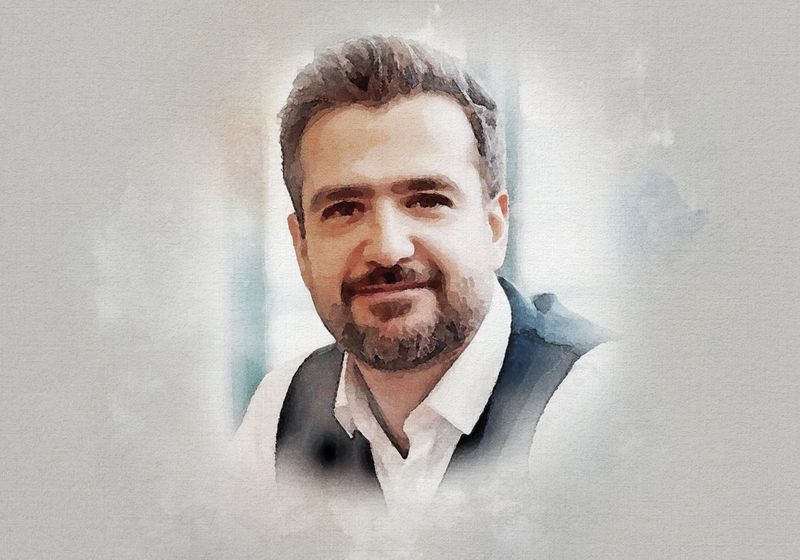
At an urban energy lab, this postdoc optimizes sustainable design through modeling and computation.
Q | Write a brief introduction to yourself including the lab you work in and your research background.
My name is Hasan Bazzazzadeh, and I work as a postdoctoral researcher at the Urban Energy Systems Lab (UESL) at the Swiss Federal Laboratories for Materials Science and Technology in Switzerland. Here at UESL, we aim to develop innovative solutions for energy-efficient, low-carbon buildings and cities. My focus is on applying artificial intelligence (AI) to simulation and optimization in sustainable design.
Q | How did you first get interested in science and/or your field of research?
I first became interested in my field while working on historic and heritage buildings, where I realized how inherently sustainable many of these structures were. This inspired me to seek ways to use modern technology to improve buildings and cities, making them more livable and environmentally responsible. My curiosity led me to explore advanced simulation methods, both physics based and data driven, to understand the behavior of buildings within the complex context of cities, including their interactions with the environment and each other. Over time, I progressed from purely simulation-based studies to integrating measurements and real-world applications, ensuring that research outcomes could be implemented in practice. This combination of sustainability principles and cutting-edge technological approaches continues to guide my work as I strive to create solutions for more resilient cities that can combat climate change and mitigate its impact on people.
Q | Tell us about your favorite research project you’re working on.
One of my favorite research projects is the Innosuisse project called “DecarbAI,” where we collaborate with the science-based startup Urban Symphony AG. In this project, we work on developing an AI-based workflow to predict the energy consumption of different buildings and identify the optimal energy system configuration within an urban district. The goal is to enhance Urban Symphony’s existing science-driven process by making it significantly more accurate and much faster, enabling energy planners and decision-makers to evaluate multiple scenarios in a fraction of the usual time. By integrating advanced AI models with robust simulation data, we aim to simplify complex district energy planning into a process that is not only faster but also easier to understand for a wide range of stakeholders. This work combines my passion for AI applications, simulation, and urban sustainability, and it is deeply rewarding to see how these tools can help accelerate the transition toward low-carbon, energy-efficient cities.
Q | What has been the most exciting part of your scientific career/journey so far?
The most exciting part of my scientific journey has been working in an environment where every day presents a new challenge and an opportunity to learn. I cannot think of another field as dynamic, where problem-solving skills are constantly tested and refined, and where growth happens almost daily. Over time, dealing with completely unknown areas has stopped being a source of fear for me. Instead, it has become a skill I have developed that allows me to control my initial emotions, approach the challenge with curiosity, and learn until I can proficiently contribute to it. Research also gives me the freedom to pursue topics I find truly striking and worth exploring, providing both creative and intellectual independence. This combination of constant learning, practical problem-solving, and the ability to adapt to new territories keeps my work deeply engaging. It is incredibly rewarding to see ideas evolve from initial concepts into tested, real-world solutions that can positively impact our built environment and people’s lives.
Are you a researcher who would like to be featured in the “Postdoc Portraits” series? Send in your application here.
